Guides
Instagram Click-to-Message Ads vs Organic Comment-to-DM

Click-to-message ads pay to bring people into a conversation. Organic comment-to-DM responds to a qualifying request under a post. Choose between them by the audience you need to reach, the supported entry event and the work required after the first message.
Published by ReplyMagnet · Last updated
A business can use the same offer in both routes and still need different campaign configurations. A paid ad button, a public keyword comment and a message someone types are separate events. This guide helps you plan the choice before buying traffic or assuming an existing automation will handle it.
What is the difference between the two entry events?
A click-to-message ad routes an interested viewer toward a messaging conversation. Comment-to-DM starts from a qualifying comment on a covered post. An ad impression, click, comment and sent message should be recorded as different events.
Meta offers ads that click to Instagram Direct, alongside other messaging destinations. Its official training overview describes that advertising route. A paid distribution decision comes before the conversation: you select an audience, creative and budget in the advertising system.
An organic comment campaign starts with a post people can encounter without that specific paid placement. The caption might invite a relevant request: “Comment MEASURE for the cabinet measurement sheet.” An eligible comment can then start the configured private response. The comment-to-DM guide covers that mechanism.
The distinction matters when the same creative is reused. A viewer tapping a messaging button has not necessarily left the keyword comment your existing campaign expects. Likewise, someone commenting below an ad has not necessarily followed its messaging button. Describe the actual entry event before asking whether an automation supports it. For visitors already on your site, compare DM automation with website live chat; for organic captions, see choosing a DM, comment or link call to action.
Do not infer a person's purchase intent from the entry alone. Both routes can attract curious visitors, ready buyers and people who need a different service. The conversation still has to establish what useful next step is appropriate.
Choose a route by the audience and offer
Use an organic request route when an existing post can reach the relevant people. Consider paid messaging when you have a clear audience hypothesis, a useful conversation offer and a budget you can evaluate against actual outcomes.
Imagine a fictional kitchen-design studio offering a measurement checklist. Its followers already ask which dimensions to bring to a consultation. An organic Reel demonstrating one measurement can invite those viewers to request the sheet. The immediate job is delivering something useful to people who recognize the problem.
A paid campaign could introduce the same studio to people outside its current audience. That changes the creative burden. A viewer who has never heard of the business needs enough information to understand who the sheet is for and what will happen after starting a chat. A vague “Message us” button leaves that explanation unfinished.
Write an audience hypothesis rather than a reach promise. For example: “People considering a kitchen redesign in our service area may find a preparation sheet useful.” The trial should test the relevance of those conversations, not simply count how many messages were generated.
There is no universal winner between free distribution and paid distribution. Organic content still costs production and response time. Paid traffic can increase the number of unsuitable enquiries if the offer is unclear. Resolve that fit problem before increasing either posting volume or advertising spend.
Match the first response to the promise
The opening response should recognize the offer the person saw, explain the immediate next step and avoid inventing context the tool has not actually received.
For the studio's organic post, a suitable first private response might say: “Here is the measurement checklist from the kitchen Reel. Open the sheet before you measure, then bring the dimensions to your consultation.” The resource and the reason for sending it are explicit.
For a paid conversation, the first exchange might need to establish which service the person is interested in before giving a resource. That does not mean every ad should begin with a long questionnaire. Ask only what changes the next response. A visitor seeking a replacement cabinet handle should not have to describe an entire renovation budget to reach a useful answer.
Treat the campaign name and ad context as information that must be supported by the actual setup. Do not write “I saw that you clicked our renovation ad” unless the chosen tool provides reliable context and the wording is appropriate. A generic incoming DM is not automatically evidence of which ad produced it.
Use the lead-qualification guide for deeper question design. This comparison owns the entry route; the qualification work begins once a relevant conversation has actually started.
Check tool compatibility before paying for traffic
Verify the precise ad entry, account, destination and response behavior in the tool you intend to use. Support for organic comments does not establish support for ad-specific referrals or message templates.
ReplyMagnet can be used for its supported Instagram resource-request campaigns. This article does not establish an ad-referral integration, an Ads Manager connector or automatic matching of every paid entry. Keep the paid route in a separately verified setup until those requirements have been demonstrated.
Before launch, write down what the tool must observe and what should happen next. For example, is the first event a user-sent message, a selected prompt, or a comment? Which profile receives it? Does the first response differ from a visitor's ordinary incoming DM? Who will notice if the expected response does not occur?
Use a controlled test participant and clearly labeled test content. Check the actual recipient experience rather than stopping at a successful preview in an editor. A preview can validate wording without proving that the advertising entry reaches the intended automation.
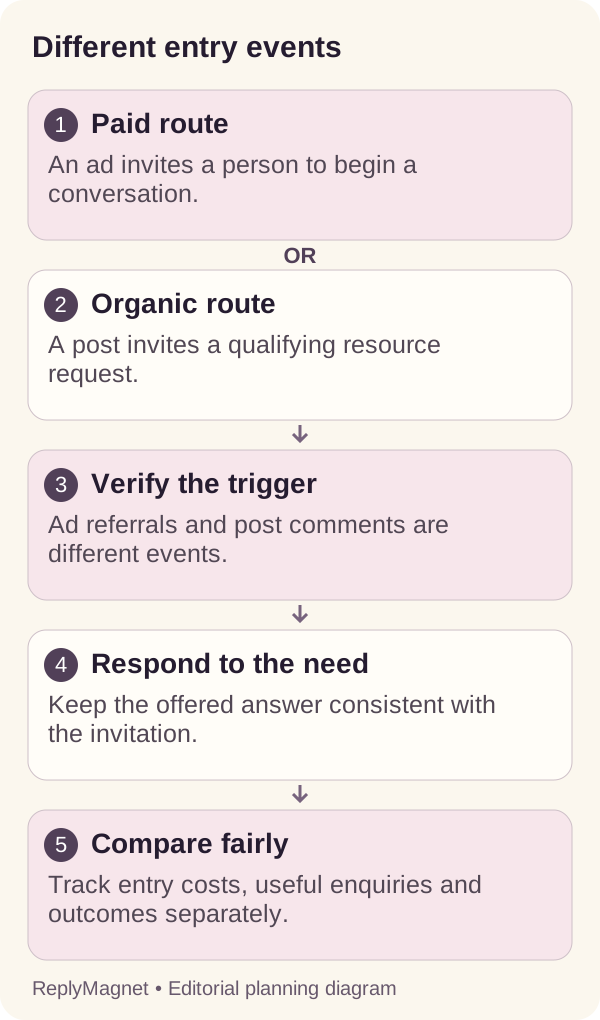
Planning diagram: paid and organic entry events need their own compatibility checks before their outcomes can be compared.
Prelaunch compatibility record
Question
What starts the response?
- Evidence to record
- Exact supported entry event
Question
Which account receives it?
- Evidence to record
- Verified business profile
Question
What does the visitor see first?
- Evidence to record
- Observed test response
Question
Who handles an exception?
- Evidence to record
- Named person and support route
Question
What counts as success?
- Evidence to record
- Relevant enquiry or other defined outcome
Build a small budget decision sheet
Choose a spending boundary, review date and outcome definition before starting an ad experiment. Keep production time, advertising spend and conversation handling visible as different costs.
A useful budget sheet is a decision document, not a revenue forecast. The studio might decide that it can afford a limited experiment and will review the conversations after a specified period. The exact amount depends on its own finances and risk tolerance; no example amount in this article is a recommendation.
Record three categories. First, cash spent on distribution. Second, production and maintenance work, including preparing the checklist and correcting a confusing response. Third, the time required to handle actual enquiries. Keep cash and estimated labor value separate so a change in your hourly assumption does not disguise an advertising bill.
Define the outcome before looking at the numbers. A relevant consultation enquiry could require a service-area match and an expressed renovation need. A message saying “hello” is still a conversation, but it is not automatically that outcome. Record unknown qualification rather than treating every unanswered conversation as irrelevant.
The qualified-enquiry cost guide explains denominator choices. Use it for the calculation after deciding which cohort and outcome you are counting. If no qualifying outcome appears, report the spend and zero observed outcomes rather than presenting a misleading average.
Keep paid and organic records separate
Compare like-for-like outcomes within clearly labeled cohorts. Do not turn an ad click, accepted DM, resource visit and completed purchase into one assumed continuous journey.
Use stable campaign names and note the active dates. Where supported, the advertising platform can report its own events. ReplyMagnet activity can provide evidence about its messaging route. Your destination site or booking system provides another set of records. These systems do not automatically identify the same person or apply the same attribution model.
For the studio, a weekly review can record paid conversations, organic requests, resource visits and consultation enquiries as separate totals. Some enquiries may have an unknown source. Preserve that category. Forcing every enquiry into the latest campaign can make a tidy report inaccurate.
If you use tagged destination links, follow the DM UTM guide. Tags can help distinguish a link's placement, but they do not prove that the advertising interaction caused a later purchase. Links can be copied, sessions can restart and people can return through another route.
Also compare quality qualitatively. Read a small, privacy-conscious sample of enquiries to identify repeated confusion: wrong geography, unclear price expectations or misunderstanding of the resource. Those observations may suggest a better next test than simply increasing reach.
Change the part that the evidence points to
Use the last observed stage to choose a revision: creative, entry configuration, opening response, resource or human follow-up. More traffic will not repair a broken destination.
Suppose the paid entry produces conversations but many visitors ask whether the studio sells individual handles. The creative may be attracting the wrong expectation. Rewrite the offer around full kitchen design rather than adding more questions to the DM.
If the correct people enter but the response never arrives, investigate the supported entry and configuration before changing the copy. If the sheet arrives but visitors cannot use it, inspect the resource itself. A technically successful send can still lead to an unhelpful document.
For organic comments, a failed keyword test belongs in the troubleshooting workflow. For paid entries, use the actual advertising and messaging tool's diagnostics. Do not treat all failures as the same Instagram-wide problem.
Make one meaningful change at a time when practical and record the reason. A different audience, new ad, new resource and new response launched together may improve the outcome, but they make it harder to understand which change mattered. A useful experiment leaves a decision you can explain.
Common questions
Can I use the same resource in an ad and an organic comment campaign?
Yes, if the resource suits both audiences. Configure and test each entry route separately, and label destination links so the evidence stays interpretable.
Does this mean ReplyMagnet supports click-to-message ad triggers?
No. This guide compares acquisition routes. Use ReplyMagnet for its verified supported requests; validate any ad-specific integration separately before spending.
Are organic DMs free?
Organic distribution has no ad charge for that post, but content creation, software and handling conversations can still cost money or time.
Keep reading
- Instagram call to action: DM, comment or link?
- How to measure Instagram DM campaigns (2026)
- Instagram Comment-to-DM Automation: Setup & Test Guide
- Create a ReplyMagnet campaign: posts, triggers and delivery
- ReplyMagnet assets: upload a PDF or add a link