Guide
How to measure Instagram DM campaigns
To measure an Instagram DM campaign, count each stage separately: matched requests, delivered messages, captured contacts and the business outcome you care about. Then attach an honest cost to that outcome, check whether automation saves real time, and close every run with a short retrospective. The numbers describe your records. They rarely prove what caused a sale.
Published by ReplyMagnet · Last updated
What should you measure in an Instagram DM campaign?
Measure each stage of the journey on its own: matched comments, delivered messages, captured contacts and outcomes such as bookings or sales. Name the denominator beside every number so a delivery count never passes for a qualified lead.
A comment-to-DM campaign is a chain of separate events. If the mechanic is new to you, the comment-to-DM setup guide walks through each step. ReplyMagnet's campaign analytics reports the stages it can see. Your booking or checkout system holds the rest. Start free and run one test campaign before you read any totals.
Before launch, write down 3 things: the outcome that matters, the period you will observe, and how you will treat repeats and your own test activity. Changing any of them after the results arrive makes this month impossible to compare with the last.
Stages of an Instagram DM campaign and where each one is recorded
Stage
Matched request
- What it counts
- A comment that met the trigger
- Where to read it
- Campaign analytics
Stage
Delivered engagement
- What it counts
- The reply and DM completed
- Where to read it
- Campaign analytics
Stage
Queued request
- What it counts
- Waiting for capacity, not yet delivered
- Where to read it
- Campaign analytics
Stage
Captured contact
- What it counts
- Email or phone submitted on the capture page
- Where to read it
- Leads
Stage
Verified follow
- What it counts
- Follow confirmed by the enabled follow check
- Where to read it
- Campaign analytics
Stage
Business outcome
- What it counts
- Booking, sale or confirmed subscription
- Where to read it
- Your own system
How do you connect DM clicks to sales and signups?
Tag the link inside the DM with UTM parameters, then read sessions and conversions in your web analytics tool. Keep app counts and site counts in separate columns, because a link open is not a session and a session is not a sale.
The Instagram DM UTM tracking guide shows how to build tagged links, test redirects and find the traffic in GA4. If you are asking whether people want an offer that does not exist yet, the waitlist validation guide separates interest from commitment. If the follow-up runs by email, DM automation vs email marketing explains which channel should carry which job.
Expect gaps. A person can receive a resource on Instagram and buy weeks later through another route. Mark those records as unknown or mixed source instead of crediting them to the campaign. For the wider question of which leads are worth chasing, see how to get more leads from Instagram.
Calculate the cost of a qualified Instagram enquiry
Write a qualification rule before launch, total the campaign's cash and valued time in one ledger, then divide by qualified enquiries only. Report contact cost and enquiry cost separately, since neither ratio is return on investment.
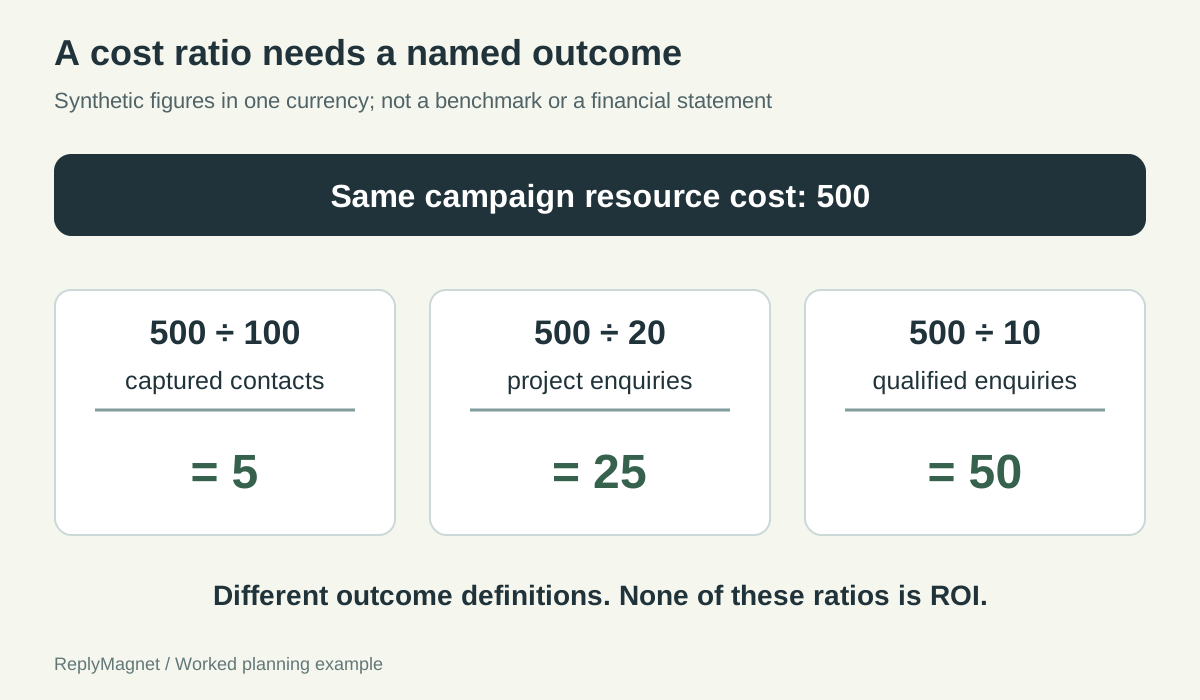
A qualified enquiry needs an observable rule. In a fictional design studio example, it means a distinct project request within the studio's service scope, with enough detail to decide whether to talk further. A question about using the free checklist is support. 2 messages about the same project are 1 opportunity.
Give the ledger a clear boundary. The example totals 500 in one currency. Content work is 8 hours at an internal value of 30 per hour (240), and setup and review is 4 hours (120). Add a stated software allocation of 60 and an 80 design asset. Keep cash and valued time in separate columns before you combine them.
If qualified enquiries are zero, report the ratio as undefined, never as zero. Separate "none confirmed yet" from "all reviewed, none qualified". With only 10 qualified enquiries, one record moves the ratio from 50 to about 45 or 56, so never rank campaigns on a gap that small.
Same synthetic cost of 500, three denominators. None of these ratios is ROI.
Outcome definition
Distinct captured contacts
- Count
- 100
- Cost per outcome
- 5
Outcome definition
Project enquiries
- Count
- 20
- Cost per outcome
- 25
Outcome definition
Qualified enquiries
- Count
- 10
- Cost per outcome
- 50
Is Instagram DM automation worth the cost?
Time one routine task by hand, then estimate the staff minutes that remain once it is automated. Subtract maintenance and setup, value the released time honestly and compare the result with the software fee at low, central and high volumes.
Time the complete task, from reading the request to sending the right resource. Automation rarely takes staff time to zero. Someone still reviews exceptions, maintains the file and answers follow-up questions. Keep bespoke advice and complaints outside the model as manual work.
Use 5 variables for one month of the same request type:
- N: routine requests
- m: manual minutes per request
- a: remaining minutes per request with automation
- M: maintenance minutes for the month
- A: setup minutes allocated to the month
Net time released is N × (m - a) - M - A. In an invented example, m is 3, a is 1, M and A are 60 each, an hour is valued at 30 and software costs 20 a month.
Under those assumptions, break-even sits at 80 requests: (60 + 60 + 60 × 20 ÷ 30) ÷ 2. Released minutes are capacity, not cash saved, unless the time is actually reassigned. Stress the remaining-handling estimate first: at 2 minutes instead of 1, the saving per request halves. Use your real fees and limits from the plan documentation.
Hypothetical monthly scenarios with identical time assumptions. Not customer results or current prices.
Routine requests
25
- Net minutes
- -70
- Time value
- -35
- After the 20 fee
- -55
Routine requests
100
- Net minutes
- 80
- Time value
- 40
- After the 20 fee
- 20
Routine requests
300
- Net minutes
- 480
- Time value
- 240
- After the 20 fee
- 220
Why do people leave your Instagram lead capture form?
Common reasons are a contact request the offer never mentioned, fields with no clear purpose, or an input that fails on a phone. Fix any reproducible failure first, then change one requirement at a time.
Abandonment means someone reached the form and did not complete it within your observation period. A sent DM without a captured email is not abandonment, because the person may never have opened the message. Read the post, DM and capture page in sequence. The same resource name and contact requirement should appear in all 3.
Keep a field only when you can name the action that needs it. A printable planner can use direct delivery. An explained email follow-up justifies email capture. A requested callback justifies a phone number. ReplyMagnet offers direct delivery or optional email and phone capture gates.
Test on a phone, from the DM link, with details you control:
- Open the link and note whether it opens inside Instagram.
- Say aloud what the page asks for before you type.
- Enter one deliberate formatting mistake and read the error.
- Correct it, submit once and open the resource.
- Check that the test contact appears in Leads.
Calculate completion only when you have form visits and completions for the same cohort. In an illustrative cohort of 40 visitors, 24 completions give 60%. Never divide captured emails by sent DMs and call the result form conversion.
End an Instagram campaign with decisions worth keeping
Recover the original objective, build a dated timeline of changes, then sort what you saw into facts, explanations and open questions. Finish with 2 or 3 actions, each with an owner, completion evidence and a check-in date.
Start from the brief, not the biggest number on the dashboard. A high request count cannot answer a campaign that was meant to produce relevant enquiries. If the objective changed mid-run, record when and why.
Place operational events beside outcomes: a corrected resource sentence, a changed booking page, 2 days when nobody reviewed enquiries. "Wording changed on day 10" is a fact. "The change increased trust" is an explanation that still needs evidence.
Then decide what to repeat, what to stop and what needs a separate test. Keep the record to one page and open it at the next planning session. Otherwise the same problem gets rediscovered under a new creative theme.
Fictional retrospective record. Events are invented for the example.
Fact
Materials questions recurred
- Possible explanation
- An instruction may be ambiguous
- Action and owner
- Content coordinator revises the wording and checks it with a new reader
Fact
Late enquiries unclassified at cutoff
- Possible explanation
- Owner absence delayed review
- Action and owner
- Campaign owner finishes review and keeps the original cutoff date
Fact
Bookings not linked to requests
- Possible explanation
- Records omit part of the route
- Action and owner
- Campaign owner logs material changes during the next run
Where Instagram DM campaign measurement goes wrong
Measurement goes wrong when a denominator quietly changes, when pending work is counted as complete, or when one campaign is credited with outcomes that arrived through several routes.
Check your report against these mistakes before you share it:
- Calling every captured address a qualified lead.
- Reporting queued requests as delivered.
- Comparing a cash-only cost with a fully allocated one.
- Spreading a one-week campaign's setup over a full year.
- Ranking 2 campaigns on a difference of 1 or 2 records.
- Rewriting last month's report after late classifications, instead of labelling it provisional.
A useful report is short: cost scope, period, qualification rule, counts, ratios and the next question to investigate.
Common questions
Is cost per lead the same as customer acquisition cost?
No. Cost per lead divides by captured contacts, while customer acquisition cost divides by acquired customers. Neither includes revenue or margin, so neither one is return on investment.
Does ReplyMagnet show a form abandonment rate?
Do not assume one. ReplyMagnet analytics separates matched requests, deliveries and captured contacts, but a completion rate needs reliable form-visit counts for the same cohort.
How long should I wait before reporting qualified enquiries?
Choose a review period before launch and label results provisional until it passes. Keep the original cohort rather than adding later, unrelated enquiries to the denominator.
When is DM automation not worth the cost?
Automation is not worth it when maintenance and allocated setup exceed the minutes saved. In the worked example, 25 routine requests a month leave a 70-minute deficit, so keeping the task manual is sensible.
Does a verified follow prove the campaign gained a follower?
No. A verified follow confirms follow status inside the campaign flow, and an existing follower also passes the check, so the count does not measure account-wide follower changes.
Keep reading
- Guides
- Instagram Comment-to-DM Automation: Setup & Test Guide
- Get more qualified Instagram leads: a practical worksheet