Compare
A Chatfuel alternative whose limits you can see
Chatfuel is a multi-channel AI-bot platform built to hold a whole conversation. If you use it mainly to send one resource from an Instagram comment, the decision is narrower: its AI replies draw on a fair-use allowance it does not publish, and the $49 on its pricing page is the annual rate shown per month.
Published by ReplyMagnet · Last updated
The short answer
Chatfuel's paid plan is $69 a month when billed monthly, its AI replies pause once an undisclosed allowance is crossed, and whether comment auto-reply is on its free plan is not documented. ReplyMagnet runs comment-to-DM free, publishes every quota, and queues overflow on every plan instead of going quiet.
Start freeAt a glance
Chatfuel bills a flat $69 a month for AI and pauses the bot on an undisclosed fair-use allowance. ReplyMagnet bills a published engagement quota from $0, queues anything over it, and includes an API-verified follow check that Chatfuel's docs do not mention.
Three tools, the rows that decide most comparisons. Real monthly prices throughout, never an annual rate relabeled as monthly.
Chatfuel, ManyChat and ReplyMagnet at a glance
Comment auto-reply from
- Chatfuel
- Not established in published docs; paid plan is $69
- ManyChat
- $0, capped at 4 automations
- ReplyMagnet
- $0, one live campaign
Real monthly price with AI
- Chatfuel
- $69 (page shows $49)
- ManyChat
- $39 (page shows $29)
- ReplyMagnet
- AI matching at $0; AI-written replies from $29
Over the monthly limit
- Chatfuel
- AI replies pause until the allowance resets
- ManyChat
- No queue; $0.10 per extra contact, $0.05 from $39
- ReplyMagnet
- Queues on every plan, including free
AI limit
- Chatfuel
- Undisclosed fair-use allowance
- ManyChat
- Full suite from $39
- ReplyMagnet
- Published: 100 to 2,000 checks a day
Follow check
- Chatfuel
- Not found in published docs
- ManyChat
- Asks to follow from $17; not documented as verifying
- ReplyMagnet
- API-verified, and optional
Email capture from
- Chatfuel
- Not found in published docs
- ManyChat
- $17 a month
- ReplyMagnet
- $0
Mailchimp or Kit sync
- Chatfuel
- Not found in published docs
- ManyChat
- From $39 a month
- ReplyMagnet
- From $9 a month
Instagram accounts
- Chatfuel
- Not found in published docs
- ManyChat
- One per ManyChat account
- ReplyMagnet
- 3 from $29, 10 from $79
Try the resource flow for 30 days with 1,000 engagements. No card required.
Start freeFirst decide where the exchange should end
ReplyMagnet delivers a configured resource after a matching comment and can collect contact details before access. Chatfuel's published offering covers a broader conversational workflow.
A buyer who comments CATALOGUE may want to browse quietly. Sending the catalogue can be the whole task. Another buyer may ask about availability, shipping and payment before choosing a product. That second exchange calls for more context.
Write down which questions the automation must answer. If all roads lead to the same PDF, start with a delivery campaign. If the answer changes with stock, order history or customer circumstances, evaluate a conversation tool against those requirements.
What Chatfuel does well
Chatfuel is a WhatsApp Business Solution Provider as well as a Meta Partner, runs Instagram, Facebook, WhatsApp and TikTok, never meters static keyword replies or broadcasts, and lets you bring your own OpenAI key so the AI runs on your account instead of its allowance.
Chatfuel's reach is the headline. WhatsApp as a first-class channel is rare in this category, and Chatfuel holds the Business Solution Provider status that makes it real rather than a bolt-on. Instagram, Facebook and TikTok sit alongside it, and the product is built as a conversational AI bot that holds a whole exchange.
Its limit model is generous where it is generous. Active contacts and messages are unlimited, and static actions, meaning keyword replies, button flows and broadcasts, are never metered. On the AI side there is an escape hatch: bring your own OpenAI key and the fair-use allowance no longer applies.
Lead routing is documented too. Google Sheets, Zapier, Stripe and the Chatfuel API all appear in the pricing-page FAQ.
Pricing, compared properly
Chatfuel's pricing page opens on the annual toggle, so the $49 it shows for the paid plan is $69 when billed monthly. ReplyMagnet's real monthly prices are $0, $9, $29 and $79, billed per engagement with nothing to toggle.
Chatfuel has one paid plan and one free one. The paid plan reads $49 a month on page load, but that is the annual-commitment rate labelled per month; the month-to-month price is $69. Its own help docs still describe an older conversation-tiered model that the live pricing page no longer uses.
On ReplyMagnet the meter is the engagement, a reply or DM that was sent, and nothing else. A person who comments five times is five engagements. The prices below are the monthly prices, and the AI check counts are the actual daily caps.
Real monthly prices and what they include
Free
- Chatfuel
- Free plan exists; comment auto-reply inclusion not documented
- ReplyMagnet
- 1,000 engagements, 1 live campaign, AI matching, email capture, plus a 30-day trial
From $9
- Chatfuel
- No plan at this price
- ReplyMagnet
- 25,000 engagements, CSV, phone capture, Mailchimp or Kit sync
From $29
- Chatfuel
- No plan at this price
- ReplyMagnet
- 100,000 engagements, 3 accounts, webhooks, AI-written replies
From $69
- Chatfuel
- Unlimited contacts and messages, AI on an undisclosed allowance
- ReplyMagnet
- No plan at this price
From $79
- Chatfuel
- No plan at this price
- ReplyMagnet
- 400,000 engagements, 10 accounts
Past the cap
- Chatfuel
- AI replies pause until the allowance resets
- ReplyMagnet
- Queued, released when headroom opens
What happens when the AI pauses
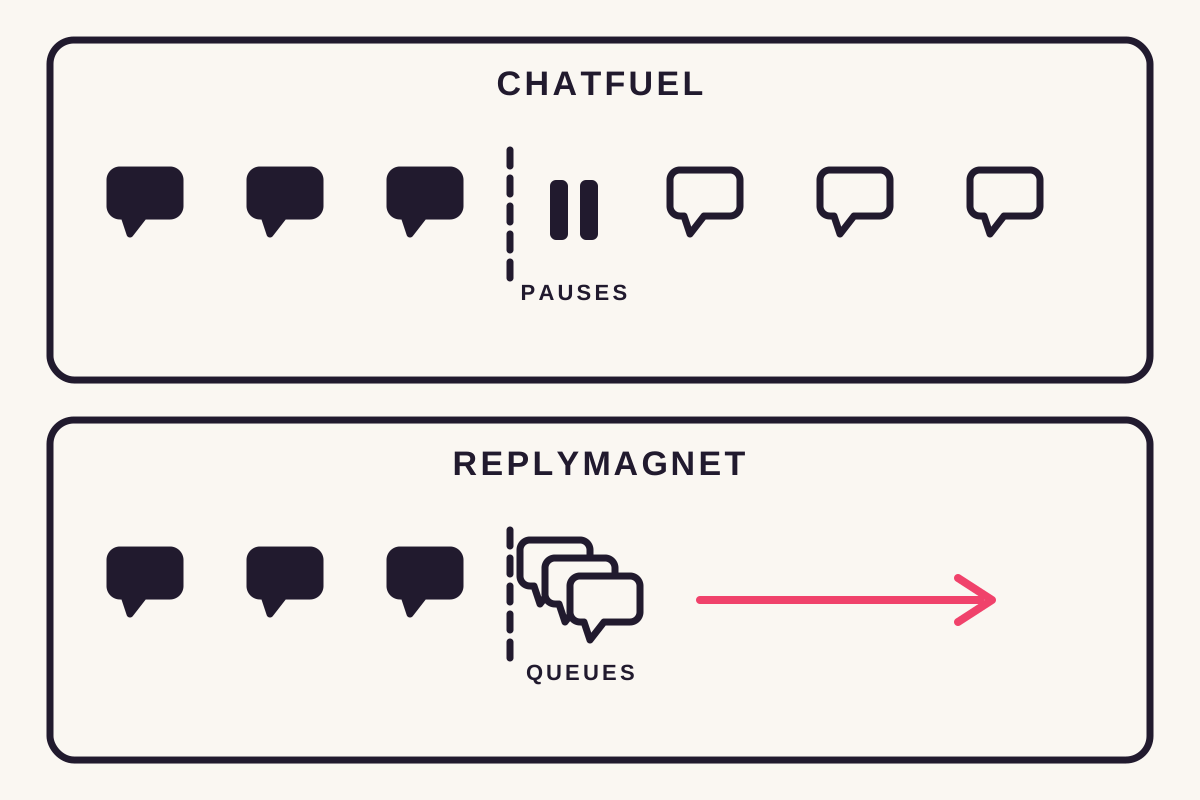
Chatfuel documents an AI fair-use allowance and a pause once that allowance is crossed, without publishing the size of the allowance. ReplyMagnet publishes its daily AI check count per plan and queues a comment past the monthly engagement allowance instead of pausing.
For a customer-support use case, a pause is an operational question, not just a pricing detail. Find out how your team knows the agent has stopped, what customers see and how a person takes over.
Chatfuel also documents using your own OpenAI key to bypass its AI cap. That changes the billing arrangement and should be assessed with the rest of the setup.
ReplyMagnet handles the same moment differently. Its AI matching allowance is published, 100 to 2,000 checks a day depending on plan, and a comment beyond the month's engagement allowance queues, then releases oldest-first once headroom opens.
The honest edge case: if a queued request outlasts Instagram's messaging window it expires instead of arriving late; flat pricing does not mean instant delivery.
Feature by feature
The two overlap on answering a comment with a DM and separate on whether the AI ceiling is published, what happens past it, whether a follow check exists, and where lead capture starts. Every price is the point at which the feature actually works.
Figures pulled from each tool's own published pages on 29 August 2026 for Chatfuel and 14 September 2026 for ReplyMagnet, not a sales call. Where Chatfuel's material does not state something, the table says so rather than reading silence as absence.
Chatfuel against ReplyMagnet, feature by feature
Comment auto-reply from
- Chatfuel
- Not established in published docs; paid plan is $69
- ReplyMagnet
- $0, one live campaign
Free plan
- Chatfuel
- Exists; comment auto-reply inclusion not documented
- ReplyMagnet
- 1,000 engagements, comment auto-reply and email capture included
Platforms
- Chatfuel
- Instagram, Facebook, WhatsApp, TikTok
- ReplyMagnet
- Instagram or Facebook
Billed per
- Chatfuel
- Flat fee; unlimited contacts and messages
- ReplyMagnet
- Engagement actually sent
Instagram accounts
- Chatfuel
- Not found in published docs
- ReplyMagnet
- 1 free, 3 from $29, 10 from $79
AI limit
- Chatfuel
- Undisclosed fair-use allowance; bring your own OpenAI key to bypass
- ReplyMagnet
- Published: 100 to 2,000 checks a day
Past the limit
- Chatfuel
- AI replies pause until it resets
- ReplyMagnet
- Queues on every plan, including free
Follow check
- Chatfuel
- Not found in published docs
- ReplyMagnet
- API-verified through is_user_follow_business, optional
Email and phone capture
- Chatfuel
- Not found in published docs
- ReplyMagnet
- Email free; phone from $9
Mailchimp or Kit sync
- Chatfuel
- Not found in published docs
- ReplyMagnet
- From $9 a month
Zapier, Make, webhooks
- Chatfuel
- Google Sheets, Zapier, Stripe, Chatfuel API
- ReplyMagnet
- Outbound webhooks from $29
Partner status
- Chatfuel
- Meta Partner, WhatsApp Business Solution Provider
- ReplyMagnet
- Meta App Review approved, August 2026
Where Chatfuel still fits you better
If WhatsApp is the channel, or you want a bot that holds a whole conversation across Facebook, WhatsApp and Instagram, Chatfuel is the better fit. ReplyMagnet has no WhatsApp channel and is a delivery pipeline, not a chatbot builder.
Chatfuel is a WhatsApp Business Solution Provider and ReplyMagnet has no WhatsApp channel at all. A business whose automation lives on WhatsApp, or that wants one AI bot carrying multi-turn conversations across Facebook, WhatsApp and Instagram, should take Chatfuel for that; no feature table changes it. The same goes if its documented Stripe connection is central to how you sell.
Choosing it means accepting the shape that comes with it: the $69 real monthly rate and an AI allowance you cannot see until the bot pauses. For the ManyChat side of that decision, read ManyChat vs Chatfuel.
Switching
Your Instagram account and its comments live on Instagram's own API, not inside Chatfuel, so a new ReplyMagnet campaign with the same keyword on the same post starts answering new comments the moment it launches. Nothing needs exporting.
Five steps, in this order:
- Keep the original Chatfuel automation saved. Connect the Instagram account to ReplyMagnet and start the free plan; no card is needed.
- Create a campaign with the same trigger keyword on the same post, attach the catalogue or file, and turn on email capture only if you will follow up on the address.
- Test from another Instagram account. Check the public reply, the DM and the delivery page on a phone, including every product or checkout link inside the file.
- Turn off the Chatfuel automation for that keyword or post. With both active, the faster tool claims the comment and the slower one posts a duplicate under it.
- Launch, then compare completed deliveries and usable lead records before changing the wording or adding steps.
Whatever sits in Chatfuel today, contacts, flows and conversation history, stays there. Exporting from Chatfuel is outside what we can speak to, since it is not our product. After launch, every answered comment lands in Leads straight away, with CSV export available from $9 a month.
Start free with one existing offer, or use the resource delivery guide to plan the campaign first.
Sources: Chatfuel, checked 29 August 2026; ReplyMagnet plan guide. This comparison reflects published material rather than a hands-on benchmark.
Common questions
Does Chatfuel have a free plan?
Yes. Whether comment-to-DM is included on it is not documented on Chatfuel's published pages, so treat that as unconfirmed. ReplyMagnet's free plan includes comment-to-DM, AI matching and email capture on 1,000 engagements a month.
What happens when Chatfuel's AI limit runs out?
Chatfuel's AI replies pause once the undisclosed fair-use allowance is crossed and stay paused until it resets, unless you bring your own OpenAI key. ReplyMagnet publishes its daily AI check count per plan, and a comment past the monthly engagement allowance queues and releases automatically.
Is the $49 on Chatfuel's page the real price?
No. $49 is the annual-commitment rate shown while the page is labelled per month. The month-to-month price of the paid plan is $69. ReplyMagnet's real monthly prices are $0, $9, $29 and $79, with nothing to toggle.
Which handles a viral post better?
ReplyMagnet, for this case. A comment beyond the plan's monthly allowance queues and releases once headroom opens. Chatfuel's static actions are unlimited, but any AI reply can hit the undisclosed allowance and pause mid-surge, exactly when a viral post is still pulling comments.
Is Meta App Review the same as Meta Partner status?
No. App Review approves particular application permissions, which is what ReplyMagnet's Instagram integration passed in August 2026. A partner designation such as Chatfuel's Meta Partner or WhatsApp Business Solution Provider badge describes a separate programme relationship.