Guides
Instagram Affiliate Links by DM: A Practical Creator Workflow

Answer a specific request with a useful recommendation, explain the commercial relationship, and send readers to a destination your affiliate programme permits. Keep resource clicks separate from merchant sales and approved commission.
Published by ReplyMagnet · Last updated
A viewer watches your recording setup and asks which microphone you use. You could send a shop link, but the better answer may include why you chose it, what it connects to, and whether the viewer needs to buy anything at all. Automation can deliver that answer consistently once you have prepared it.
This guide uses a fictional home-recording creator with two resources: a tool shortlist containing affiliate recommendations and a setup checklist that requires no purchase. Product screenshots show an unsaved demonstration in ReplyMagnet, not a live campaign or customer results. Replace every example.com address before publishing your own workflow.
What should an affiliate DM actually deliver?
Deliver the product or resource the person requested, with enough context to understand the recommendation and its commercial relationship. A clear request is the starting point.
For the recording creator, the offer is “DM TOOLS for my recording shortlist and a no-purchase setup checklist.” The audience knows both what to request and where to send it. A direct-message campaign answers that inbox request. If you instead invite a comment on a Reel, configure the corresponding post-comment campaign; the two invitations are not interchangeable.
Make the shortlist useful before considering automation. For each item, explain its job, the situation where it helps, a compatibility requirement and when to skip it. A microphone that needs an audio interface is a poor recommendation for someone expecting to plug directly into a phone. Your own experience should be described as your experience, not a universal performance claim.
Keep a no-purchase route when it genuinely helps. Moving closer to an existing microphone or reducing room noise might be the reader’s immediate next step. This gives the person a useful answer without turning every request into a shopping instruction. For a fuller comparison matrix, use the separate product comparison guide.
Where should affiliate disclosures appear?
Make the commercial relationship understandable where the recommendation appears. Check the public invitation, private reply and destination together rather than relying on a distant profile note.
The US Federal Trade Commission’s Disclosures 101 guidance says material relationships should be disclosed clearly and where people will notice them. It also advises creators not to assume their audience already knows about the relationship. Its endorsement questions and answers discuss affiliate links specifically. These are US sources, not a universal approval of a campaign.
For the fictional example, write plain wording such as “I may earn a commission if you buy through links in this shortlist.” Put that explanation alongside the relevant recommendation, then review it on a phone. A reader should not have to infer the arrangement from an unfamiliar label.
Use the worksheet below to review your own journey. It is an editorial check, not a certification that your promotion satisfies every applicable rule. Other markets, platforms and affiliate programmes may impose additional requirements.
A four-surface review for the fictional recording-tool offer
Surface
Reel or post
- What the reader needs to understand
- What is being recommended and the commercial relationship
- Check before publishing
- Review the content itself, including video wording where relevant
Surface
Invitation
- What the reader needs to understand
- Which resource to request and how
- Check before publishing
- DM TOOLS describes an inbox request
Surface
Private reply
- What the reader needs to understand
- What the link opens and that purchases may earn commission
- Check before publishing
- Keep explanation beside the recommendation
Surface
Recommendation page
- What the reader needs to understand
- Relevant context and commercial relationship at the point of choice
- Check before publishing
- Review mobile placement, each item and its destination
Check the affiliate programme before choosing a destination
Verify that your programme permits the proposed placement and delivery method. A messaging tool can deliver a URL; it cannot authorize an affiliate network’s use of that URL.
Read the current terms for the actual merchant or network you use. Check which websites and social accounts are approved, whether private-message distribution is allowed, and whether the programme restricts link shortening, redirects, email or downloadable files. Requirements differ, so a tutorial about one network is not permission for another.
Record your decision in a small link register: merchant, approved property, intended placement, final destination, tracking identifier, date checked and the source of the rule. If the rules are unclear, resolve that question with the programme before promoting the link. Do not assume that putting a restricted link inside a PDF removes the restriction.
A maintained page on your own site can explain several recommendations and make updates easier. It still needs to be an allowed destination and placement. A direct merchant link can be appropriate for one precise request when permitted. Choose according to the reader’s task and programme requirements, not merely whichever URL is shortest.
Avoid rewriting merchant tracking parameters casually. Your website analytics tags and the network’s affiliate identifier have different jobs. Adding a UTM campaign name does not create commission attribution.
Start with one ordinary resource reply
A single accurate response is enough when everyone requests the same resource. Prepare the resource and message before adding a choice-based conversation.
For an ordinary campaign, select the request source, choose a clear keyword and attach the resource that fulfills the promise. A PDF can be a self-contained checklist; an external page can hold changing recommendations. ReplyMagnet hosts PDFs up to 25 MB on Starter, while external-link assets require Basic or higher. Check asset setup for the delivery controls.
Draft the response as a complete answer: “Here is the recording-tool shortlist you requested. I may earn a commission if you buy through its links. The page explains who each tool suits and includes a no-purchase setup checklist.” Then make the link title describe the destination, such as “Read the tool shortlist.”
Keep email capture optional unless you have a clear reason to ask for it and have explained the exchange. Someone asking where to find a microphone has not necessarily asked to join a newsletter. A resource-delivery decision and a marketing-subscription decision deserve separate attention.
Before launch, compare the invitation, message and destination side by side. A campaign promising a checklist should not drop someone directly into an unexplained checkout.
Offer two paths when the reader has two useful next steps
A branched conversation can let the reader choose the tool shortlist or the setup checklist. Use it only when the choice makes the answer easier to navigate.
The demonstrated advanced workflow uses ReplyMagnet’s Resource or booking template, relabeled for this example. Flow editing and publishing require an eligible Instagram Pro or Agency workspace, including an eligible trial, with owner access. The template name is a starting point; this example does not offer a booking.
In a new draft, rename the choices Tool shortlist and Setup checklist. Write an introduction that explains the difference: “Would you like the tools I use, or a checklist to improve your current setup?” If the message includes numbered instructions, keep those numbers consistent with the options.
On the shortlist branch, add the disclosure and choose External HTTPS link. The example destination is https://example.com/recording-tools; it is a placeholder, not a working affiliate offer. Set a descriptive link title. On the second branch, use https://example.com/recording-checklist for the no-purchase example and explain what the checklist helps someone do.
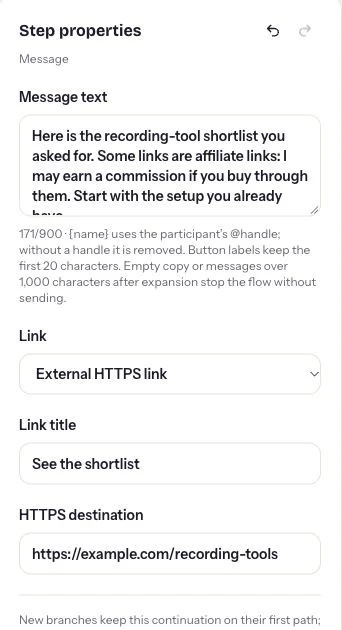
Actual controls in an unsaved demonstration. The example address must be replaced; this screenshot does not show a sent Instagram message.
Applying a template replaces the current draft, so use a new campaign or a draft you intend to replace. Keep the campaign’s ordinary reply accurate too: it is separate from the flow messages. The chat flow builder guide explains the broader publishing workflow.
Preview the choices, then test the real destinations
Preview checks the configured conversation. It does not prove Instagram delivery, merchant tracking or the usefulness of the destination. Verify those separately.
Run the draft preview and take each branch. Does Tool shortlist lead to the recommendation message? Does Setup checklist lead to the no-purchase resource? Look for leftover template labels, a mismatched link title or the wrong destination on a copied message.
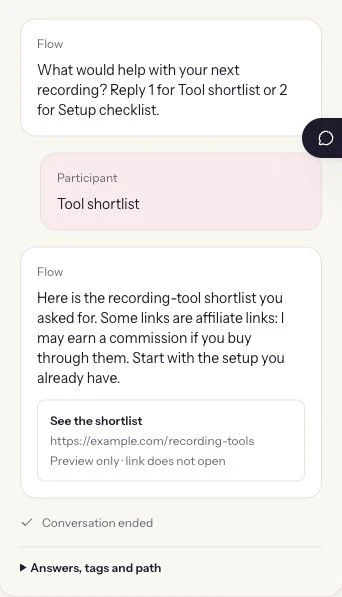
Unsaved demonstration preview. It illustrates the configured paths, not a customer conversation, sale or commission.
Replace the placeholders, then open each real page on a phone, including from Instagram’s browser when you perform your controlled campaign test. Check the product variant, region, currency, sign-in requirement and availability. Follow the merchant’s approved method for checking tracking; a test purchase is not necessary simply to inspect a destination.
Ask someone to read the recommendation without your explanation. Can they identify what the item is for, whether it fits their setup and the commercial relationship? If they cannot, revise the resource before increasing requests. The automation can consistently deliver an unclear page just as easily as a useful one.
Measure the journey without calling every click a sale
Track requests, delivered replies, resource opens, merchant-recorded purchases and approved commissions as distinct events. Use the system responsible for each event.
Create a weekly record with those five columns and a note explaining each data source. ReplyMagnet activity can help assess the request-and-delivery steps. Your page analytics can describe visits. The merchant or affiliate network records attributed purchases and commission status under its own rules. None is a substitute for the others.
For example, several resource opens with no recorded purchases could mean readers are researching, choosing the no-purchase option, buying later through another path or encountering a broken link. Investigate the journey before declaring the content ineffective. Missing attribution is not proof that no purchase happened.
Keep reporting periods aligned and label provisional amounts. Returns, cancellations and programme adjustments may change commission. Report approved earnings from the network’s evidence rather than multiplying your click count by an assumed conversion rate. For website campaign labels, see the DM UTM guide, while retaining the distinction between analytics and affiliate attribution.
Maintain the recommendation after the post gets old
Assign an owner and review date to each resource. Update or pause a promotion when the recommendation, destination or commercial relationship changes.
Check links when a product is discontinued, a model changes, an affiliate programme ends or your own recommendation changes. Review which campaigns still send the resource, not just the newest post. An old Reel can continue bringing fresh requests.
Keep the explanation honest when you replace an item. “Updated alternative” is clearer than silently presenting a new product as the exact one shown in an older video. If the replacement changes compatibility or price assumptions, revise the surrounding advice as well.
Maintain the no-purchase path with the same care. A broken checklist undermines the offer even when the shopping link works. Your simplest operational record is one row per resource: owner, current URL, last checked date, next review date and campaigns using it.
Common questions
Can I use this workflow for any affiliate programme?
Only after checking that programme’s current rules for your account, property, links and delivery method. The examples explain a resource workflow; they do not establish permission for a particular merchant.
Do I need a two-branch flow?
No. Start with one ordinary reply when it fulfills the request. The advanced example helps when the reader benefits from choosing between a recommendation and a no-purchase resource.
Should I send the resource to everyone who likes the post?
This workflow starts with a supported request, such as the configured inbound DM keyword. A like or a follow is not that request.
Does a preview prove affiliate tracking works?
No. Preview checks conversation paths. Review the real destinations and the affiliate programme’s tracking evidence separately before relying on the campaign.
Keep reading
- Create a Product Comparison Guide for Instagram Shoppers
- Deliver an Instagram lead magnet without losing the reader
- Instagram DM UTM tracking: links, GA4 and limits
- ReplyMagnet assets: upload a PDF or add a link