Guide
Facebook lead generation: 6 ways to get leads, with or without ads

Most advice on Facebook lead generation starts and ends with lead ads. Ads work, but they are one of 6 ways to generate leads on Facebook, and the only one you pay for per result. This guide compares all 6 and shows the comment route step by step.
Published by ReplyMagnet · Last updated
What is Facebook lead generation?
Facebook lead generation is collecting contact details, usually an email or a phone number, from people who show interest in your Facebook content or ads. A person becomes a lead when they type their own details in exchange for something specific.
Should you use ReplyMagnet for this? Yes, if your Facebook Page posts get comments and you have a resource worth an email address. ReplyMagnet replies to people who comment your keyword and sends the link in a Messenger private reply. Its email gate asks for the address before the file opens. The email gate is on every plan, including the free one with 1,000 engagements a month. Start free.
Use Meta's own lead ads instead if you want paid reach to people who have never seen your Page. ReplyMagnet does not create, run or manage ads.
Every route to a Facebook lead has the same 3 parts:
- Attention. A post, a video, a group thread or an ad that the right people see.
- An offer. A lead magnet such as a guide, a checklist, a quote or a booking.
- A capture step. The place where the person types an email or a phone number.
6 ways to generate leads on Facebook
There are 6 common ways to generate leads on Facebook: lead ads, a comment keyword on a Page post, a link post to a landing page, a group, a live video or event, and Messenger conversations. Only lead ads need an ad budget.
Six ways to generate leads on Facebook, by cost and who they reach
Way
Lead ads (a paid ad with a form)
- Cost
- Ad spend for every lead
- Who it reaches
- People you target, including strangers
Way
Comment keyword on a Page post
- Cost
- Your time, plus a reply tool
- Who it reaches
- People who already see your posts
Way
Link post to a landing page
- Cost
- Your time, plus a page to send people to
- Who it reaches
- Followers willing to leave Facebook
Way
A Facebook group you run
- Cost
- Your time, every week
- Who it reaches
- Members who joined for the topic
Way
Live video or event with a signup
- Cost
- Your time, in bursts
- Who it reaches
- People who attend or watch the replay
Way
Messenger conversations
- Cost
- Your time, one chat at a time
- Who it reaches
- People who message the Page first
Pick by where your attention already comes from. A Page with active comments suits the comment keyword. A new Page with no audience needs ads or a group first, because a keyword cannot work on a post nobody sees.
The same comment method works on Instagram. Our guide to getting more leads from Instagram covers how to count them once they arrive.
One route is left out on purpose: bought lists and details copied from profiles. Nobody on those lists asked to hear from you.
How to generate leads from Facebook comments
To generate leads from Facebook comments, promise a resource in a Page post, ask people to comment a keyword, and reply with a link that asks for an email. Meta's private replies documentation allows one message per comment, sent within 7 days.
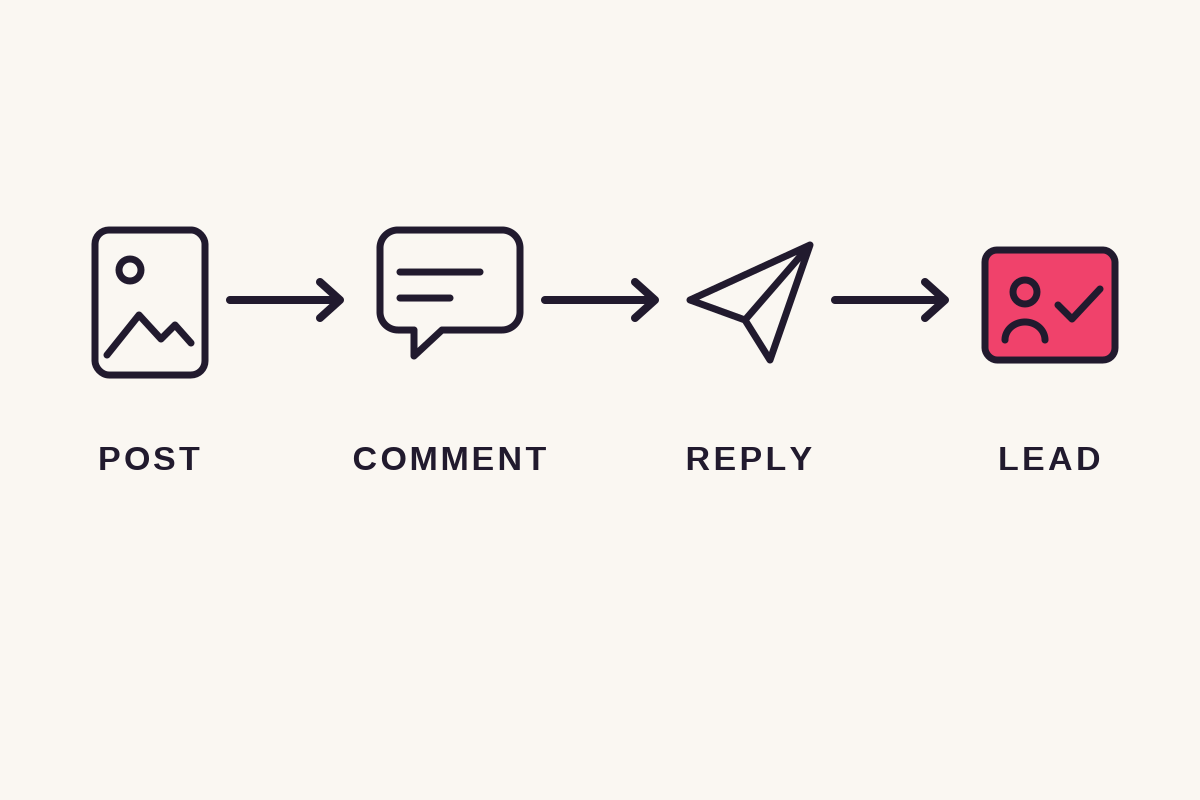
In ReplyMagnet the setup is 6 steps:
- Connect the Facebook Page. Sign in with Facebook and tick the Page you manage.
- Upload the resource you will send, such as a PDF guide. The free plan hosts a PDF up to 25 MB.
- Create a campaign. Pick the posts and a trigger keyword such as GUIDE.
- Turn on the email gate, and the phone gate from $9 a month if you call leads back.
- Say it plainly in the post and the reply: the guide is free, and it needs an email.
- Test from a second profile, then post. Comments from the Page itself are ignored.
Each keyword comment gets a public reply under the post and a private reply in Messenger. The one-message limit comes from Meta's private replies documentation, checked 21 November 2026. The same page lets a Page continue the conversation only after the person responds, inside a 24-hour window. So the first message has to carry the link.
The campaign documentation covers each screen.
What you need before you start
Facebook lead generation from comments needs 4 things in place: a Facebook Page you manage, one offer, somewhere for the leads to go and a first follow-up. A personal profile or a group cannot be connected.
Set these up in order:
- A Facebook Page. The reply runs through the Page, so you need a role on the Page that allows messaging. Posts on a personal profile and posts inside groups are not covered.
- One offer. A single guide, checklist or template that solves one problem for one kind of customer. These lead magnet ideas work on Facebook too.
- A place for the leads. ReplyMagnet keeps a leads table. Syncing to Mailchimp or Kit and CSV export start at $9 a month.
- A first follow-up. Write the welcome email before the first lead arrives.
ReplyMagnet hosts the form on a capture page, so you do not need a website. Our lead capture page guide explains what that page should say.
Facebook lead ads or comments: which should you use?
Use Facebook lead ads when you need reach beyond the people who already see your Page, and use comments when your posts already get replies. Many businesses run both: ads for cold audiences and a comment keyword on every organic post.
Meta describes lead ads on its own lead ads page, which lists an instant form and a website form. Ads Manager is where you set one up and see what each lead costs.
Facebook lead ads compared with a comment keyword
Question
What do you pay for?
- Lead ads
- Ad spend
- Comment keyword
- A flat monthly plan, or nothing on the free plan
Question
Who sees the offer?
- Lead ads
- The audience you target
- Comment keyword
- People your posts already reach
Question
Where does the person type?
- Lead ads
- A form attached to the ad
- Comment keyword
- A page linked from Messenger
Question
What stops when you stop paying?
- Lead ads
- The leads
- Comment keyword
- Nothing, the posts stay up
Question
What does it need to work?
- Lead ads
- A budget and a tested ad
- Comment keyword
- Posts that people comment on
A simple rule: if your last 5 Page posts drew fewer than 10 comments in total, start with ads or build the audience first. If they drew more, add a keyword to the next post before spending anything.
The rule Facebook lead generation trips on: one reply, 7 days
A Facebook Page gets one private reply per comment, and Meta's private replies documentation requires that reply within 7 days of the comment. Lead generation from comments fails when that single message does not contain the link.
Three habits keep you inside the rule:
- Put the link in the first message. A greeting with the link "coming soon" wastes the only message you get.
- Reply fast. An automated reply arrives while the person is still looking at the post. A manual reply 3 days later mostly goes unread.
- Do not chase. If the person never responds, the Page cannot keep messaging them. The messaging window opens only when they write back.
Permission matters as much as timing. A keyword comment is an opt-in to receive the resource. A keyword comment is not agreement to marketing emails or sales calls. Ask for that in plain words on the post and the form.
Email, phone and privacy laws differ by country, and this guide is not legal advice. Our gated content guide covers when asking for details is fair.
A worked example: 198 Facebook leads from 4 posts
In an illustrative example, 4 Page posts with 150 keyword comments each produce 360 link opens and 198 captured emails in a month. All 600 engagements fit inside ReplyMagnet's free plan of 1,000 a month.
These numbers are made up to show the arithmetic. They are not a benchmark.
| Step | Count | Share of the step before |
|---|---|---|
| Page posts with a keyword | 4 | |
| Keyword comments | 600 | |
| Private replies sent with the link | 600 | 100% |
| Link opens | 360 | 60% |
| Emails captured | 198 | 55% |
Now compare with ads. Assume, only for the sum, that a lead ad delivers leads at $5 each. Then 198 leads cost $990. Your own Ads Manager shows your real figure, which may be far lower or higher.
On the free plan the comment route costs nothing in this example. To send those 198 addresses to Mailchimp or Kit automatically, the $9 plan covers 25,000 engagements a month.
ReplyMagnet bills by monthly engagements, 100,000 for $29, and never by the number of contacts stored. Every signup also gets a 30-day trial of the paid features with no card.
What to measure in Facebook lead generation
Measure Facebook lead generation with 4 numbers: keyword comments per post, link open rate, capture rate and cost per lead. Each number points at a different fix, so track all 4 for every post or ad.
Four Facebook lead generation numbers and what a poor one means
Number
Keyword comments per post
- How to work it out
- Count of comments containing the keyword
- A poor figure means
- The offer or the ask in the post is unclear
Number
Link open rate
- How to work it out
- Link opens divided by private replies sent
- A poor figure means
- The reply does not say what the link gives
Number
Capture rate
- How to work it out
- Emails captured divided by link opens
- A poor figure means
- The form asks for too much, or the promise changed
Number
Cost per lead
- How to work it out
- Money spent divided by leads captured
- A poor figure means
- The route is too expensive for what a lead is worth
ReplyMagnet counts replies, link opens and captured emails for each campaign, so the comment route is easy to read. Ad numbers live in Ads Manager. Compare the two routes on cost per lead, and then on how many leads become customers.
Judge a month, not a day. One strong post can double a week and tell you little about the trend.
Where Facebook lead generation goes wrong
Facebook lead generation goes wrong most often in 5 ways. The 5 are a vague offer, a form with too many fields, a keyword on a post nobody sees, no follow-up and counting leads instead of customers.
Check your plan against each one:
- A vague offer. "Comment for more info" gives nobody a reason. Name the resource.
- Too many fields. Ask for the email alone. Add the phone number only if someone will call.
- No audience yet. A keyword on a post with no reach produces no leads. Build reach first.
- No follow-up. A lead who hears nothing for 2 weeks has forgotten the request.
- Counting leads, not customers. 50 leads who buy beat 500 who wanted a freebie.
A lead is the start of the work. Our guide to what happens after the download covers the first email, and the email capture guide compares form tools if you also collect leads on a website.
Common questions
How do I generate leads on Facebook for free?
You can generate leads on Facebook for free by offering a resource in a Page post and collecting emails from people who comment a keyword. ReplyMagnet's free plan covers 1,000 engagements a month and includes the email gate.
How do I generate leads on Facebook without ads?
Facebook lead generation without ads relies on attention you already have: Page posts, a group, live video or Messenger conversations. A comment keyword turns that attention into leads by sending each commenter a link that asks for an email.
What is a Facebook lead ad?
A Facebook lead ad is a paid ad from Meta built to collect contact details through a form. Meta's lead ads page lists an instant form and a website form, and you create and pay for the ad in Ads Manager.
Can I send a Messenger message to everyone who comments on my post?
A Facebook Page can send one private reply to each comment, and Meta's private replies documentation requires the reply within 7 days of the comment. Further messages are allowed only after the person responds, inside a 24-hour window.
Does ReplyMagnet run Facebook lead ads?
No. ReplyMagnet does not create or manage ads. ReplyMagnet replies to keyword comments on Facebook Page posts, sends the link in Messenger and captures the email on a hosted page.
Does Facebook lead generation work from a personal profile?
Lead ads and automated private replies both run through a Facebook Page, not a personal profile. ReplyMagnet connects Facebook Pages you manage and does not cover posts on personal profiles or inside groups.
Keep reading
- How to design an Instagram lead magnet people use
- Get more qualified Instagram leads: a practical worksheet
- Lead capture page: what to put on it, with examples
- Instagram Comment-to-DM Automation: Setup & Test Guide