Guides
n8n Instagram Automation vs Managed Tools: A Build-or-Buy Guide

Choose between n8n and a managed Instagram tool by deciding which operating responsibilities your team can own. A workflow editor can connect steps; the business still needs authorized access, safe recovery and a clear customer outcome.
Published by ReplyMagnet · Last updated
An n8n workflow is one part of the integration
n8n can coordinate API requests and other workflow steps. A working Instagram service also needs authorized access, event handling, message eligibility checks, operational records and someone responsible when it fails.
The decision is not simply “visual builder or subscription.” It is whether your team wants to own the system around a workflow as well as the workflow itself. Moving boxes on a canvas may be straightforward; keeping credentials, events and recovery working for months is a separate responsibility.
The n8n Facebook Graph API node documentation describes configurable requests, including the API version, node and edge. That is a useful integration component. It does not mean that importing a template grants the permissions needed for a particular Instagram account or messaging use case.
Start with one business job, such as responding to an eligible request for a course outline. Describe the desired event and result without choosing the implementation: a person requests the outline, an appropriate response carries the resource, and the operator can distinguish success from failure.
This guide offers an architecture and maintenance worksheet. It is not a ready-to-import n8n Instagram workflow or a guarantee that a particular template supports your account.
Separate workflow configuration from Meta access
Verify the official API, account eligibility, authorization and permissions for your exact use case before designing a production message flow. A workflow editor cannot grant missing platform access.
A useful discovery document has two columns: “What the business wants to do” and “What the approved connection can do.” A request to deliver a brochure is specific enough to investigate. “Automate Instagram” is too broad to establish whether the proposed route is available.
Use the supported platform authorization process and current official documentation for the endpoint you intend to call. Do not substitute browser scripts, stored account passwords or a copied credential from an unrelated integration when access is missing. A demonstration that works for its author may depend on their own permissions, account configuration and development setup.
For each operation, record the account it acts for, the permission evidence, the interaction that makes the message eligible and the person who can renew or revoke access. Keep secret values out of that document. The record should explain ownership without becoming a credential leak.
Avoid sending messages as a way to discover what is permitted. Establish the documented route first, then use controlled testing with accounts and data you are authorized to use. Make unresolved access a blocker rather than quietly assuming the workflow will solve it later.
When evaluating a managed product, ask the equivalent questions. Managed access reduces the integration work you perform, but the campaign still needs an eligible interaction and an appropriate purpose. No product label makes every proposed message valid.
Draw the architecture with an owner at every boundary
Map credentials, incoming events, eligibility, send attempts, resource delivery and downstream records. Assign a failure signal and recovery owner to every component you intend to operate.
For a fictional training business, the initial request is simple: send a course outline when someone asks for it under the selected post. The architecture might include an event receiver, a filter, a state record, a send operation and a destination check. These are design requirements, not a claim that an n8n template already provides them.
The state record matters because the same business event can be encountered more than once during retries or recovery. Before repeating a send, the system needs evidence of what happened previously. “The workflow ran again” is not a sufficient reason to message the person again.
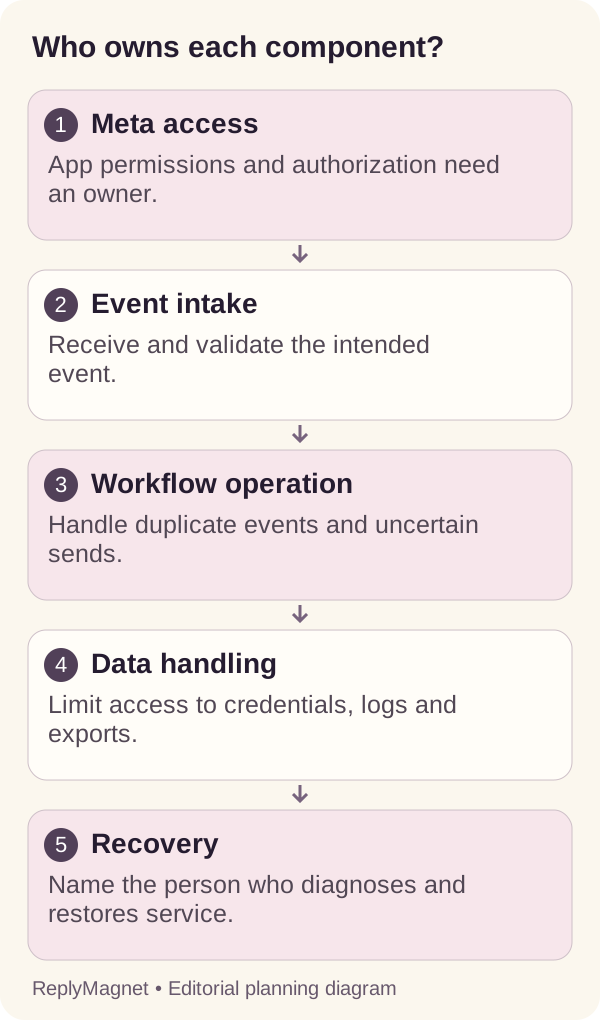
Original responsibility map for evaluating a custom or managed workflow. It does not depict a ready-made integration.
Use the table to expose missing ownership. A row with no recovery plan is a reason to narrow the first release. For example, postpone CRM enrichment until resource delivery and its failure reporting are dependable.
The same map is useful when buying software. Replace an internal owner with the provider’s documented responsibility where appropriate, then record how your operator notices a problem and contacts support.
Architecture responsibility worksheet; proposed checks, not guaranteed product behavior
Component
Authorization
- Evidence to retain
- Account and permission purpose, without secrets
- Owner and recovery question
- Who reconnects after access changes?
Component
Event receiver
- Evidence to retain
- Safe event reference and arrival time
- Owner and recovery question
- Who investigates missing or repeated events?
Component
Eligibility and state
- Evidence to retain
- Reason accepted, skipped or already handled
- Owner and recovery question
- Who reviews an ambiguous retry?
Component
Message attempt
- Evidence to retain
- Observed outcome and unresolved errors
- Owner and recovery question
- Who stops repeated or invalid sends?
Component
Resource destination
- Evidence to retain
- Correct destination and last access test
- Owner and recovery question
- Who repairs changed content?
Component
Downstream handoff
- Evidence to retain
- Delivery or failure of the separate handoff
- Owner and recovery question
- Who can replay it without another DM?
Choose hosting and application ownership separately
Self-hosted n8n, hosted n8n and a managed messaging product leave different work with your team. Ask who operates the infrastructure and who maintains the customer workflow.
Hosting a workflow platform and owning an Instagram application are separate decisions. A hosted workflow service may remove server administration while leaving your team responsible for the logic, credentials, message eligibility and external integration. Do not describe all n8n projects as self-hosted, or assume a hosted instance makes your custom application someone else’s job.
For self-hosting, include updates, backups, access control, monitoring and recovery in the operating plan. Confirm those tasks are assigned to someone who has both time and access to perform them. A spare server is not the same as an available operator.
For hosted n8n, inspect the service’s current terms and operational boundaries. Identify what happens if your workflow uses a faulty expression, an expired external credential or a destination that has changed. Infrastructure availability does not establish that your own business logic is correct.
For a managed messaging product, examine the supported workflow and its limits. You may have less flexibility, but also fewer application components to build. Check how you investigate a failed campaign and what remains your responsibility, such as keeping the resource current.
The right comparison is a list of owned tasks under each option. Keep unknowns visible and ask for evidence. Do not award a custom build points for features that exist only in the proposed architecture, or a subscription points for capabilities the provider has not documented.
Budget for credentials, errors and safe recovery
Include maintenance and failure handling in the build estimate. Test ambiguous outcomes, repeated events and expired access before deciding that the custom workflow is operationally affordable.
A useful estimate separates initial construction from recurring work. Initial work includes access setup, event mapping, business rules and controlled tests. Recurring work includes reviewing failures, renewing connections when needed, updating dependencies and checking that API changes do not invalidate assumptions.
Use a monthly worksheet with task, expected frequency, owner, time allowance and evidence. Leave the allowance as an estimate until you have operated the workflow. Do not present a low server bill as the full cost of a business-critical integration.
Design recovery around the uncertain case. If a request times out after a message may have been accepted, automatically repeating the send can produce an unwanted duplicate. Record the uncertainty and inspect available delivery evidence before choosing a replay. Replaying a downstream bookkeeping step should not automatically repeat the customer-facing message.
n8n documents a security audit that can identify common issues, including unused credentials, unprotected webhooks and outdated instance settings. Running such a check is useful maintenance; it does not certify the correctness or security of your whole custom Instagram service.
Keep operational logs proportionate to the troubleshooting task. Avoid copying full conversations and secrets into every error notification. An operator needs enough context to identify the failed step, not an uncontrolled archive of customer data in several tools.
Run a small proof of concept with explicit failure tests
Test one eligible request and its recovery cases before expanding the build. Define success in terms of the customer result and the operator’s ability to explain what happened.
For the fictional training business, the proof of concept has one post, one outline and one destination. It excludes payment, personalized recommendations and a full CRM migration. Limiting scope makes a failure easier to understand and prevents several unfinished integrations from disguising one another.
Write the acceptance criteria before building. A valid controlled request should reach the correct outline. An unrelated event should be ignored for a recorded reason. Reprocessing the same event should not create a second customer response. A missing permission should produce a visible problem rather than disappearing into an unreviewed execution log.
Add a resource-change test: replace the destination in a controlled environment and confirm the intended route uses it. Add a handoff-failure test: make the downstream system unavailable in a safe test and check that recovery does not resend the DM. Never disrupt production customer systems to create these cases.
Save the observed result, the test conditions and the unresolved gaps. “It worked once” is evidence of one successful path, not evidence of reliable operation. “It failed” is also incomplete unless you know where and whether the recovery was safe.
Run an equivalent narrow task in a managed product. The tool scorecard can hold both results. Compare actual tests and operating responsibilities rather than the visual appeal of the two editors.
A hybrid can keep custom work after the customer response
Use a managed product for its supported request workflow and a separate integration for a justified downstream task. Keep the boundary explicit, including plan access, data fields and retry behavior.
A business may prefer managed comment-to-resource delivery while needing a custom internal notification or reporting process. That is a different architecture from rebuilding the entire Instagram integration. The customer-facing response can remain in the product while the downstream process receives an authorized event.
ReplyMagnet’s outbound webhooks require Pro or above. They are a separate capability from basic resource delivery. If a downstream workflow depends on them, include that plan requirement and inspect the actual event contract before choosing the architecture. Do not infer a native n8n connector or a guaranteed ready-made workflow.
The Zapier and Make lead guide explains the existing outbound-handoff approach. Apply the same boundary questions to a custom destination: which event is sent, which fields are necessary, how the receiver authenticates the request, what identifies a repeated event, and who investigates a failure?
Keep the receiving workflow narrow. A notification that a resource request occurred should not invent a checkout purchase, newsletter permission or sales qualification. Preserve the meaning of the original event when translating it into another system.
If the downstream task fails, consider whether the resource request can still complete safely. Separating these jobs can make recovery easier: the operator can repair an internal record without treating the customer’s completed request as unfinished.
Use maintenance readiness to make the final decision
Build when a justified requirement and a capable ongoing owner warrant the extra responsibility. Buy when the supported workflow fits and operating the integration would distract from the customer task.
Answer five questions with names and evidence: Who understands the official API route? Who owns credentials? Who investigates a failed customer request? Who can recover without duplicate sends? Who maintains the service when its original builder is away? “We will work it out” is an unresolved cost, not a completed answer.
Choose a custom proof of concept if you have a requirement a managed service cannot meet and a team prepared to own it. Choose a managed trial if the core need is standard resource delivery and you primarily want to run the campaign. Choose a hybrid if the unusual work begins after a supported customer interaction.
The DM automation cost model helps evaluate routine operating work. Add the architecture responsibilities above before comparing total cost. For a resource campaign, prepare the destination using the asset guide and follow the campaign setup.
Finish with one small decision you can verify. Trial the supported campaign, or approve a bounded custom experiment with an owner and acceptance criteria. Avoid commissioning an entire integration before proving that its extra complexity solves a real requirement.
Keep reading
- Instagram DM automation for agencies: a playbook
- How to measure Instagram DM campaigns (2026)
- Send Instagram leads to Zapier or Make with webhooks