Guides
Facebook Your Algorithm: a discovery plan for creators
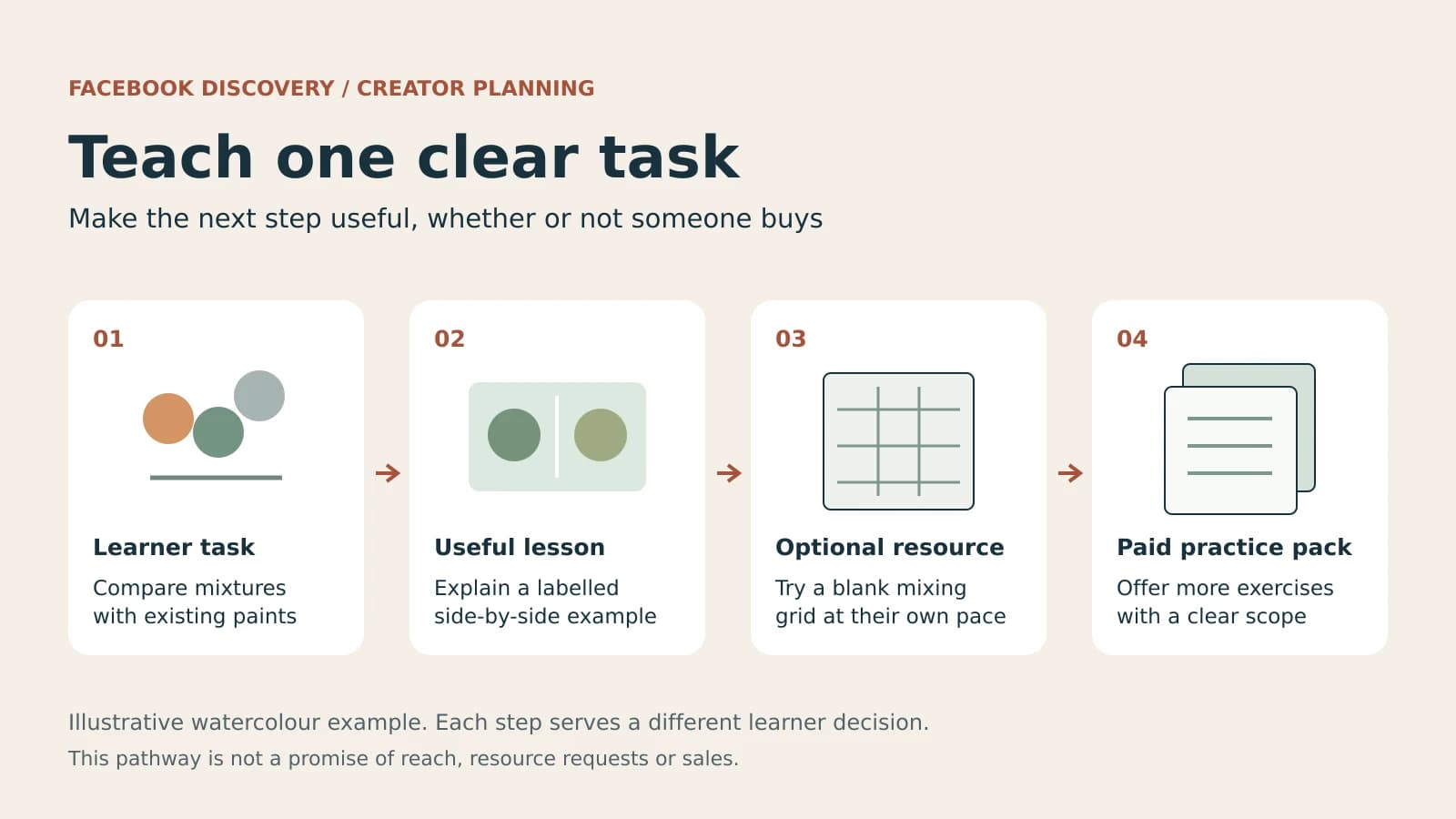
Facebook's Your Algorithm lets viewers steer their own recommendations. You cannot use that control to choose your reach, but you can make a lesson easy to recognise, offer one useful next step and measure what happens. Here is a plan you can inspect and improve.
Published by ReplyMagnet · Last updated
What does Facebook's Your Algorithm update actually change?
Your Algorithm, announced by Meta on October 13, 2026, lets a viewer adjust Facebook Feed and Reels recommendations from the three-dot menu. Meta publishes no creator ranking weights, rollout schedule or discovery keywords, so treat any distribution benefit as something to test.
Meta's announcement describes the viewer side: topic controls, Interested and Not interested feedback, and recommendations that Meta says can adapt within a session. That is Meta's product claim, not an independent performance result.
What Meta does not give:
- A country-by-country rollout schedule or completion date. Check your own interface.
- Creator ranking weights or a list of terms to repeat for reach.
- Any guarantee that a clearer topic earns more distribution.
Our practical interpretation: make the subject and usefulness of your work easy for a person to understand, then offer the shortest useful next step. If you sell a course, template or practice pack, discovery matters when it brings the lesson to someone who can use it. A bigger audience is only part of that job.
Separate three questions before changing your content
A Facebook discovery plan is easier to judge when relevance, usefulness and continuation are scored separately. A post can hold attention without creating a buyer, and a learner can want the free sheet while already owning the paid class.
Answer each question on its own:
- Relevance. Is this a problem the intended viewer recognises?
- Usefulness. Can the viewer learn or do something from the content itself?
- Continuation. Does the resource or product help with the next genuine task?
Do not use one comment total to answer all three. In its 2023 ranking explanation, Meta described combining several predictions rather than treating one predicted action as the whole measure of value. Useful background, not a published formula for the October update.
Originality is a separate production check. Our Facebook original content examples cover what your own contribution adds. This guide covers choosing the audience problem and evaluating the journey after discovery.
Choose a learner's task, not a broad niche
“Art” is a category; “mix a muted green with the paints on my desk” is a task. A task gives you something concrete to teach and gives a Facebook viewer a reason to stop, so write four planning lines per topic before filming anything.
Start with questions you can document: customer emails, support requests, lesson feedback and relevant comments. Record the question, where it appeared and what remains uncertain. One enthusiastic reply is not proof of demand.
For each candidate topic, write four lines:
- Person: who has the problem, and what can they already do?
- Task: what are they trying to accomplish today?
- Constraint: what makes the task hard or limits the solution?
- Evidence: what have they asked, tried or misunderstood?
A fictional watercolour teacher might pick beginners who own a small paint set, want less muddy mixes and cannot compare mixtures. If the student questions have not actually been collected, label the idea a hypothesis.
Keep adjacent interests in reserve. A beginner mixing exercise, a paint-shopping comparison and an advanced colour-theory lesson all fit the business, but they solve different problems. Combining them in one lesson hides which need attracted the response. These phrases are audience hypotheses, not a Facebook topic taxonomy.
Build one topic-to-product pathway
Work backward from the learner's next decision. The free lesson answers a real question, the optional resource makes practice easier, and the paid product offers a clearly larger outcome. The resource must still help someone who never buys.
For the fictional watercolour teacher, the pathway could look like this. It is an illustrative planning model, not a customer result.
One pathway for one learner
Stage
Facebook lesson
- Learner's task
- Understand how two mixtures differ
- What the creator prepares
- A clear explanation with visible, labelled examples
Stage
Optional resource
- Learner's task
- Compare mixtures using their own paints
- What the creator prepares
- A blank mixing grid with one completed example
Stage
Paid practice pack
- Learner's task
- Apply the observations across several projects
- What the creator prepares
- Structured exercises, material list and an honest scope
Before building the resource, ask one learner what they would do first. If they cannot name the first action, simplify. Our worksheet design guide covers working backward from a useful decision; its campaign examples use Instagram, but the exercise stands alone.
Remove practical friction for US and European audiences. State the paper size and offer A4 and US Letter. Explain unfamiliar material names. Give a time zone for any live session.
Make the topic clear without inventing a Your Algorithm formula
Review the lesson as if the viewer has never heard of you. They should identify the subject, level and practical result without opening another page. Those are editorial choices that help a reader, not verified Your Algorithm ranking factors.
Use ordinary, specific language. Show the object or process clearly. Label comparisons so a reader can tell them apart. Keep the lesson long enough to finish its explanation.
Three checks before publishing:
- Comprehension. Ask a reviewer what question the lesson answers. The reply should match your planning brief.
- Completeness. The main takeaway stands on its own without a download or purchase.
- Continuity. The proposed resource develops the same task at the same skill level.
Do not add topics because they look popular in your own feed. Your feed is one account's observation, not a demand study. If you browse for inspiration, record what you noticed separately from what customers have asked for.
Give interested people the shortest useful next step
A resource link can be enough. ReplyMagnet delivers that resource from a comment on a Facebook Page post or an Instagram post on every plan. The free Starter plan includes 1,000 engagements a month in the published catalogue.
Choose a destination that explains what the file contains, opens on a phone and never surprises the reader with a second account. If an email step is part of the offer, say so before the form and explain the purpose. Do not add a signup because the software offers one.
When a viewer asks for the grid under the post, ReplyMagnet replies publicly and sends the link privately. On a Facebook Page post that is a Messenger private reply; on Instagram it is a DM. The campaign setup guide shows how to select posts, set a trigger keyword and test valid and unrelated comments before launch.
Keep that delivery role separate from discovery. ReplyMagnet does not provide Facebook audience-interest data, ranking controls or a reach guarantee, and this plan does not depend on any of those.
Measure Facebook discovery in separate stages
Choose the question before collecting numbers, then keep five records apart: content exposure, expressed interest, resource access, resource usefulness and completed orders. No stage alone proves the next one.
For the watercolour example, a useful question is whether people interested in beginner colour mixing can find, open and use the companion grid.
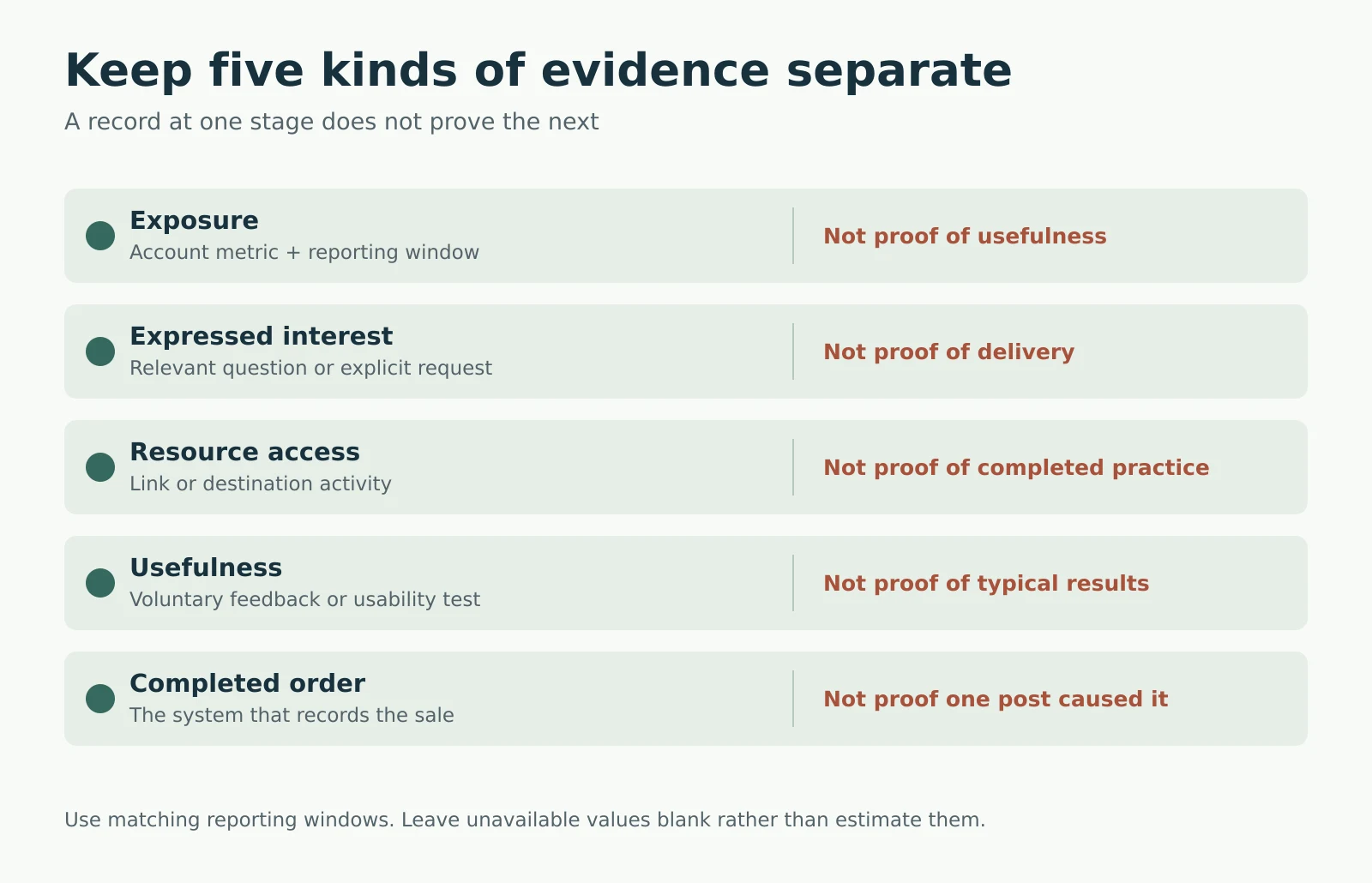
Original evidence checklist. A request, an opened resource and a completed order answer different questions.
A small measurement log
Stage
Content exposure
- Evidence to record
- The metrics your account exposes, with exact labels and dates
- What it cannot establish alone
- That the intended learners found the lesson useful
Stage
Expressed interest
- Evidence to record
- Relevant questions or explicit resource requests
- What it cannot establish alone
- A successful delivery or purchase
Stage
Resource access
- Evidence to record
- Link or page activity in your destination system
- What it cannot establish alone
- That the reader completed the exercise
Stage
Resource usefulness
- Evidence to record
- Voluntary feedback or a small usability test
- What it cannot establish alone
- Typical results across the whole audience
Stage
Commercial outcome
- Evidence to record
- Completed orders in the system that records them
- What it cannot establish alone
- That one Facebook post caused every order
Use the metrics your account actually shows. Never invent a missing value or treat views, people and sessions as the same unit. Campaign-labelled links help organise destination traffic but do not prove that every visit came from one post. Our DM tracking guide separates a delivery record, a link interaction and a website session. ReplyMagnet's analytics documentation separates matching and delivery stages and sends you to your own store for sales.
Run a small comparison and pick the next action
Test one editorial question at a time, keep the learner, subject, resource and offer consistent, and set a review date before publishing. A small or mixed sample leaves the question open; it does not declare a winner.
For the teacher, the question might be whether beginners understand a labelled side-by-side comparison better than a single finished painting. Record what you could not control: timing, promotion, collaborations, audience exposure. This is a practical comparison, not a randomised experiment.
At the review, choose from the evidence:
- Readers misunderstand the lesson: clarify the explanation before changing the offer.
- People ask for the resource but cannot open it: repair access before judging demand.
- The resource opens but testers cannot begin: simplify the first task.
- Learners use the resource but the paid pack feels unrelated: review the product transition.
- Evidence is sparse: collect more comparable observations.
Then complete one planning sheet per topic before expanding the calendar:
- Intended learner and task.
- Observed evidence, with hypotheses marked.
- The standalone lesson.
- The optional resource and the task it helps.
- What the paid offer adds, and whom it does not suit.
- Access checks: phone, paper size, language, any signup.
- The measurement question and the records that answer it.
- The review date and one change to consider.
Start with one topic your audience recognises, one lesson worth their time and one resource that helps them continue. That is a creator discovery plan you can improve even when the reasons behind any single recommendation stay unknown.
Common questions
Can creators use Facebook's Your Algorithm to increase their reach?
No. Your Algorithm is a viewer control for Feed and Reels recommendations. Meta publishes no creator ranking weights or discovery keywords, so any distribution benefit is something to test, not an established consequence.
Does ReplyMagnet provide Facebook audience-interest or ranking data?
No. ReplyMagnet delivers a resource when someone comments on a Facebook Page post or an Instagram post. Discovery, interest and ranking data stay with Meta and your own account metrics.
What is the first thing to change after the Your Algorithm update?
Make the subject, level and practical result of each lesson recognisable to a stranger, then attach one useful optional resource. Change the paid offer only after the lesson and resource are understood.
How many posts prove that a creator discovery plan works?
There is no universal number. Compare items after an equal amount of time, record the differences you could not control, and treat a small or mixed sample as an open question rather than a result.
Keep reading
- Facebook original content rules: 6 examples (2026)
- How to design an Instagram lead magnet people use
- Instagram DM UTM tracking: links, GA4 and limits
- Guides