Guides
Facebook original content guidelines with six creator examples
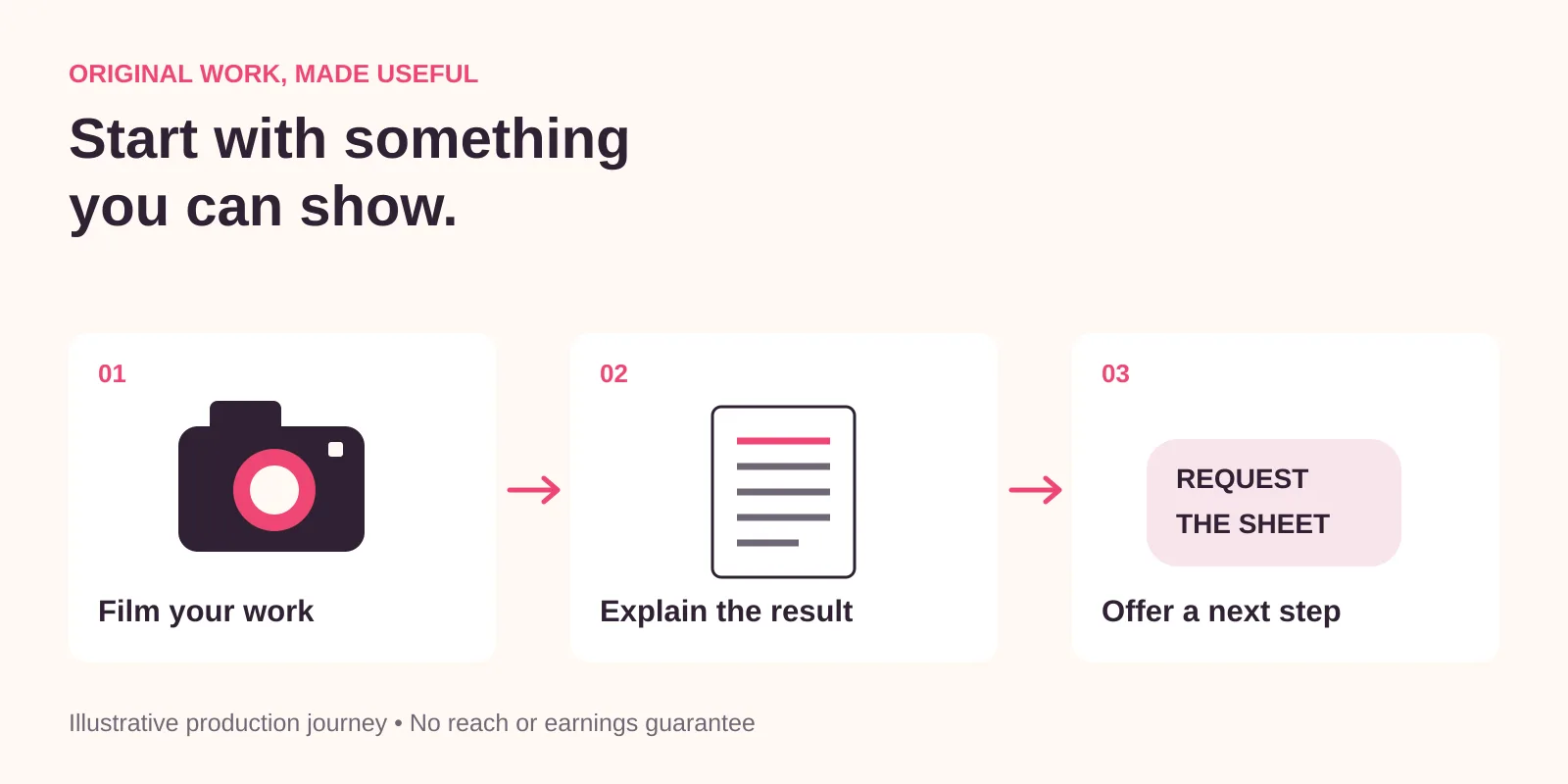
Facebook rewards work you film, explain or investigate yourself and deprioritizes reuse. Here are six fictional production plans that pass that test, a five-line production record, and the comment campaign that delivers each plan's companion resource.
Published by ReplyMagnet · Last updated
What Facebook counts as original content
Facebook treats material you film, record or produce yourself as original. Third-party footage counts as original only when your on-screen contribution adds real information, analysis or a better story; minor edits, reactions and re-uploads are low-value reuse.
Meta's March 2026 originality update separates creator-produced work from low-value reuse. Passive reactions, stitched clips and a new border can be deprioritized. An account that keeps publishing mostly unoriginal material can be labelled non-recommendable and lose monetization, with an appeal route available.
Treat that as a production constraint, not a formatting rule. Before recording, finish this sentence: "A viewer will understand this specific thing because I showed or explained it." If the honest answer is "they will see the same clip with my logo," the concept needs more work.
Three things the guidance does not give you:
- A percentage of new footage that makes a post safe. Judge your contribution by what it does for the viewer.
- A promise about any single upload. Our six examples are planning recommendations, not predictions of how Facebook will classify a post.
- A rights clearance. Originality and permission are separate checks, covered next.
ReplyMagnet's part comes after the lesson: when a viewer asks for the companion worksheet, a comment campaign delivers it. Start free once you have one lesson worth a resource.
Keep originality and usage rights as separate checks
Write two notes for every borrowed asset: what your contribution adds, and why you may use the footage, image, audio or document. Passing one check is never evidence for the other.
The US Copyright Office's fair-use FAQ says no fixed number of words, notes or percentage of a work automatically makes a use permissible. Attribution alone is a poor rights plan. For a commercial post built on borrowed material, settle permission or the applicable legal basis before production. Creators serving European audiences should check local rules rather than importing a US fair-use assumption.
A source record can be short. Keep it beside the project files so a teammate can answer "can this clip appear in an ad?" without guessing.
A short source record for every borrowed asset
Field
Asset
- What to write
- Name and where it came from
Field
Owner
- What to write
- Who holds the rights
Field
Basis
- What to write
- Licence reference, written permission or the legal basis relied on
Field
Permitted use
- What to write
- Organic post, paid ad, paid course, other accounts
Field
Conditions
- What to write
- Credit wording, expiry, territory
Six original Facebook content examples
Each example replaces a weak reuse idea with something the creator can demonstrate, explain or investigate on camera, then pairs it with a small companion resource. All six are fictional editorial exercises, not Meta decisions or customer results.
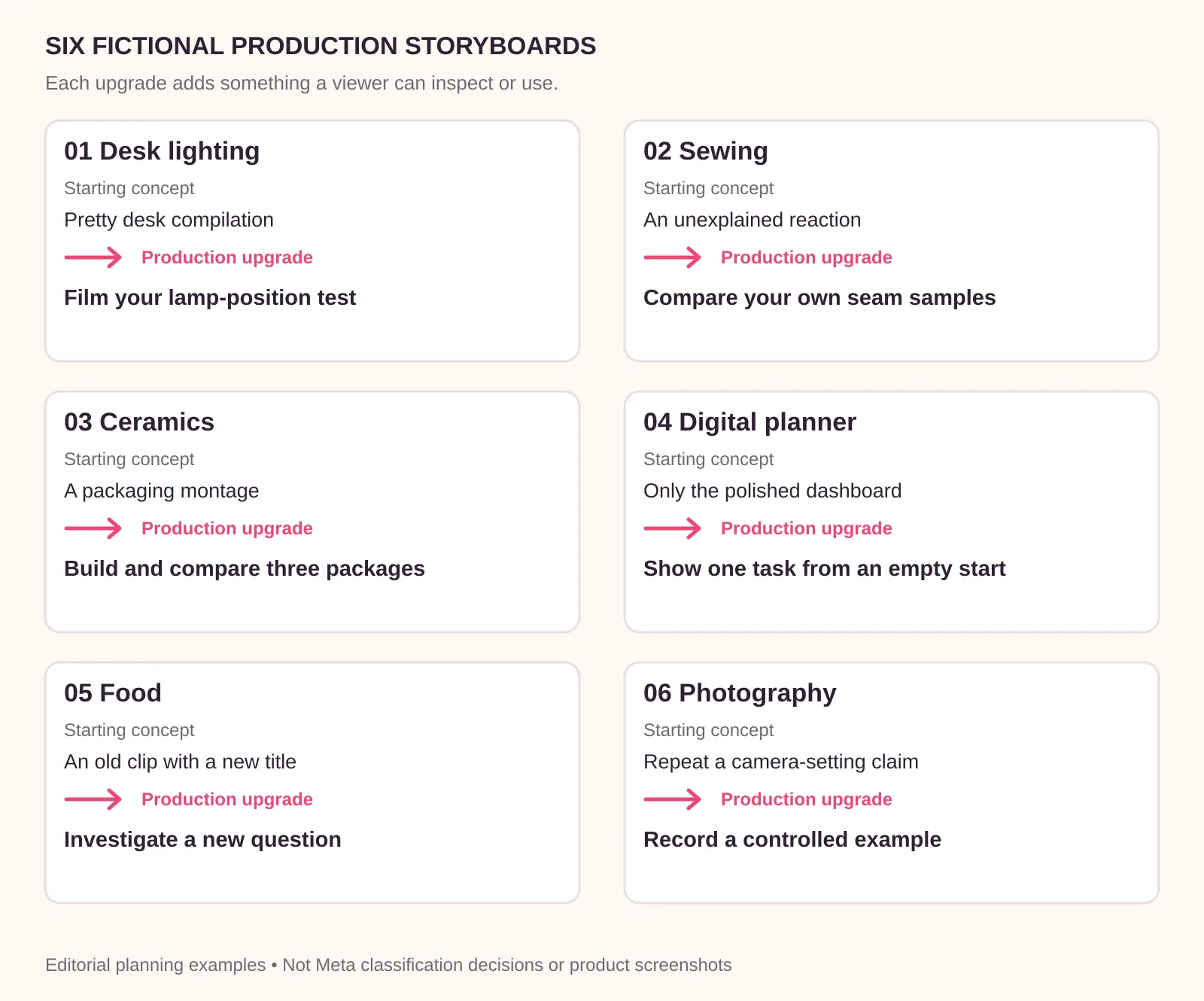
Six fictional production storyboards. The upgrade in each gives the viewer something to inspect or try; none is a platform classification result.
1. Film the problem and your own test. A home-office creator wants to explain desk-lamp glare. Instead of a compilation of attractive desks, she locks the camera on her own screen, moves the lamp without touching monitor brightness, and shows where the reflection went. The lesson is reproducible: move and test the light before buying another lamp. Companion resource: a one-page lighting test sheet.
2. Replace an empty reaction with a worked explanation. A sewing teacher sees a viral clip about a puckered seam. Rather than filming a surprised face beside it, she sews two labelled samples, changing only the needle, and compares them close enough to inspect. She claims only what one cotton sample shows. Companion resource: a troubleshooting log; the paid offer is a beginner workshop.
3. Turn a compilation into an original comparison. A ceramic artist packs the same mug three ways with her own materials, scoring each on assembly steps, bench space, ease of reopening and visible movement. Costs carry a date and currency, and she never calls it a shipping-damage test. Companion resource: a packing worksheet.
4. Add evidence to a familiar tutorial. A digital-planner seller runs a weekly review on camera from an empty template with labelled example data, moves one slipped task and deletes one that no longer matters. She names a limit: recurring schedules live elsewhere. Companion resource: the blank review questions; the paid product is the template.
5. Rework your own archive around a new question. A food creator has three old bread demonstrations. Rather than reposting the montage with a new headline, she asks why the same dough behaved differently on two days and uses her archive as evidence. Missing measurements are marked unknown, never invented. Companion resource: a baking observation sheet.
6. Turn a borrowed claim into a documented investigation. A photography educator tests the claim that one setting always gives sharper indoor portraits, with her own camera, a consenting subject and comparable framing. She summarises the claim in her own words and links to it rather than reusing the source video. Companion resource: a portrait-session checklist.
Example 5 is the one most creators can start this week. The repurposing guide covers adapting a finished lesson for an Instagram companion without repeating every sentence.
Fill in a production record before you edit
Answer five questions before editing: the viewer task, the original work, any borrowed material and its rights basis, the evidence limit, and the next step. A concept with no clear original contribution fails at the first question.
- Viewer task: what should someone understand or try after watching?
- Original work: which shots, observations, examples or explanations will you make?
- Borrowed material: what is included, why, and where is the permission or rights assessment?
- Evidence limit: what did you not measure or cannot generalise?
- Next step: is there a genuinely useful resource, product page or service that follows?
For the ceramic artist: the viewer task is choosing a packing method to test; the original work is three filmed attempts; the evidence limit is that assembly comparisons say nothing about courier performance; the next step is a worksheet for the viewer's own supplies. Those four sentences brief an editor better than "make it engaging."
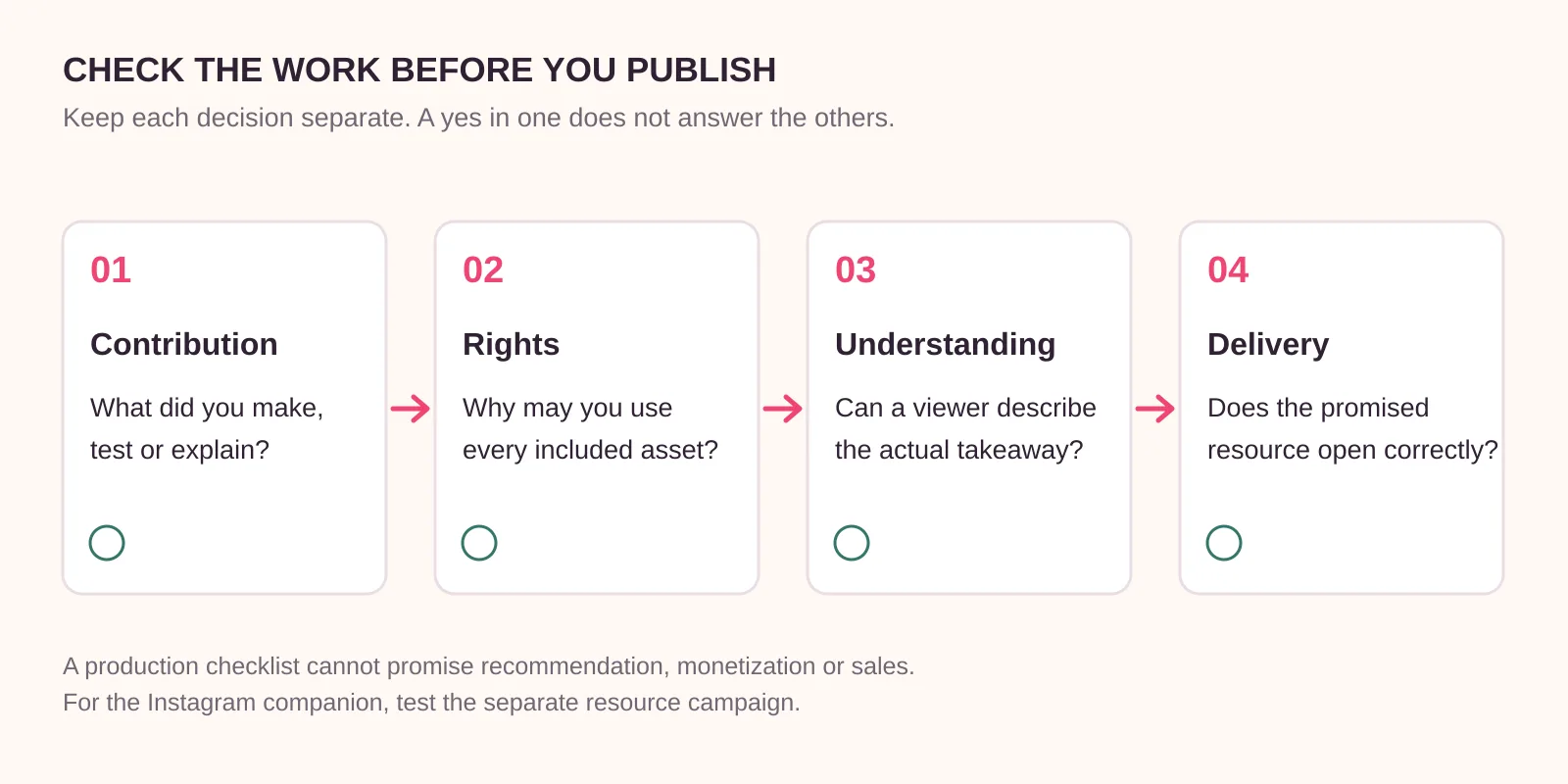
Four separate checks. Passing them does not guarantee Facebook recommendations or monetization.
Then ask someone to describe the lesson after watching the rough cut without your commentary. If they can only name the topic, strengthen the demonstration. If they misread the result, fix the sequence or labels.
Deliver the companion resource with a ReplyMagnet comment campaign
ReplyMagnet delivers a requested PDF or link by comment on Instagram and Facebook through Meta's reviewed API. Its asset documentation allows hosted PDFs up to 25 MB on every plan and external links from Basic. It does not decide originality, distribution or monetization.
Offer the resource after a complete takeaway. The desk-lighting viewer should see the glare test in the video; the optional sheet then helps them repeat it at home. The steps below follow the documented Instagram companion workflow. ReplyMagnet also runs on Facebook Pages, but check that Page's permissions, messaging window and campaign controls separately rather than assuming the Instagram rules transfer.
- Prepare the PDF and open it on a phone. Use a readable version title such as "Desk lighting test sheet v1."
- Connect the eligible Instagram professional account and select the post that makes this exact offer.
- Choose a specific trigger keyword such as LIGHTING, so unrelated comments stay outside the request.
- Write a brief public reply and a DM that names the sheet. If an email step is required, say so before anyone requests it.
- Test from another account: a valid request, an unrelated comment, and the delivered file.
Example caption: "The video shows the lamp-position test. Comment LIGHTING on this Instagram post for the one-page worksheet." Example DM: "Here is the desk-lighting worksheet. Start with the baseline photo before you move anything." Adapt both.
The campaign documentation covers each control. The reply and DM go through endpoints that passed Meta App Review, not a browser script. A recipient can forward a delivery link, so keep paid, access-controlled material in the system built for checkout.
Measure content quality and business outcomes separately
Pick the question before you read the numbers. Viewer understanding, resource delivery and purchases come from three different sources, and Meta's March 2026 monetization announcement describes Content Monetization as invite-only.
Meta's March 2026 monetization announcement separates qualified views from earnings and describes Content Monetization as invite-only. Check eligibility in your own dashboard; originality alone earns nothing.
Keep a weekly record with a row per post and leave a cell blank when the data does not exist. Separate Facebook results from the Instagram companion campaign so an audience shift stays visible. In the ReplyMagnet analytics guide, a queued request is still pending and a saved email is not a purchase. Use matching reporting periods and remove your own test activity first.
Match each question to its evidence
Question
Is the opening understandable?
- Where the answer lives
- A few structured viewer observations, not the raw comment count
Question
Did the worksheet reach people?
- Where the answer lives
- Completed deliveries and opens in the campaign analytics
Question
Did anyone buy?
- Where the answer lives
- Store or booking records, never DM counts
Question
Is the audience shifting?
- Where the answer lives
- Facebook and Instagram results kept in separate columns
Where Facebook original content plans go wrong
The common failures are cosmetic edits presented as originality, a caption that promises a different lesson from the video, and an Instagram keyword instruction copied onto a Facebook post with no response flow behind it.
Meta's spam guidance targets unrelated captions, spam networks and coordinated fake engagement. Keep the caption about the actual post and never manufacture activity.
- Captions as the only change. Captions help comprehension; they do not turn a reused video into original work.
- Rights assumed from attribution. A credit line is not a licence. Resolve the basis before production.
- A hidden result. Making people request a DM to learn the answer weakens the public lesson. Finish the lesson in the video and make the resource optional.
- Caption and video that disagree. Read them together. The opening promise, the example label and the final instruction must match.
- A copied instruction. "Comment LIGHTING" on a Facebook post confuses people when no matching campaign is live there.
- Invented data. A tidier temperature or cost that was never measured turns an honest exercise into a false claim.
Common questions
Does adding captions make a reused video original?
No. Captions improve access and comprehension, but cosmetic changes alone are not an originality strategy. Start with an original demonstration or explanation, then add captions to help people follow it.
Can I use my own older footage?
Yes, when you hold the rights to every component, music included, and the new piece gives viewers a clear new task. The archive example in this guide is an editorial approach, not a promise about distribution.
Do I need to show my face throughout the video?
Not as a rule. A hands-on recording can teach through the work itself. For third-party remixes, Meta's guidance looks at the on-screen creator's contribution, so check that case specifically.
Will original content automatically qualify for monetization?
No. Program requirements and your account's current status decide eligibility. Keep the content plan useful even while program access or earnings are uncertain.
Can ReplyMagnet improve a Facebook originality decision?
No. ReplyMagnet does not decide originality, distribution or monetization. Its role is delivering a resource someone requests by comment after watching your lesson.
What does the free ReplyMagnet plan include?
After the 30-day trial, Starter is free with 1,000 engagements a month, one connected account and one live campaign. One matching comment's public reply and DM use one engagement together.