Guides
Should a download require an Instagram follow?
Checking whether someone follows you is a technical capability. Deciding to withhold a promised resource until they follow is a separate editorial and policy decision.
Published by ReplyMagnet · Last updated
What a follow gate is
A follow gate is a check inserted between the comment and the delivery: the commenter has to follow the account, and the automation confirms it through Instagram's API before sending the file, rather than taking a claim on trust.
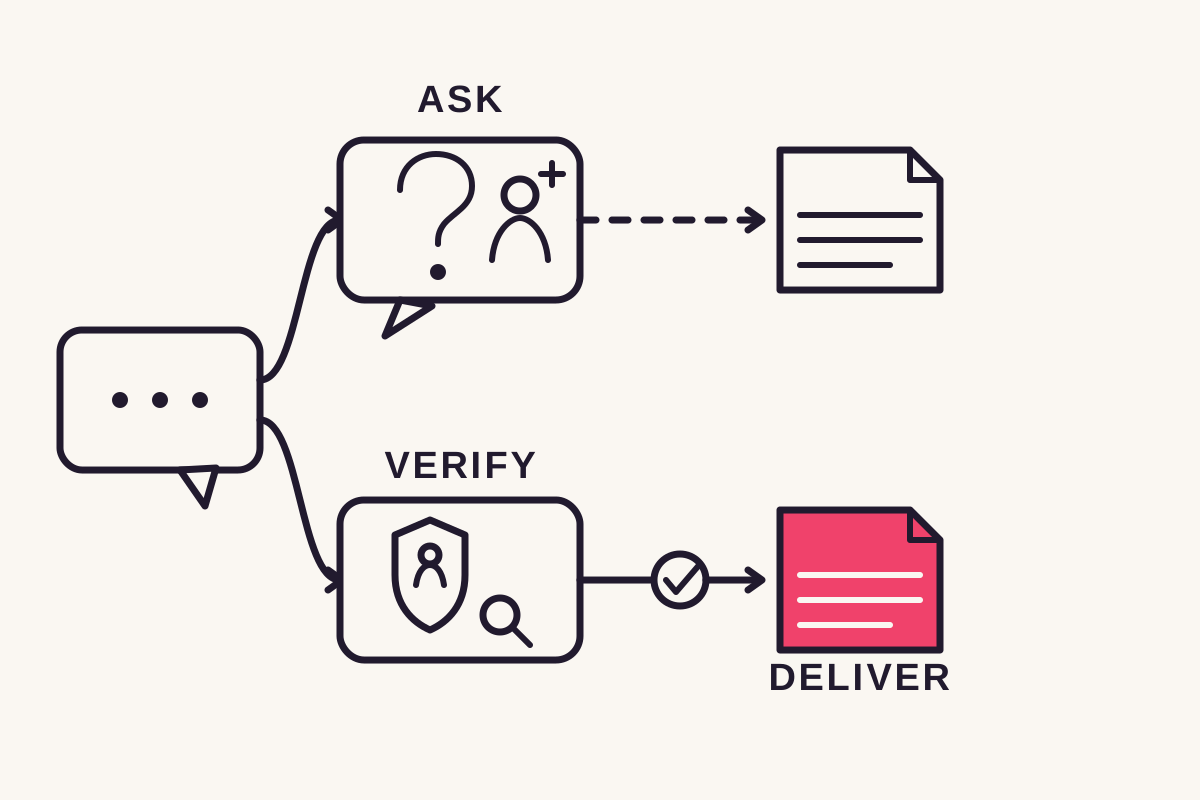
A follow gate sits between the trigger keyword comment and the DM that carries the lead magnet. With the gate off, the automation replies and sends the link right away. With it on, the sequence changes:
- Someone comments the trigger word on a post the campaign covers.
- The public reply posts as usual.
- ReplyMagnet checks Instagram's follow-status field for that commenter before writing the DM.
- An existing follower gets the file straight away, with no extra step.
- A non-follower gets a short prompt to follow, then a button to confirm.
- The check runs again when they tap confirm, and the file is sent once it passes.
A follow request and a follow gate are different things. ‘Follow for the next worksheet’ leaves the current download available. ‘Follow before you can open this worksheet’ adds a requirement, and the file genuinely does not move until the check passes. Enforcement is what makes the gate worth being careful about.
Start by reading your caption as a new visitor. If it promised a free resource without mentioning another step, adding a gate afterward changes the deal. You can try ReplyMagnet with the gate off; it is off by default, and direct delivery is a complete campaign, not an unfinished configuration.
What Meta's Spam Community Standard says
Meta's Spam Community Standard restricts requiring people to engage, including following an account, as the price of accessing content. A mandatory follow gate matches that pattern closely, so the policy is a reason to weigh the gate rather than assume it is fine.
The clause is not a niche one. It sits in the same policy family as like-farming and comment-baiting: the broad category of ‘do this to unlock that’ asks that trade content for engagement. Read Meta's Spam Community Standard directly before introducing any engagement condition.
In summary form, the patterns the policy describes include:
- Requiring a follow, like, share or comment before someone can view or receive promised content.
- Posting, commenting or messaging at very high frequency, including through automation.
- Misleading people about what they will receive after they engage.
None of that makes the gate a flat ban, and this page does not certify any campaign as compliant. Policy wording changes; the current text is the authority, not a summary written months ago. For the wider permissions and messaging context, see Instagram automation rules.
App approval is not approval of every offer
Meta App Review grants application permissions for the demonstrated integration. It does not approve every future caption, promotion or condition an account owner chooses.
ReplyMagnet's Meta App Review demonstrated the full flow a reviewer would see: a comment lands, a public reply posts, a DM goes out. That demonstration ran with the follow gate off, a deliberate choice made because of the Spam Community Standard above.
The two permissions the app requested, managing comments and managing messages, are both fully proven by reply-and-deliver alone. Nothing about the approval depended on also proving a mandatory follow, and the approval should not be presented as an endorsement of one.
That is the posture behind the toggle existing at all: an available mechanic, not one ReplyMagnet is trying to talk you into using. It ships off on every new campaign. Whether to switch it on carries a real policy trade-off, and it is worth weighing on purpose rather than assuming a serious campaign is supposed to have it.
What the API can and cannot verify
Instagram's is_user_follow_business field gives a yes-or-no answer on whether a commenter follows the account. Per-user likes are not exposed by the API at all, so no tool, ReplyMagnet included, can verify one.
When the gate is on, the check runs through the Instagram Graph API field is_user_follow_business, queried against the commenter's user ID. It comes back true or false. Nobody is typing ‘done, followed’ into a text box and being trusted; the answer comes from Instagram itself.
A follow can be verified this way, but a like cannot. Instagram's API does not expose who liked a given post at the per-user level, not to this tool and not to any third-party tool, whatever a landing page might claim. A ‘like gate’ runs on the honor system whether it says so or not.
The check also has limits on what it means. An existing follower may already satisfy it. A person who follows to obtain a file may still have little interest in later posts. Don't treat those two situations as identical evidence of audience quality; the check proves follow status, not interest, consent or future attention.
What a comment-to-DM tool can and cannot verify
Signal
Someone follows the account
- Verifiable through the API?
- Yes, via is_user_follow_business
- ReplyMagnet
- Checked before the prompt; existing followers skip the extra step
Signal
Someone liked a specific post
- Verifiable through the API?
- No, per-user likes are not exposed
- ReplyMagnet
- Not offered; there is no like gate
Signal
Someone typed ‘done’ in the DM
- Verifiable through the API?
- No, that is a claim, not a check
- ReplyMagnet
- Never used as proof of a follow
Signal
Someone commented the keyword
- Verifiable through the API?
- Yes, the comment itself is the event
- ReplyMagnet
- The trigger for every campaign
Signal
Someone gave an email or phone
- Verifiable through the API?
- Collected on the capture page, not an Instagram signal
- ReplyMagnet
- Optional email gate on every plan; phone capture on paid plans
Platform rules that apply with the gate on or off
The account must be a Business or Creator account, the tool must hold Meta App Review permissions, and a private reply to a feed comment has to go out within Instagram's seven-day window. A follow gate changes none of those limits.
A follow gate is one extra step inside a flow that already has rules of its own. The Business or Creator account requirement, the App Review permissions and the reply windows all still apply, and a gate adds waiting time to a clock that is already running.
The follow prompt is itself a DM, so it goes out inside the same window as any private reply. Instagram does not allow a DM to someone who has not commented on or messaged the account first, so the gate only reaches people who already asked for the file. Story replies and live comments use the shorter 24-hour messaging window.
Overflow behaves the same way on every plan. Once a workspace's engagement quota is used up, new requests wait in the overflow queue and are released as headroom returns. A queued request that passes the platform window expires rather than sending late; raising the allowance afterward does not revive it.
Consult Meta's private-reply documentation for the platform rule and ReplyMagnet billing help for queue behaviour.
Time limits ReplyMagnet works inside
Trigger
Comment on a feed post or Reel
- Window for the private reply
- Seven days from the comment
- ReplyMagnet
- Reply and follow prompt sent inside the window; queued requests past it expire
Trigger
Story reply
- Window for the private reply
- 24 hours, Instagram's standard messaging window
- ReplyMagnet
- Story campaigns skip the public reply and DM directly
Trigger
Live comment
- Window for the private reply
- Treated as 24 hours
- ReplyMagnet
- Delivery limited to 24 hours
Trigger
Tap on the follow-prompt button
- Window for the private reply
- Counts as a message from the commenter
- ReplyMagnet
- Follow check runs again, then the file is sent
Alternatives that keep the resource available
An ungated delivery paired with an optional follow ask in the DM copy carries none of the policy risk of a mandatory gate. The comment itself already shows the person wanted the file.
The comment is the opt-in. Someone typed the trigger word because they wanted the thing, which is a more specific signal than a follow: a follow says someone once decided the account was worth a tap, not that they want this file today. Leaning on the comment rather than gating a later step does not lose that signal.
Three ways to keep the ask without the enforcement:
- Soft ask in the DM. ‘Here’s the worksheet. I post a new worked example each week if you’d like to follow along.’ The link delivers regardless, and the invitation gives a reason to return.
- Ask in the public reply. The reply under the comment can mention that the account posts more of the same, while the DM carries the file with no condition attached.
- Use an email gate instead, if reach is the goal. A follow gate and an email gate solve different problems. An email gate builds a list you can reach again off the platform, and it does not touch Meta's Spam policy at all.
The email or phone step has to earn its place too. Neither should be collected merely because the field is available; the lead magnet delivery guide covers when a gate of that kind is warranted.
If you turn it on, how to reduce the risk
Keep the DM copy honest about why the follow matters, do not gate every resource behind it, and watch the volume of automated messages as you would for any campaign. None of that is a guarantee.
If the gate goes on anyway, a few things reduce the actual risk rather than just its appearance. Before enabling it, answer these questions:
- Did the caption explain the requirement, so a new visitor is not surprised by it?
- Does the prompt say why? ‘Follow so future guides land in your feed’ reads differently from a bare ‘follow to unlock’.
- Does following serve the reader's goal, or only yours?
- Is the gate reserved for one genuinely premium resource, with the account's other campaigns ungated?
- Is the campaign about to go unusually large? A sudden spike in automated replies and DMs draws scrutiny with or without a gate, so that is a moment for fewer extra asks, not more.
- Can someone get help if the check fails, for example because they followed from a second account?
- Have you re-read the applicable policies recently?
There is no conversion benchmark on this page, and this guide will not invent one. If you compare gated and ungated versions, keep the resource and audience context in mind rather than attributing every difference to the gate. Reading the policy again before flipping the toggle is worth the two minutes.
Common questions
Are follow gates against Instagram's rules?
They sit in a gray area rather than under a flat ban. Meta's Spam Community Standard restricts requiring engagement, including a follow, to access content, which is why a hard-gated lead magnet carries a real risk to weigh.
Can a tool verify that someone actually followed?
Yes. Instagram's is_user_follow_business field returns a real answer for a given user at check time, which is different from an honor-system checkbox the commenter fills in themselves.
Can any tool verify a like?
No. Instagram's API does not expose per-user like data to third-party tools, so nothing built on it, ReplyMagnet included, can confirm that a specific person liked a specific post.
Is the follow gate available on the free plan?
ReplyMagnet's plan catalogue includes the optional verified follow gate on every plan, and it is off by default on every new campaign. Availability does not establish whether a particular campaign use is appropriate.
Does a verified follow mean I can send unrelated promotions?
No. Follow status does not establish permission for unrelated messages or remove Instagram's messaging window restrictions.