Compare
ManyChat pricing: the real monthly cost, line by line
ManyChat's pricing page opens on the annual toggle, so the first number you see is not the one a monthly subscriber pays. Below is every real monthly rate, the active-contact unit behind it, and the overage a busy post adds, set next to ReplyMagnet's flat per-engagement plans.
Published by ReplyMagnet · Last updated
The short answer
ManyChat's real monthly prices are $0, $17, $39, $99 and $199, billed per active contact, with overage added automatically once a post pushes you past the cap. ReplyMagnet bills a flat $9 for 25,000 engagements or $29 for 100,000, includes email capture free, and queues overflow on every plan instead of billing it.
Start freeWhat the pricing page shows first
ManyChat's pricing page loads with the annual toggle selected while labelling every price per month, so the $29 on screen is $39 when billed monthly and the $69 is $99. Real monthly prices are $0, $17, $39, $99 and $199.
Open ManyChat's pricing page and the toggle sits on annual. The figures underneath still read per month, so the $14, $29, $69 and $139 you see first are what a year's commitment works out to, paid up front. Switch the toggle to monthly and the real rates appear: $17, $39, $99 and $199.
Every figure on this page is the monthly rate, read with the toggle set to monthly on 13 September 2026. Budget from that number and from your own contact count, not from the figure the page opens on.
Try the resource flow for 30 days with 1,000 engagements. No card required.
Start freeThe real monthly ladder
At real monthly rates ManyChat runs $0, $17, $39, $99 and $199, including 25, 250, 2,500, 7,500 and 25,000 active contacts. Overage past those caps costs $0.10, $0.05, $0.025 and $0.004 per extra contact on the four paid tiers.
Five tiers, one unit. Contacts are the active-contact cap for a billing month, seats are the team members a tier allows, and channels are how many of ManyChat's channels one account can run at the same time. The free tier also caps live automations at 4 in total, and comment-to-DM shares that cap.
ManyChat's real monthly prices and what each tier includes
Real monthly price
$0
- Active contacts
- 25
- Team seats
- 1
- Channels at once
- Any 2
- Overage per extra contact
- Not stated; 4 live automations in total
Real monthly price
$17
- Active contacts
- 250
- Team seats
- 2
- Channels at once
- Any 2
- Overage per extra contact
- $0.10
Real monthly price
$39
- Active contacts
- 2,500
- Team seats
- 3
- Channels at once
- 3
- Overage per extra contact
- $0.05
Real monthly price
$99
- Active contacts
- 7,500
- Team seats
- 5
- Channels at once
- All
- Overage per extra contact
- $0.025
Real monthly price
$199
- Active contacts
- 25,000
- Team seats
- 10
- Channels at once
- All
- Overage per extra contact
- $0.004
How active contacts are counted
An active contact is a real person ManyChat interacts with during a billing month, counted on any automated, AI, broadcast or inbox interaction rather than only a first comment. The count resets each period, so one busy post can fill a cap in days.
ManyChat prices by the active contact, and its own definition is broad: a real person you interact with during a monthly billing period. Any automated, AI, broadcast or inbox interaction counts someone in. A person who comments once and never returns still holds a billable place for the month they landed in.
That definition is why the meter climbs with reach rather than with effort. Every new commenter a post pulls in becomes an active contact for that month. The count resets each billing period rather than accumulating, but within one month a busy post fills it fast.
A follower count is not an estimate of active contacts, and neither is a historical address book. Use last month's invoice, or a recent post's comment count, as the working number.
What overage costs when a post does well
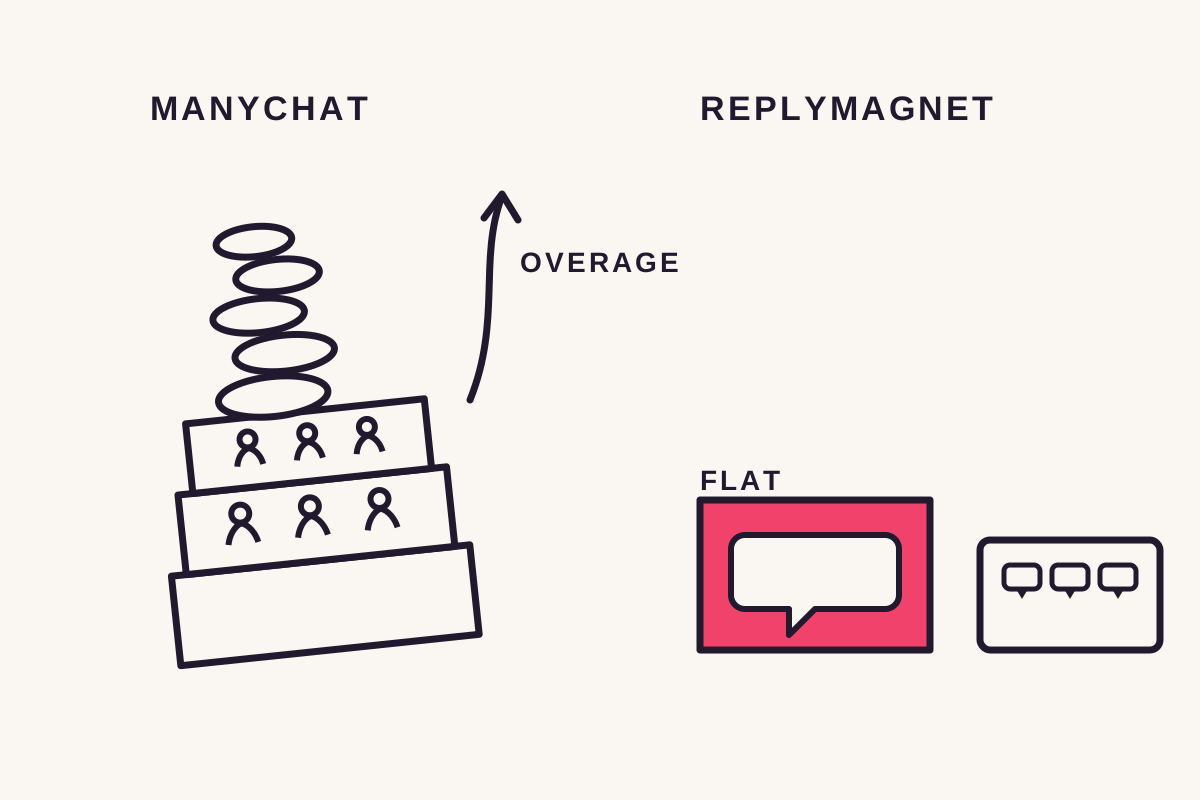
ManyChat keeps sending past a plan's contact cap and bills the overage automatically unless a threshold is set: 3,000 extra contacts on the $39 plan is about $150 in one month, on top of the base fee. ReplyMagnet queues requests past its allowance and bills nothing extra.
Overage math tells the story better than the headline price. The $39 plan carries 2,500 active contacts. A post that pulls 3,000 new commenters past that cap adds roughly $150 at ManyChat's published $0.05 rate, on top of the $39 base, that month. On the $17 plan the rate is $0.10 per extra contact.
None of that is hidden; it is ManyChat's documented model working as designed. The point is only that the number you budget from the plan page is not the number a viral month bills, and the gap is set by how many people you reach, not by how many replies you chose to send.
ManyChat lets you set an overage threshold instead. The reviewed documentation does not establish what automations do once that threshold blocks further overage, so do not assume requests are held or retried. Confirm the behaviour you would rely on before a launch.
ReplyMagnet handles the same moment by queueing. A comment beyond the plan's allowance waits, then releases oldest-first once the next cycle opens or the plan is upgraded, on every plan including the free one. One honest limit: a queued request that outlives Instagram's messaging window expires instead of delivering, so flat billing is not instant delivery.
Multiple Instagram accounts
ManyChat documents one Instagram account per ManyChat account, and a second Instagram account needs a separate ManyChat account; whether that second account is billed as its own plan is not stated. ReplyMagnet connects one account free, 3 from $29, 10 from $79.
ManyChat's help centre, updated 17 February 2026, is explicit: one Instagram account per ManyChat account. A second Instagram profile means a second ManyChat account. What the published material does not say is whether that second account carries its own subscription, so ask before buying for several brands.
Channels are capped separately from accounts. The $0 and $17 tiers run any 2 of ManyChat's channels at once, the $39 tier runs 3, and every channel opens from $99. So a feature list that names both Instagram and WhatsApp does not by itself tell you the price of using both alongside your other channels.
List every profile and channel in your proposed setup before pricing it. On ReplyMagnet the account limit is a plan line, not a second login: one connected account on the free and $9 plans, 3 from $29, 10 from $79, on Instagram or Facebook.
The smallest complete setup, compared
For a comment-to-DM campaign that also captures an email, ManyChat starts at $17 a month for 250 active contacts, with overage after that. ReplyMagnet runs it free with 1,000 engagements, and its $9 plan adds 25,000 engagements, CSV export, phone capture and Mailchimp or Kit sync.
Most people pricing ManyChat for Instagram want one thing: a keyword comment answered with a DM, the file or link delivered, and the email kept. Priced at the level where each feature actually works, the two setups look like this.
If the setup you really need spans WhatsApp, SMS and email from one inbox, or leans on HubSpot, Klaviyo or ActiveCampaign, ManyChat is the better fit; those channels and integrations are what its higher tiers buy. Count the rebuild before comparing subscriptions. For the migration decision itself, read the ManyChat alternative page.
A comment-to-DM campaign with email capture, priced where each feature works
Comment-to-DM trigger
- ManyChat
- $0, capped at 4 live automations
- ReplyMagnet
- $0, one live campaign
Email capture
- ManyChat
- From $17 a month
- ReplyMagnet
- $0
Included volume at that price
- ManyChat
- 250 active contacts a month
- ReplyMagnet
- 1,000 engagements a month
Past the cap
- ManyChat
- $0.10 per extra contact, billed automatically
- ReplyMagnet
- Queued, released when headroom opens
Phone capture
- ManyChat
- From $17
- ReplyMagnet
- From $9
Mailchimp or Kit sync
- ManyChat
- From $39
- ReplyMagnet
- From $9
Follow check
- ManyChat
- From $17; asks to follow, not documented as verifying
- ReplyMagnet
- API-verified through is_user_follow_business, optional, every plan
AI matching
- ManyChat
- From $39
- ReplyMagnet
- Every plan, 100 to 2,000 checks a day
Zapier, Make, webhooks
- ManyChat
- From $39
- ReplyMagnet
- Outbound webhooks from $29
Instagram accounts
- ManyChat
- One per ManyChat account
- ReplyMagnet
- 1 free, 3 from $29, 10 from $79
Platforms
- ManyChat
- Instagram, Messenger, TikTok, Telegram; WhatsApp, SMS, email from $39
- ReplyMagnet
- Instagram or Facebook
Partner status
- ManyChat
- Meta Business Partner, TikTok partner
- ReplyMagnet
- Meta App Review approved, August 2026
Switching
Your Instagram account and its comments live on Instagram's own API, not inside ManyChat, so a ReplyMagnet campaign with the same keyword on the same post starts answering new comments the moment it launches. Nothing needs exporting first.
Five steps, in this order:
- Read last month's ManyChat invoice for the real monthly charge and the active-contact count. That pair, not the figure the pricing page opens on, is the number to beat.
- Connect the Instagram account to ReplyMagnet and start the free plan; no card is needed. Create a campaign with the same keyword on the same post, attach the file or link, and turn on email capture.
- Test from a second Instagram account on a phone, including a test email if capture is on.
- Turn off the ManyChat automation for that keyword or post. Two live automations on one keyword race each other: the first reply wins, the second looks like spam.
- Run one full post cycle, then compare completed deliveries and usable lead records before changing the wording or adding steps.
Whatever sits in ManyChat today, contacts, tags and conversation history, stays there. Exporting from ManyChat is outside what we can speak to, since it is not our product. After launch, every answered comment lands in Leads straight away, with CSV export available from $9 a month.
Start free with one existing offer. The setup guide covers the controls.
Sources: ManyChat pricing, verified 13 September 2026, and ReplyMagnet's plan catalogue. Prices are monthly, not annual equivalents. Recheck the vendor's checkout before purchase.
Common questions
What does ManyChat really cost per month?
At the real month-to-month rate ManyChat is $0, $17, $39, $99 or $199. The lower figures its page shows first, such as $29 and $69, are annual-commitment rates still labelled per month.
Why does the pricing page show $29?
Because the page loads on the annual toggle. $29 is an annual-commitment rate displayed per month; the same plan is $39 when billed month to month, and committing for a year is what unlocks the lower figure.
What happens if I go over my contact limit?
ManyChat keeps sending and bills the overage automatically at a rate set by tier: $0.10 per extra contact on the $17 plan, $0.05 on the $39 plan, $0.025 at $99 and $0.004 at $199. A threshold can block overage instead, but what automations do once it does is not documented.
Does ManyChat still have a free plan?
Yes. The plan verified in September 2026 lists 25 active contacts, one seat, any two channels and four live automations in total. Email and phone collection are excluded, and there is no follower check.
How does ReplyMagnet's pricing differ?
ReplyMagnet bills per engagement, meaning a reply or DM actually sent, with no contact ledger: $0 for 1,000 engagements, $9 for 25,000, $29 for 100,000 and $79 for 400,000 a month. A comment past the allowance queues rather than billing overage.