Compare
A LinkToDM alternative with email capture and AI on the free plan
LinkToDM runs comment-to-DM free, then holds email collection, the follow ask and every AI feature until you pay $15 a month. If the campaign behind your post needs any of those three, the two free plans are not equivalent, and the $10 a month it advertises is the annual rate, billed as $126 a year.
Published by ReplyMagnet · Last updated
The short answer
LinkToDM's free tier excludes email collection, the follow ask and all AI, and no webhooks, Zapier, Make or named email-list sync were found in its published docs at any price. ReplyMagnet includes email capture, AI matching and an API-verified follow check at $0, queues overflow on every plan, and syncs leads to Mailchimp or Kit on every paid plan.
Start freeAt a glance
Comment-to-DM starts at $0 on all three tools, but LinkToDM holds email collection, the follow ask and AI until $15, and ManyChat unlocks them at $17 and $39. ReplyMagnet includes email capture, AI matching and a verified follow check on its $0 plan.
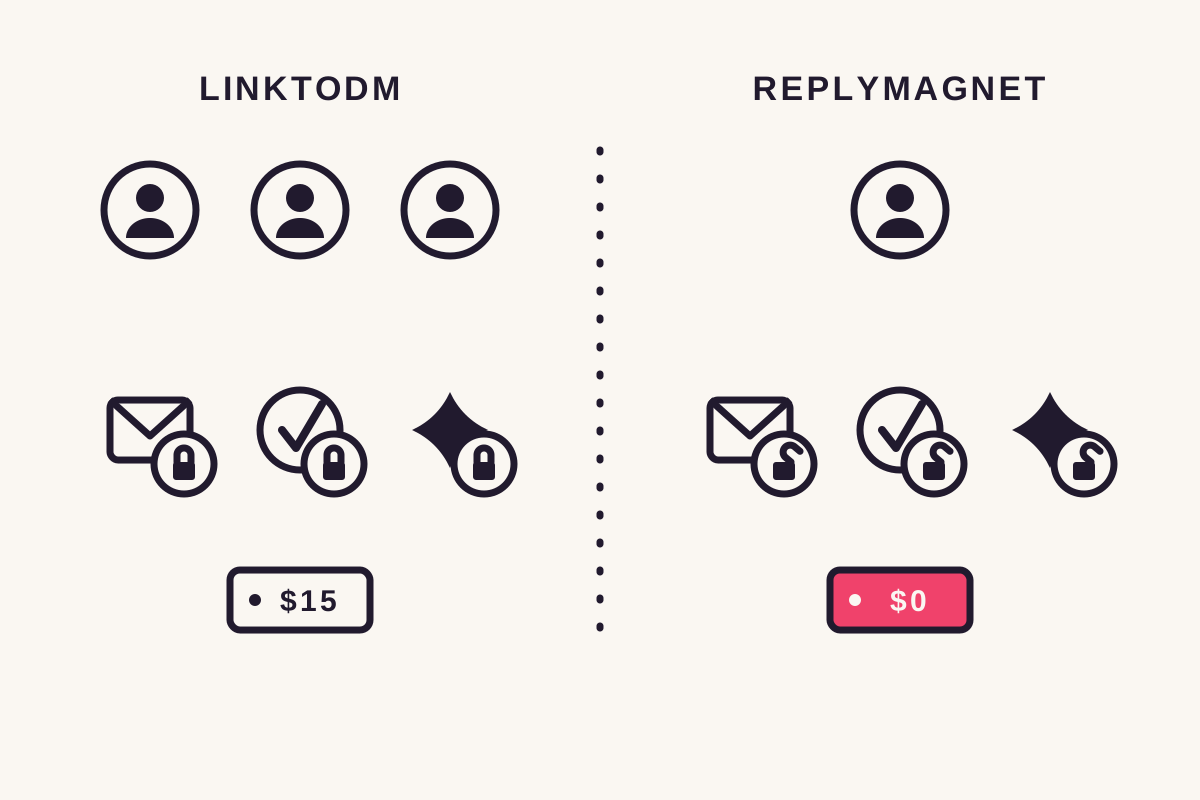
Three tools, eight rows that decide most comparisons. Every price is the real monthly rate, never an annual figure shown per month.
LinkToDM, ManyChat and ReplyMagnet at a glance
Comment auto-reply from
- LinkToDM
- $0, 3 accounts
- ManyChat
- $0, capped at 4 automations
- ReplyMagnet
- $0, one live campaign
Billed per
- LinkToDM
- Contacts: 2,000 free, unlimited from $15
- ManyChat
- Active contact, overage billed automatically
- ReplyMagnet
- Engagement actually sent
Over the monthly limit
- LinkToDM
- Send-rate queue documented; behaviour at the free 2,000-contact cap not stated
- ManyChat
- No queue; $0.10 per extra contact, $0.05 from $39
- ReplyMagnet
- Queues on every plan, including free
Email capture from
- LinkToDM
- $15 a month
- ManyChat
- $17 a month
- ReplyMagnet
- $0
Follow check
- LinkToDM
- Ask to follow from $15; documented as holding the DM until the person follows
- ManyChat
- Asks to follow from $17; not documented as verifying
- ReplyMagnet
- API-verified, and optional
AI matching
- LinkToDM
- From $15 a month; off on free
- ManyChat
- From $39 a month
- ReplyMagnet
- Every plan, 100 to 2,000 checks a day
Mailchimp or Kit sync
- LinkToDM
- Not found in published docs
- ManyChat
- From $39 a month
- ReplyMagnet
- From $9 a month
Instagram accounts
- LinkToDM
- 3 free, 8 from $25
- ManyChat
- One per ManyChat account
- ReplyMagnet
- 3 from $29, 10 from $79
Try the resource flow for 30 days with 1,000 engagements. No card required.
Start freeWhat LinkToDM does well
LinkToDM claims Meta Business Partner status, describes itself as SOC 2 ready and connects 3 Instagram accounts on its free tier. Contacts become unlimited from $15 a month, and team seats scale from 2 on the free tier to 5 at $15 and 10 at $25.
LinkToDM claims Meta Business Partner status and, in its own wording, describes itself as SOC 2 ready. Both are noted here as stated: the phrasing is LinkToDM's, and ready is not the same word as certified, so read it as the claim it is.
Where LinkToDM is generous is accounts, contacts and seats. Even the free tier connects 3 Instagram accounts with 2 team seats. At $15 a month contacts stop being counted and seats rise to 5; at $25 the plan covers 8 accounts and 10 seats, with API access.
Free means different things in the two products
LinkToDM's free tier connects 3 accounts and holds 2,000 contacts but, by its own feature table, excludes the scheduler, the Ask to follow action, follow-ups, email collection and all AI. ReplyMagnet's free plan carries one live campaign, 1,000 monthly engagements, email capture and AI matching.
LinkToDM counts contacts: 2,000 on the free tier, unlimited from $15. ReplyMagnet counts engagements, meaning a matched comment's reply and DM together. Those units are not interchangeable, so do not divide one vendor's price by the other vendor's unit and call the result a saving.
The free tiers are drawn in opposite directions. LinkToDM's gives you account slots and the basics, with email collection, the follow ask and every AI feature switched off. ReplyMagnet's runs one account and one live campaign at $0, with email capture, AI matching and the verified follow check all on.
A link to a public menu and a worksheet behind an email form are different offers. Decide which experience your caption promises first; that decision matters more than which tool has the longer feature list.
Monthly entry points for a lead-resource campaign
Requirement
Email collection
- LinkToDM
- From $15
- ReplyMagnet
- $0
Requirement
Phone collection
- LinkToDM
- Not found in published docs
- ReplyMagnet
- From $9
Requirement
Mailchimp or Kit connection
- LinkToDM
- Not found in published docs
- ReplyMagnet
- From $9
Requirement
Custom integration
- LinkToDM
- API access from $25; no webhooks, Zapier or Make found
- ReplyMagnet
- Outbound webhooks from $29
AI matching and the follow check: $15 against every plan
LinkToDM gates its AI intent trigger, AI auto reply and Ask to follow action to its $15 plan and switches all three off on the free tier. ReplyMagnet runs AI matching on every plan at 100 to 2,000 checks a day, and its optional follow check reads Instagram's is_user_follow_business field.
On LinkToDM the trigger and AI auto reply start at $15 a month, and every AI feature is off on the free tier. On ReplyMagnet AI matching starts at $0, with a daily allowance of 100 to 2,000 checks by plan. The same capability sits behind a $15 tier on one and on the free plan on the other.
Both tools can hold delivery behind a follow. LinkToDM's Ask to follow, from $15, is documented as keeping the DM back until the person follows (docs updated 27 August 2026). ReplyMagnet checks Instagram's own follow-status field before delivering, on every plan, and the check stays off unless you turn it on.
Pricing, compared properly
LinkToDM's $10 a month is the annual rate, billed as $126 a year; month to month the same plan is $15, and the next tier is $25. ReplyMagnet's real monthly prices are $0, $9, $29 and $79, billed per engagement sent, with overflow queued rather than billed.
The number LinkToDM shows first is not always the number a monthly subscriber pays. Its $10 a month entry price is the annual rate, billed $126 up front; month to month the plan is $15. The table below uses $15 and $25, the month-to-month figures.
ReplyMagnet bills one unit: an engagement, meaning a reply or DM actually sent. Five comments from one person are five engagements, and so are five people commenting once. There is no contact ledger, no seat count and no overage line.
The paid ladder is $9 for 25,000 engagements, $29 for 100,000 and $79 for 400,000, with the free plan at 1,000. Every plan queues overflow: a request past the monthly allowance waits, then releases oldest-first once headroom opens or the plan is upgraded. Plainly: queued requests that outlive Instagram's messaging window expire instead of arriving late, so a flat bill is not the same as instant delivery.
Real monthly prices and what they include
Free
- LinkToDM
- 3 accounts, 2,000 contacts, 2 seats; no email collection, follow ask or AI
- ReplyMagnet
- 1,000 engagements, 1 live campaign, email capture, plus a 30-day trial
From $9
- LinkToDM
- No plan at this price
- ReplyMagnet
- 25,000 engagements, CSV export, phone capture, Mailchimp or Kit sync
From $15
- LinkToDM
- Unlimited contacts, 3 accounts, 5 seats, email collection, Ask to follow, AI intent trigger, scheduler, follow-ups
- ReplyMagnet
- No plan at this price
From $25
- LinkToDM
- 8 accounts, 10 seats, API access
- ReplyMagnet
- No plan at this price
From $29
- LinkToDM
- No plan at this price
- ReplyMagnet
- 100,000 engagements, 3 accounts, webhooks, AI-written replies
From $79
- LinkToDM
- No plan at this price
- ReplyMagnet
- 400,000 engagements, 10 accounts
Past the cap
- LinkToDM
- Contacts unlimited from $15; behaviour at the free 2,000-contact cap not stated
- ReplyMagnet
- Queued, released when headroom opens
Feature by feature
The two tools overlap on the comment-to-DM mechanic and separate on where email capture, AI and the follow ask start, on the billing unit, and on what was found for integrations. Every price below is the point at which the feature actually works, at the real monthly rate.
Figures come from each tool's own published pages, LinkToDM checked on 29 August 2026, not a sales call. Where LinkToDM's material does not state something, the table says so rather than reading silence as absence.
LinkToDM against ReplyMagnet, feature by feature
Comment auto-reply from
- LinkToDM
- $0, 3 accounts
- ReplyMagnet
- $0, one live campaign
Free plan
- LinkToDM
- 3 accounts, 2,000 contacts, 2 seats; no scheduler, Ask to follow, follow-ups, email collection or AI
- ReplyMagnet
- 1,000 engagements, email capture and AI matching included
Platforms
- LinkToDM
- ReplyMagnet
- Instagram or Facebook
Billed per
- LinkToDM
- Contacts: 2,000 free, unlimited from $15 with no fair-use cap found
- ReplyMagnet
- Engagement actually sent
Instagram accounts
- LinkToDM
- 3 free and at $15, 8 from $25
- ReplyMagnet
- 1 free, 3 from $29, 10 from $79
Overflow
- LinkToDM
- Per-account send-rate queue documented; behaviour at the free contact cap not stated
- ReplyMagnet
- Queues on every plan, including free
Follow check
- LinkToDM
- Ask to follow from $15; documented as holding the DM until the person follows
- ReplyMagnet
- API-verified through is_user_follow_business, optional
AI matching
- LinkToDM
- AI intent trigger and AI auto reply from $15; off on free
- ReplyMagnet
- Every plan, 100 to 2,000 checks a day
Email and phone capture
- LinkToDM
- Email collection from $15; phone not found in published docs
- ReplyMagnet
- Email free; phone from $9
Mailchimp or Kit sync
- LinkToDM
- Not found in published docs
- ReplyMagnet
- From $9 a month
Zapier, Make, webhooks
- LinkToDM
- Not found in published docs; API access from $25
- ReplyMagnet
- From $29 a month
White-label pages
- LinkToDM
- Not found in published docs
- ReplyMagnet
- From $29 a month
Team seats
- LinkToDM
- 2 free, 5 from $15, 10 from $25
- ReplyMagnet
- Not a per-seat model; plans scale by engagements and accounts
Partner status
- LinkToDM
- Claims Meta Business Partner status; describes itself as SOC 2 ready
- ReplyMagnet
- Meta App Review approved, August 2026
When LinkToDM's ladder is the better fit
If connected-account count and named team seats per dollar decide the purchase, LinkToDM is the better fit: 3 accounts free, 8 accounts and 10 seats at $25, and contacts uncounted from $15. ReplyMagnet is not built as a per-seat product.
LinkToDM has two honest advantages. The first is accounts and seats for the money: 3 accounts even on the free tier, 5 seats at $15, and 8 accounts with 10 seats at $25. ReplyMagnet's $29 plan (3 accounts) and $79 plan (10 accounts) count no seats at all.
The second is unlimited contacts. From $15 up, LinkToDM stops counting contacts, so a large existing audience does not push you up a tier. ReplyMagnet bills per engagement sent rather than per contact, a different shape; if an uncounted-contact ceiling is specifically what you want, LinkToDM states it plainly.
Switching
Instagram's API holds your account and its comments, not LinkToDM, so a ReplyMagnet campaign with the same keyword on the same post starts answering new comments the moment it launches. No export step is needed.
Five steps, in this order:
- Keep the LinkToDM automation saved. Connect the Instagram account to ReplyMagnet and start the free plan; no card is needed.
- Recreate the campaign: same trigger keyword, same post, the file or link attached, and email capture on if the address is part of the offer.
- Test from another Instagram account: open the DM on a phone, submit a test address, and confirm it reached Mailchimp or Kit if connected.
- Turn off the LinkToDM automation for that keyword or post before inviting real requests. If the two overlap, the earlier reply wins and the later one sits under it as a duplicate.
- Launch, then compare completed deliveries and usable lead records before changing the wording or adding steps.
Whatever sits in LinkToDM today, contacts and conversation history, stays there. Exporting from LinkToDM is outside what we can speak to, since it is not our product. Every answered comment after launch is recorded as its own lead immediately; CSV export starts at $9 a month.
Start free with one existing offer. The setup guide covers the controls.
Sources: LinkToDM, checked 29 August 2026; ReplyMagnet plans. Published by ReplyMagnet; no independent performance benchmark is claimed.
Common questions
What does LinkToDM's free plan exclude?
By LinkToDM's own feature table, the free tier connects 3 accounts and 2,000 contacts but leaves out the scheduler, the Ask to follow action, follow-ups, email collection and every AI feature. ReplyMagnet's free plan includes email capture, AI matching and the API-verified follow check on 1,000 engagements a month.
What is the real monthly price of LinkToDM?
LinkToDM's entry paid plan is $15 a month when billed monthly. The $10 figure is the annual rate shown per month, billed as $126 a year. The next tier is $25 a month and lifts the plan to 8 accounts and 10 seats.
Is Ask to follow the same as ReplyMagnet's verified follow check?
Both hold delivery until the person follows. LinkToDM's Ask to follow, from $15, is documented as keeping the DM back until the follow happens. ReplyMagnet's check reads Instagram's own is_user_follow_business field on every plan, and it is optional: a campaign runs without it unless you turn it on.
Which unlocks AI matching more cheaply?
ReplyMagnet, at $0: AI matching runs on the free plan, with a published allowance of 100 to 2,000 checks a day by tier. LinkToDM gates its AI intent trigger to its $15 plan and switches AI off entirely on the free tier, so the cheapest AI matching there costs $15 a month.
Is LinkToDM's queue the same as ReplyMagnet's overflow queue?
LinkToDM documents a queue for per-account sending limits, so nothing drops when Meta's rate limit is hit. Its behaviour at the free 2,000-contact cap was not established. ReplyMagnet queues requests when a plan's monthly allowance is used up, on every plan including free.