Guides
How to audit overlapping Instagram comment automations
A comment can fit more than one live rule: two connected tools, an all-post campaign, a post-specific offer or several keywords may all be eligible. Audit the possible routes before promotion so one request has one intended owner, reply and resource.
Published by ReplyMagnet · Last updated
Why can one comment match more than one automation?
Overlap happens when more than one connected tool or campaign can see the same account, post and comment text. Eligibility does not tell you which rule will run, so verify the intended route instead of assuming a universal winner.
A broad all-post campaign can overlap with every post-specific offer on the account. An any-comment rule can overlap with a keyword rule. Two keyword campaigns can accept the same word, and an old provider can remain connected during a migration. Those are four separate dimensions: provider, account, post scope and text rule.
Ask which configurations are eligible to see the event, then which one is actually chosen. A product may prioritize or deduplicate candidates, but the answer varies by configuration and provider. Manychat documents its own priority behavior when several post-comment triggers are active. Kajabi warns that third-party messaging integrations can interfere and that Meta Inbox and Kajabi automations can both trigger. These are product-specific examples, not universal Instagram behavior.
Meta's private-reply documentation defines the initial reply after a comment and its limits; it does not choose between third-party campaign definitions.

Generated editorial illustration of campaign routing choices. It is not product UI, customer evidence or a claim about a provider's precedence.
Build one inventory before changing settings
List every active or possibly active campaign across all connected tools. Record scope, matching, promised resource and ownership in one place, and mark unknown facts as unknown.
Include Meta Business Suite, the tool you are leaving, the tool you are testing and any workspace a previous agency may still control. Check the actual professional account and campaign status instead of relying on an old caption.
Add one row per live, scheduled, paused-but-relevant or uncertain campaign. If a provider names a setting differently, describe the observed setting rather than forcing a false equivalence.
Open each promised destination as a visitor. Two GUIDE rows can still conflict if one sends an old PDF. Record the exact replies, destination and resource version, then name a person who can change or retire the rule. Mark unknown facts as unknown so the team knows what requires documentation or controlled testing.
Copyable inventory for every campaign that could see the comment
Field
Tool / workspace
- Record
- Provider and workspace name
- Why it matters
- Finds cross-tool overlap
Field
Instagram account
- Record
- Exact professional account
- Why it matters
- Prevents auditing the wrong profile
Field
Campaign status
- Record
- Live, scheduled, paused or unknown
- Why it matters
- Shows what may respond now or later
Field
Post scope
- Record
- All posts or named posts
- Why it matters
- Exposes broad-versus-specific overlap
Field
Text rule
- Record
- Any comment, exact, contains or provider-specific
- Why it matters
- Shows which wording can qualify
Field
Keywords / phrases
- Record
- Literal configured values
- Why it matters
- Finds reused or ambiguous requests
Field
Promise and replies
- Record
- Resource, public reply and DM destination
- Why it matters
- Reveals duplicate or conflicting outcomes
Field
Owner and dates
- Record
- Owner, created date, last verified date
- Why it matters
- Makes cleanup accountable
Field
Evidence
- Record
- Configuration reference and test record
- Why it matters
- Separates assumption from observation
Draw the overlap map
Trace each comment through connected providers, post-scope filters and text rules, then compare the surviving candidates. The map should end with one intended resource, not several competing promises.
Draw one branch for every provider that could receive the event. Inside each branch, filter by post scope before listing keyword and any-comment candidates. Mark a collision wherever surviving candidates promise different replies or resources.
This is a planning model, not a universal execution order. Equivalent text: comment → connected providers → matching post scopes → keyword or broad candidates → collision review → one intended resource.
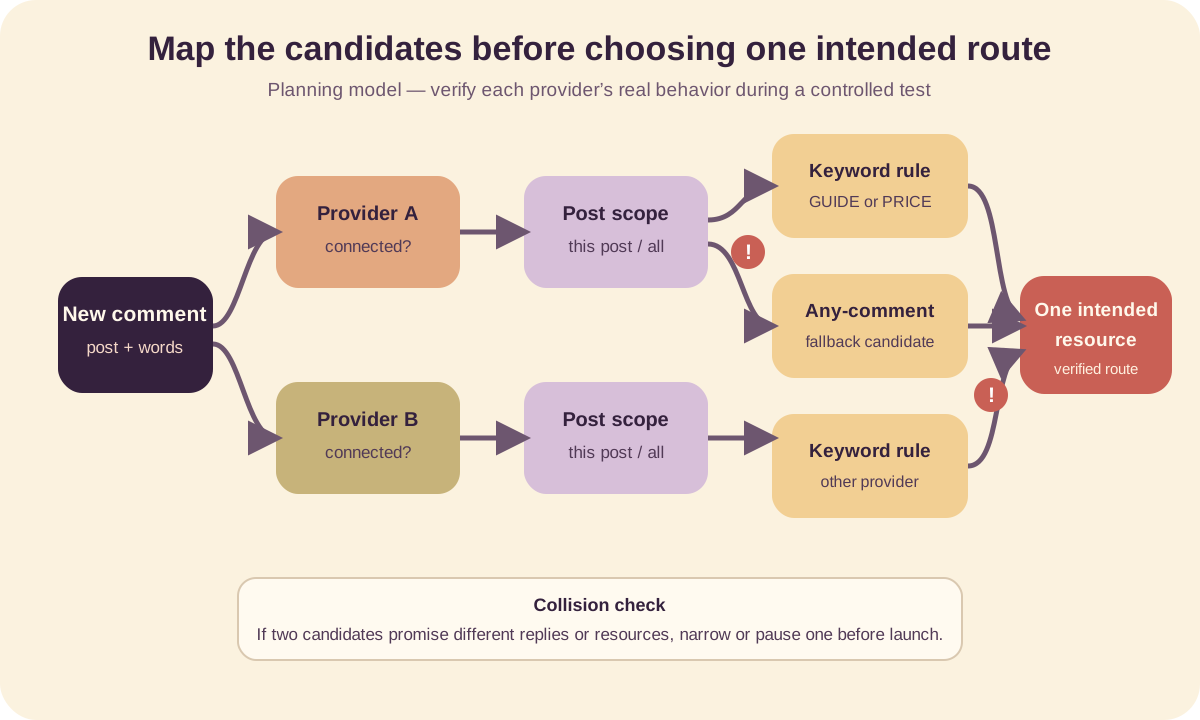
Original planning diagram. It describes an audit method, not Instagram's internal routing or a ReplyMagnet product screen.
If the map has two endings, narrow or pause a rule. The migration guide provides a fuller cutover and rollback record when the overlap comes from changing tools.
Classify each overlap before deciding what to change
Classify an overlap as an intentional fallback, duplicate promise, conflicting promise or unknown cross-tool behavior. The category tells you whether to document, consolidate, block or isolate the route.
Intentional fallback: a specific GUIDE rule should handle a clear request while an any-comment rule handles ordinary comments. Keep it only if the provider's documented and tested behavior makes that fallback unambiguous.
Duplicate promise: two rules send the same current resource and use equivalent copy. Consolidate ownership where practical. Even if the reader sees only one response today, duplicate configuration creates two places that can drift later.
Conflicting promise: the same comment could receive different resources, requirements or replies. Block promotion until one rule is narrowed, paused or given a distinct requested word. A comment containing both GUIDE and PRICE is a conflict if both campaigns can accept it and the team has not chosen a winner.
Unknown cross-tool behavior: two providers remain connected and their current documentation or your test does not establish a safe winner. Isolate one tool during the controlled test or cutover. Do not learn the answer on a live promotion.
Avoid saying duplicate sends are inevitable. A provider may choose one candidate or suppress a repeat. The audit establishes the intended behavior and the evidence you still need, not a prediction that every eligible rule will fire.
Use an eight-case acceptance matrix
Test exact, contains, ordinary, wrong-post, dual-keyword and paused-campaign cases. Define the intended campaign and resource before testing, then record the actual activity and pass or fail.
The fictional setup has an all-post GUIDE campaign using a case-insensitive whole-word contains rule, a target-post PRICE campaign using exact matching and a target-post any-comment fallback. Those matching semantics belong to this example; replace them with the current behavior documented by your provider. GUIDE owns GUIDE requests, PRICE owns an exact PRICE request on the target post, and ordinary comments on that post use the fallback.
Row six contains both words. Under the current exact PRICE rule, GUIDE is intended; if PRICE later changes to contains, define one winner or remove the ambiguity before launch. Use a fresh controlled interaction for each row and record the timestamp, campaign identity and activity evidence.
Fictional eight-case collision matrix. Fill Actual and Pass/fail during the controlled test
Case
1. Target post: GUIDE
- Intended route and reason
- GUIDE: exact word is included
- Expected reply / resource
- GUIDE reply and guide resource
- Actual / result
- ___ / ___
Case
2. Target post: please send the GUIDE
- Intended route and reason
- GUIDE: contains mode accepts whole word
- Expected reply / resource
- GUIDE reply and guide resource
- Actual / result
- ___ / ___
Case
3. Target post: Great post
- Intended route and reason
- Any-comment: no configured keyword
- Expected reply / resource
- Fallback reply and general resource
- Actual / result
- ___ / ___
Case
4. Target post: PRICE
- Intended route and reason
- PRICE: exact match on in-scope post
- Expected reply / resource
- PRICE reply and price resource
- Actual / result
- ___ / ___
Case
5. Different post: PRICE
- Intended route and reason
- No campaign: PRICE and fallback are target-post scoped; GUIDE does not match
- Expected reply / resource
- No automated reply or resource
- Actual / result
- ___ / ___
Case
6. Target post: GUIDE and PRICE
- Intended route and reason
- GUIDE under current exact PRICE rule; redefine before PRICE becomes contains
- Expected reply / resource
- One pre-agreed reply and resource
- Actual / result
- ___ / ___
Case
7. Target post: GUIDEBOOK
- Intended route and reason
- Any-comment: this example's whole-word GUIDE rule does not match
- Expected reply / resource
- Fallback reply and general resource
- Actual / result
- ___ / ___
Case
8. Fresh controlled comment after GUIDE is paused
- Intended route and reason
- Remaining eligible rule documented before test
- Expected reply / resource
- Only that rule's reply and resource
- Actual / result
- ___ / ___
Fix scope before rewriting copy
Remove the routing ambiguity first: pause obsolete responders, narrow broad scopes, separate keywords and consolidate duplicates. Then align the caption, replies and destination with the surviving rule.
Pause obsolete responders, narrow all-post scope where the offer is specific, replace accidental broad keywords and remove duplicate rules. Give simultaneous offers distinct requested words.
Only then revise the caption, public reply, DM and destination as one promise. Copy cannot stop another eligible campaign, and changing the editor keyword without changing the caption creates a new mismatch. Use the keyword guide to choose a distinct word.
Preserve the before-state without access tokens or unnecessary customer data. Record who approved the change and when temporary rules should expire.
Test one variable at a time and read the activity trail
Use a quiet post and an account you control or a consenting tester. Change one rule, create a fresh eligible interaction and confirm which campaign matched before diagnosing DM delivery.
Record the comment, post, tester, timestamp and timezone. Test the inventory as found, change one variable, then repeat the affected row with a fresh interaction. Changing scope and matching together hides which correction worked.
Inspect the activity record for the chosen campaign. An inbox DM may not identify which configuration produced it; the correct campaign can also match while delivery fails later. Keep routing acceptance separate from delivery diagnosis.
After a correct match with no DM, use the troubleshooting guide and automation rules guide. Keep private data out of evidence; a campaign ID, fictional test wording and timestamp are usually enough.
Protect future campaigns with a small release rule
Require an overlap review for all-post scope, any-comment rules, reused keywords and second-provider connections. Record an owner, promised resource and review date for every exception.
Ask four release questions: Does this use all posts? Does it accept any comment? Does another live campaign use the keyword? Is another provider connected? A yes requires a named reviewer and a matrix row proving the boundary.
Give temporary campaigns a review date. Confirm the post still makes the promise, the destination is current and the rule still has an owner. Agencies can record changes with the client-approval guide.
Run the matrix again after connecting a provider, adding a broad campaign or changing match mode. A prior pass covers only the tested configuration.
What should a ReplyMagnet user do with this audit?
Use the inventory and matrix to design one clearly scoped campaign, then verify its real behavior in the current product. Do not rely on an unpublished or assumed precedence rule.
ReplyMagnet lets you create a campaign around an account, post scope, matching rule, replies and resource. The campaign documentation explains the available controls. Use those controls to express the boundary you already decided: one offer, one intended request and one tested destination.
This guide does not claim that any recently developed precedence change is deployed, and it does not promise how another provider resolves overlapping rules. Product behavior must be verified against the current live configuration. Clear scope remains easier to maintain than intentionally creating several eligible candidates and depending on their age or an undocumented tie-break.
Before promoting the post, audit every campaign that can see it and run the eight-case matrix. If you want one place to build and inspect a clearly scoped Instagram campaign, create a ReplyMagnet account and start with one controlled offer.
Common questions
Can Instagram decide which of my automations runs?
Instagram supplies the eligible comment event under its platform rules, while campaign selection can depend on each connected provider's configuration. Verify the current behavior instead of assuming one universal winner.
Should I keep an any-comment campaign as a fallback?
Only when it has a clear purpose and controlled tests show that specific requests still reach their intended campaigns. Document its scope, owner, resource and review date.
Can I use the same keyword for two offers?
Avoid it when the offers promise different replies or resources. Use distinct requested words or nonoverlapping post scope so the intended route is clear and maintainable.
What if Meta Business Suite and another tool are both connected?
Include both in the inventory, inspect their current settings and isolate the controlled test where behavior is unknown. Do not test an unresolved cross-tool collision during a live promotion.
Why did the correct campaign match but no DM arrive?
Routing and delivery are separate checks. Record the match, then investigate account connection, platform eligibility, timing, permissions and the destination with the troubleshooting and automation-rules guides.
Keep reading
- Instagram comment-to-DM automation: setup and testing
- Instagram comment-to-DM not working? A troubleshooting guide
- Move Instagram automations to a new tool without losing the campaign plan
- Instagram trigger keyword ideas that won't confuse your campaigns
- Create a ReplyMagnet campaign: posts, triggers and delivery