Guides
Build an FAQ people can actually find answers in
An FAQ earns its place when it helps someone finish a task without interpreting your organization. Start with the question people ask, give the useful answer immediately and make it clear when that answer does not apply.
Published by ReplyMagnet · Last updated
Which questions belong in a stable resource?
Put repeatable, broadly applicable answers in the FAQ. Keep personal cases and decisions that need investigation with the person responsible for handling them.

A question can be frequent without having one safe answer. “Where is the venue?” usually has a stable answer for a particular event. “Can you accommodate my specific requirement?” may need a conversation. An FAQ can explain how to ask that second question without pretending to decide the individual case.
Collect candidate questions from your own comments, enquiries and support notes. Remove identifying details and preserve the substance of the question. The comment research guide covers how to turn those observations into a research backlog. Here, the work begins after you have chosen the questions that need maintained answers.
For each candidate, ask whether someone owns the answer and whether it is true for the audience reaching this page. If the answer depends on a date, product or location, make that scope visible. A general “we open at nine” answer is risky when different events have different arrival times.
Exclude promotional questions nobody asked, such as “Why are we the best choice?” They consume the attention people need for practical information. Explain benefits on the offer page and let the FAQ solve uncertainty.
Do not turn every question into a separate section. Two phrasings may represent the same task. “Do I need equipment?” and “Should I bring tools?” might share an answer; “Can I bring my own equipment?” may introduce a different exception. Combine based on the decision, not simply on similar words.
Six answers for one fictional workshop
A useful answer includes the direct response, any important exception and a way to verify or resolve uncertainty. The fictional example below shows those fields together.
Imagine a business planning a beginner printmaking workshop. The six entries below are invented editorial examples. The event, arrangements and answers are not real offers, and should not be copied as your own policies.
The public page would present the question and answer naturally. The source column is for the team maintaining it. It identifies the record or person that must confirm the wording before publication.
Give the page a title that names the event and date once those facts are confirmed. A reader arriving from an older Instagram post should be able to tell which event the FAQ describes. “Workshop questions” is not enough if several workshops are promoted at the same time.
The examples also show that an exception need not be lengthy. Its purpose is to stop the wrong assumption at the moment it might form. Where the business does not yet know the answer, say how the reader can get a confirmed answer instead of filling the gap with optimistic language.
Fictional beginner workshop FAQ. All arrangements require verification for a real event.
Question
Do I need experience?
- Answer and exception
- No previous printmaking experience is expected. This session teaches the introductory process; it is not an advanced class.
- Internal source
- Approved course outline
Question
What should I bring?
- Answer and exception
- The workshop supplies the listed printing materials. Wear clothes suitable for practical work; personal protective arrangements must match the actual activity.
- Internal source
- Facilitator materials list
Question
When should I arrive?
- Answer and exception
- Use the arrival time on your registration confirmation. If that differs from a social post, contact the organizer before travelling.
- Internal source
- Registration record and event schedule
Question
Can I attend with a friend?
- Answer and exception
- Each attendee needs their own confirmed place. A message asking about the event does not reserve a place.
- Internal source
- Registration process owner
Question
How do I ask about access?
- Answer and exception
- Contact the organizer through the event page with the arrangements you need checked. Do not assume every venue has the same facilities.
- Internal source
- Venue information and named contact
Question
What if my plans change?
- Answer and exception
- Read the cancellation terms shown before registering, then contact the organizer about your booking. The FAQ does not replace the agreed booking terms.
- Internal source
- Current registration terms
Put the answer before the explanation
Lead with the fact or action the reader needs. Add context only when it changes the decision, and use link text that describes the destination.
Consider the question about attending with a friend. An answer that begins with the history of the workshop forces the reader to search for the rule. “Each attendee needs their own confirmed place” resolves the main uncertainty immediately. The second sentence prevents an information request from being mistaken for a reservation.
Avoid beginning every answer with a friendly preamble. Warmth can come from clear, considerate wording. Repeated phrases like “Great question!” make a resource longer without helping anyone act.
When the answer lives elsewhere, summarize the relevant action before linking. “See our website” sends the person back into a search. “Read the cancellation terms on the registration page” names both the information and its location. If the terms vary by event, link to the applicable event rather than to a general homepage.
W3C’s writing guidance recommends clear instructions, meaningful headings and descriptive link text. Those choices are especially valuable in a resource people scan while doing something else.
Avoid absolute words unless the source warrants them. “Always,” “everyone” and “guaranteed” can hide exceptions. If a materials policy varies for private sessions, put that limitation beside the answer, not in a distant note at the bottom.
Keep an unresolved answer honest. “We are confirming the venue arrangement; contact us before booking if this affects your decision” is more useful than an unsupported assurance. Give the internal owner a task to replace that temporary wording when the information is confirmed.
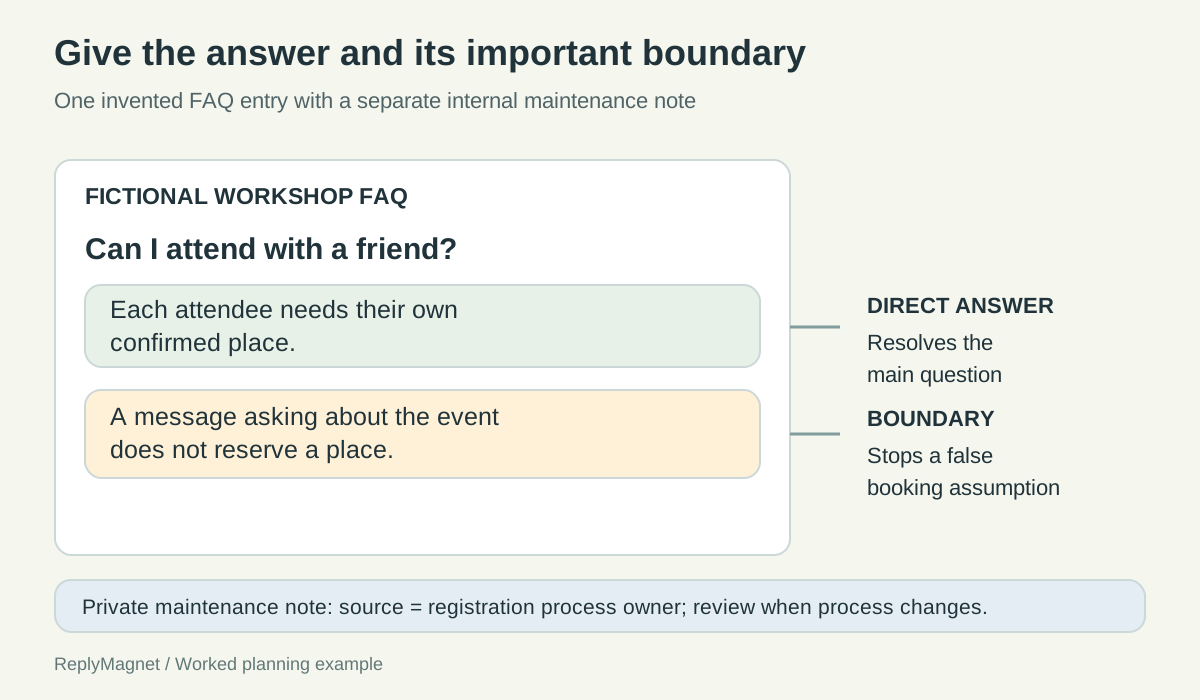
Original annotated FAQ panel. The workshop arrangements are fictional, and the private source note illustrates maintenance rather than a verified event policy.
Arrange the page around the visitor’s journey
Group answers by what the reader is trying to do: decide, prepare or change a plan. Department names and internal process labels rarely help them find information.
For the workshop, three groups are enough: “Before registering,” “Before arriving” and “If your plans change.” The grouping reflects the reader’s situation. “Operations,” “Customer success” and “Policy” reflect your organization instead.
Place a short list of linked questions at the top if the page is long enough to require navigation. Use real headings for the sections and maintain a sensible heading order. The W3C page structure tutorial explains how headings and regions help people understand and navigate a page.
Do not hide an important restriction solely in a collapsed answer if it belongs in the main offer. A requirement that determines whether someone can attend should appear where they decide to register. The FAQ can explain it further, but should not be the only place it exists.
Use the language in the enquiries as a guide to labels. If people ask “Where do I park?”, a heading called “Arrival logistics” may be less obvious than “Getting to the venue.” You can still combine public transport and parking underneath that heading.
For a product range, the same principle might produce groups called “Choose a size,” “Delivery” and “After your order.” The ecommerce resource guide provides context for choosing buyer resources; this FAQ structure is for making their answers findable.
Avoid duplicating full answers across several pages when one maintained source can serve them. A short summary may belong in a caption or reply, but note where the complete current answer lives. Otherwise a changed date can leave several plausible versions circulating.
Test whether someone finds the answer without coaching
Give a reader a realistic task and observe where they look, what they understand and what they do next. A successful search matters more than their opinion of the design.
Ask someone unfamiliar with the draft to imagine attending the workshop with a friend. Let them use the resource to work out what they need to do. Do not tell them which heading to open or repeat the wording of the correct answer in your prompt.
Record three things separately: the route they took, the answer they understood and the action they expected to take. They may find the correct paragraph but still conclude that one registration covers two people. That is a comprehension problem, not a navigation success.
A second task could ask them to check what happens if their plans change. If they stop at “contact us” without realizing that the registration terms apply, revise the answer or link label. Ask neutral follow-ups such as “What would you do next?” rather than “Was that clear?”
This is an informal usability exercise, not proof that every visitor will understand the page. GOV.UK’s moderated testing guidance describes observing people attempting realistic tasks. Apply that principle at a scale your team can support.
Keep a small observation sheet: task, place first visited, misunderstood wording, expected next action and proposed change. Separate observations from your interpretation. After revising, test the troublesome task again with someone who has not already learned the answer from the first exercise.
If a question repeatedly leads to personal circumstances, improve the route to a human rather than adding a huge list of speculative exceptions. The goal is a reliable boundary, not an answer for every possible conversation.
Give each answer a reason to be reviewed
Assign an owner and a change trigger to every answer. Review after relevant changes, even if the page’s scheduled review date has not arrived.
A date on the footer does not maintain the information. The venue owner must know that a venue change affects arrival and access answers. The registration owner must know that a change to booking terms affects the cancellation link.
Keep a private register with the question, current answer location, source, owner and review trigger. Useful triggers include a new event date, a changed destination, a revised materials list or a recurring enquiry that contradicts the published answer. Mark unanswered questions as unresolved rather than quietly treating old wording as current.
When sharing the FAQ through Instagram, use a maintained destination and describe what it contains. Automation can deliver a resource link; it should not be described as understanding and resolving every incoming question. For delivery mechanics, use the comment-to-DM guide.
Finally, read the page from an old post as well as from the newest campaign. If the event has ended, the first visible information should make that clear and direct readers appropriately. A resource is useful only when its answer still belongs to the situation in which someone finds it.