Guides
The next useful article may be hiding in your comments
A question about getting clay home is easy to miss between heart emojis and requests for class dates. It may also be the question your next workshop guide needs to answer. Here is a careful way to find those gaps and decide which deserve a full article.
Published by ReplyMagnet · Last updated
The short answer
Read a bounded set of relevant comments, record the actual questions, and group them by the decision people need to make. Use those themes to commission useful content while keeping the limits of your sample visible.
Start freeStart with a decision your content needs to support
Instagram comments can reveal unanswered questions and useful language. They cannot, by themselves, tell you how common a problem is across your whole audience.
Suppose a pottery studio wants to help newcomers choose their first class. That is a research question small enough to act on: What do people need to know before choosing a beginner workshop? “What content should we post?” is much harder to answer because almost any comment could seem relevant.
Write down the decision before reading. It will stop an enthusiastic comment about a finished vase from steering a workshop article toward home decor. Keep unrelated ideas in a separate note if they deserve attention later.
The GOV.UK guidance on planning user research recommends making assumptions explicit as research questions and choosing activities that answer them. We are adapting that principle into a modest editorial exercise here, not presenting comment reading as a substitute for a research study.
Choose an owner who can change the content after the review. A list of questions that nobody can answer becomes another abandoned document. For a small studio, the person who teaches the class can check the factual answers while the person writing the guide organizes them.

Illustration of the research process. It does not show real comments or a software interface.
Try the resource flow for 30 days with 1,000 engagements. No card required.
Start freeDraw a boundary around the comments you read
Choose relevant posts and a review period in advance. Record what you included, what you excluded, and why, so a later reader can understand where the ideas came from.
A manageable first review might cover the studio's most recent beginner-class posts and their visible comment threads. Specify actual dates in your own record. Read beyond the top-liked replies, and include follow-up questions that clarify the original request. Do not quietly switch to the account's most popular posts because the first sample seems uneventful.
Record the context: was the post explaining the class, displaying finished work, or offering a discount? A post asking everyone to type DATES will naturally produce many DATES comments. That is evidence of requests for the promised information, not evidence that scheduling is everyone's biggest concern.
Use ordinary manual review of content available to you. There is no need to scrape profiles, collect personal histories, or infer age, income or other characteristics from photos. Replace names with temporary labels if you need to distinguish repeated comments from different contributors. Avoid copying unnecessary personal details into your working document.
Your sample note could say: “Reviewed beginner-workshop posts published during [dates], including visible replies. Excluded product sales posts and giveaway entries. This covers people who commented, not everyone who considered attending.”
If you include questions voluntarily supplied through another channel, keep that source separate. An existing customer's question after a class and a prospective customer's public comment before booking describe different moments.
Keep the observation separate from your interpretation
Store the question, your reading of it, and the possible content response in separate fields. This makes it possible to challenge an idea without losing the underlying evidence.
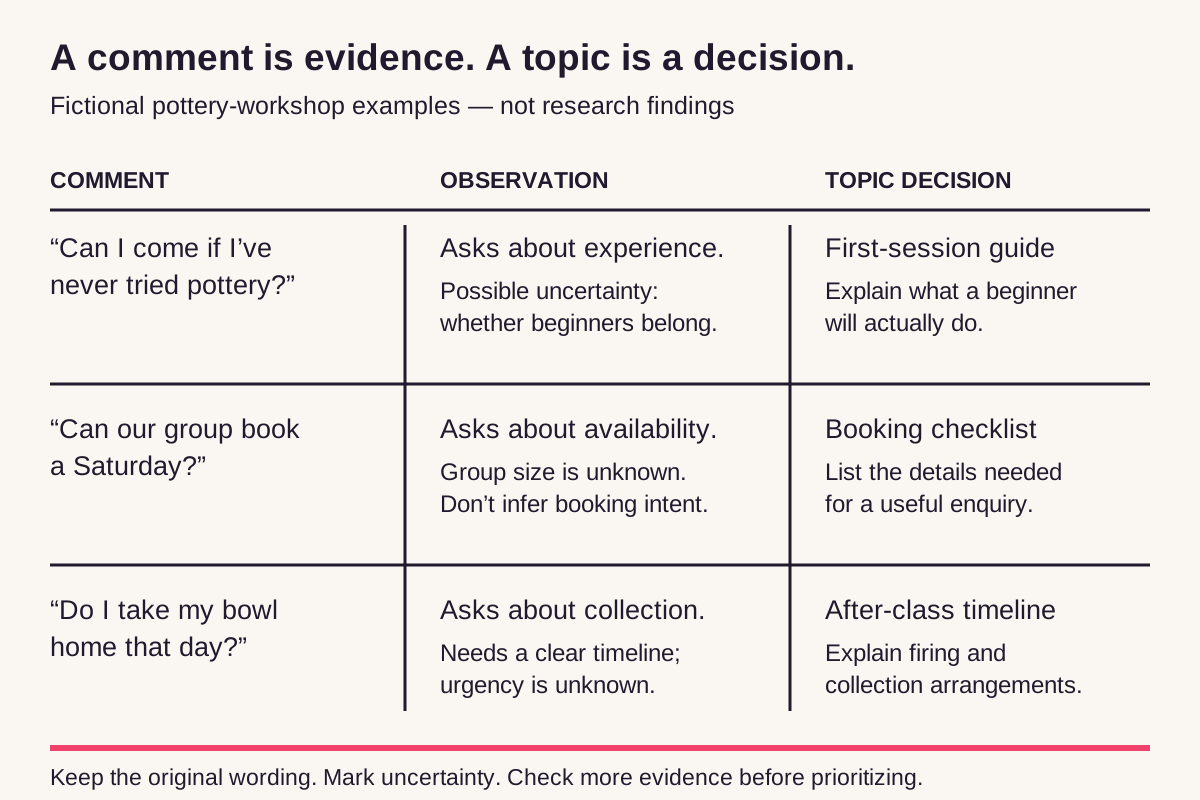
“Can I come alone?” is an observation. “Newcomers worry about attending without friends” is an interpretation. “Write a first-visit guide” is an editorial proposal. All three may be useful, but they are not interchangeable.
The GOV.UK research analysis method separates observations, findings and actions. Apply that distinction when you make a comment log. It prevents a writer's preferred article idea from appearing later as something the audience explicitly requested.
For each useful comment, keep these blank fields in a document or spreadsheet:
- Post context and date: ___
- Anonymized contributor label, if needed: ___
- Exact question or clearly marked paraphrase: ___
- What the person appears to be deciding: ___
- Theme and alternative interpretation: ___
- Answer already available, with location: ___
- Proposed action and evidence still needed: ___
Copy exact wording only into a suitably restricted working record when it is necessary. For publication, paraphrase and remove identifying details, or obtain appropriate permission for a direct quotation. Do not describe a paraphrase as a quote.
An “alternative interpretation” column is particularly useful. The person asking about coming alone may want reassurance about social arrangements, or may simply be checking whether tickets are sold individually. Those possibilities lead to different answers.
Work through twelve invented workshop comments
Group comments around the decision they express. Keep compliments, unclear reactions and information requests visible without forcing all of them into article ideas.
Every comment below is invented for this exercise. They are not copied from an Instagram account and are not evidence of demand for pottery content. Contributor labels only show how duplicate participation changes the count.
Notice how a small amount of context affects the coding. “When can I collect it?” concerns what happens after the session. It belongs with the visit timeline, even though it contains a scheduling word. “Can our team book?” concerns a different purchase from an individual beginner ticket.
The labels are provisional. Another reviewer might split access arrangements from arrival preparation, and that may be the better choice when the studio has more evidence. Keep the underlying questions so you can regroup them without reconstructing the conversation.
Fictional comment-coding exercise, not audience research results
ID / contributor
01 / A
- Invented comment
- Can I come alone?
- Provisional theme / action
- Attending alone; clarify ticket and group arrangements
ID / contributor
02 / B
- Invented comment
- Do I need to have tried pottery before?
- Provisional theme / action
- Beginner suitability
ID / contributor
03 / C
- Invented comment
- Will I use a wheel or make it by hand?
- Provisional theme / action
- Class format; explain the difference
ID / contributor
04 / D
- Invented comment
- Do we take the mug home that day?
- Provisional theme / action
- After-class timeline
ID / contributor
05 / E
- Invented comment
- When can I collect it?
- Provisional theme / action
- After-class timeline
ID / contributor
06 / F
- Invented comment
- What should I wear?
- Provisional theme / action
- Preparing for the visit
ID / contributor
07 / A
- Invented comment
- And is an apron provided?
- Provisional theme / action
- Preparing for the visit; same contributor as 01
ID / contributor
08 / G
- Invented comment
- Can our team of eight book together?
- Provisional theme / action
- Private group enquiry; separate route
ID / contributor
09 / H
- Invented comment
- Can I access the studio without stairs?
- Provisional theme / action
- Access question; verify with studio owner
ID / contributor
10 / I
- Invented comment
- How much is the Saturday session?
- Provisional theme / action
- Current factual answer; booking page check
ID / contributor
11 / J
- Invented comment
- That blue glaze is lovely
- Provisional theme / action
- Praise; no unresolved question established
ID / contributor
12 / K
- Invented comment
- DATES
- Provisional theme / action
- Prompted resource request; check post context
Count people and questions without turning them into market size
Record the number of relevant comments and identifiable distinct contributors separately. Repeated questions can guide investigation, but likes and repetition do not establish representative demand.
The fictional table contains twelve comments from eleven labeled contributors. A asked two different questions. Counting those as two separate people would overstate participation; discarding one would lose a useful question. Keep both facts.
For “preparing for the visit,” comments 06 and 07 come from two contributors. For the broader first-visit experience, A still counts once even though A appears in more than one theme. Theme totals therefore need not add up to a unique audience total. State what you counted before doing arithmetic.
Do not convert the table into claims such as “most beginners are anxious” or “one in six customers needs preparation advice.” The sample is fictional, and even a real equivalent would only describe the comments you reviewed. People who do not comment remain absent. An influential post, a caption prompt or one person's repeated replies can shape what you see.
Keep one-off concerns when the consequence matters. A single access question can justify improving factual access information. It does not need to win a popularity contest. Verify the entrance, route and facilities with someone responsible for the premises, and avoid offering a blanket assurance from an incomplete description.
Worked example using invented workshop questions. Counts describe this exercise only.
Choose the smallest content response that resolves the question
Prioritize an unresolved decision that matters to your audience and that you can answer accurately. Some questions need a corrected page or a direct reply rather than a new article.
Review each theme against three questions: does this affect a relevant decision, is the answer missing or hard to find, and can we supply useful evidence? Write the reason for the priority. A score without an explanation can make a guess look measured.
In the studio example, Saturday pricing belongs on the current booking page. If that page already answers it, improve the path to the answer before commissioning “The complete guide to workshop prices.” The private-group enquiry deserves a separate response and perhaps a group-booking page. It should not expand the beginner article into a corporate-events pitch.
Preparation questions may support a practical guide because several facts need to come together: class format, clothing, arrival, what is supplied and what happens to the finished piece. That is an editorial judgment about usefulness, not a conclusion that this theme will attract the most traffic.
Before assigning a new page, search your own published guides, help pages and drafts for the same question. Read the closest matches. A different headline does not justify a second page that answers the same task. Add a missing section to the existing page if that is where a reader would naturally look.
Keep uncertain topics in a “needs evidence” column with a concrete next action. “Ask the instructor which techniques the beginner class includes” is useful. “Research more” does not identify what would change your decision.
Turn one theme into a brief with a clear boundary
A useful brief names the reader, the unresolved decision, the evidence needed and what the article will leave to another page. Different themes should produce different briefs.
The same small exercise can suggest several editorial jobs. These three illustrative briefs are deliberately different in scope:
Brief one: What happens at your first pottery workshop? Help a first-time attendee decide whether the session fits and arrive prepared. Cover the actual technique taught, individual attendance, supplies, clothing and collection arrangements. Ask the instructor to verify every operational detail. Use authentic photos of materials and the workspace if permission and privacy allow. Exclude general pottery history and private-event packages. Link to current dates instead of embedding a schedule likely to expire.
Brief two: Why your pottery may need collecting after class. Explain the studio's real post-session process and how customers receive collection instructions. The invented questions identify the information gap; they do not supply technical answers. Have the responsible instructor verify the process before drafting. A simple sequence diagram could explain the stages better than a stock image. Do not promise a completion date that the studio cannot confirm.
Brief three: Planning a private pottery session for a group. Help an organizer gather the information needed for an enquiry. Confirm capacity, date options, accessibility information and the actual booking process with the business. If group bookings are not offered, do not write an acquisition page suggesting that they are. Answer the individual enquiry honestly.
A reusable brief record can stay short: reader / decision / observations / verified answers / unresolved facts / closest existing page / useful visual / next step / owner. The structure keeps the assignment accountable; it does not require every finished article to use identical headings.
Google's people-first content guidance emphasizes original value and satisfying the reader's purpose. For these briefs, the original value comes from verified studio details and an explanation that helps someone decide, not from repeating a competitor's generic checklist.
Publish the answer, then listen for what is still missing
Review later questions for unresolved gaps and misunderstandings. Fewer comments alone do not prove that an article worked, because audience size and post context may have changed.
Return to the original decision after the content is published. Does the guide actually explain coming alone? Can someone find the collection instructions on a phone? Ask a colleague unfamiliar with the draft to locate those answers without prompting.
At your next bounded review, note new questions, repeated questions and corrections. A repeated question can mean the answer is missing, unclear or hard to reach. It can also come from someone who never saw the guide. Check the situation before rewriting the entire article.
If the guide naturally includes a useful take-away, use the lead magnet ideas guide to choose its format. A preparation checklist might fit; a downloadable copy of every sentence usually adds little. Name what the reader will receive and choose a request keyword that matches that promise.
Once the resource exists, the comment-to-DM setup guide explains how to offer it through an eligible request. This research method is a manual editorial workflow, not a claim that ReplyMagnet exports or analyzes audience comments for you.
Keep the original observations beside the finished brief. Six weeks later, they will help you distinguish a real unanswered question from an article idea that sounded good in a planning meeting.