Guides
Keep a multilingual Instagram conversation consistent to the end
The caption is translated, the first message is translated, and the booking page opens in a language the reader cannot use. That conversation is only partly localized. Review the whole promise before calling a second language ready.
Published by ReplyMagnet · Last updated
Choose the languages the business can support
A supported language needs more than translated promotional copy. Someone must verify the offer, maintain its destinations and handle the support arrangement the campaign promises.
Start by listing what a reader will encounter: the post, request instruction, reply, resource, any form, the final destination and the support route. For each item, record which languages are actually available today. A blank cell is a dependency to resolve, not permission to assume the English version is sufficient.
A small business may be ready to provide a guide in two languages while answering personal enquiries in only one. That can be an honest offer if the limitation is clear. It becomes misleading when a translated caption suggests a fully supported conversation that the team cannot continue.
Do not infer a visitor's preferred language from their name, nationality, location or profile image. Someone living in a particular country may use several languages. A mixed-language comment does not establish which language they want for a detailed resource.
The W3C explanation of localization distinguishes translation from broader adaptation, including conventions such as dates and currency. Use that distinction to make a practical readiness list, rather than treating the translated word count as the measure of completion.

Editorial illustration. No translated text is presented as professionally reviewed in this image.
Keep the offer equivalent even when the wording changes
Translate the meaning and conditions of the offer, not just its sentences. Both versions should describe the same resource, required action and limits unless the difference is intentional and explicit.
Imagine a fictional workshop business offering an English preparation guide and a second-language edition. The English caption promises a preparation checklist. The translated version must not accidentally promise a complete course or a confirmed booking.
Create a small terminology sheet before reviewing individual messages. Include terms that describe business states, because those errors can change what the customer believes has happened. “Booking request” is not the same as “confirmed booking.” “Available dates” is not the same as “reserved place.”
For each term, write the meaning in plain English, where it appears, the approved translation supplied by a fluent reviewer, and any wording to avoid. Do not ask the reviewer to translate a fragment without knowing its context. A word on a button may need different wording from the same idea inside an explanatory paragraph.
Leave unreviewed translations visibly pending in your working file. This article uses placeholder slots rather than inventing a polished translation and calling it verified. Before publication, the person responsible for that language should replace the slots and review the complete journey.
If the local offer really differs, record the difference instead of forcing false equivalence. A workshop available at one location but not another needs accurate local content, not identical copy that promises an unavailable service.
Terminology sheet for a fictional workshop campaign
Term
Preparation guide
- Meaning to preserve
- Information for someone considering or attending a class
- Second-language review slot
- Approved term: ___; reviewer: ___
Term
Booking request
- Meaning to preserve
- An enquiry that has not reserved a place
- Second-language review slot
- Approved term: ___; distinguish confirmation
Term
Confirmed booking
- Meaning to preserve
- A place confirmed through the actual booking process
- Second-language review slot
- Approved term: ___; evidence required
Term
Available dates
- Meaning to preserve
- Current dates listed for consideration
- Second-language review slot
- Approved term: ___; no reservation implied
Term
Contact the studio
- Meaning to preserve
- Use the stated support route
- Second-language review slot
- Approved instruction: ___; support language stated
Let the reader choose when the language is uncertain
Offer an explicit language choice or clearly separated language-specific routes when needed. Do not claim automatic detection or translation unless that exact behavior has been verified.
One design is to publish separate offers whose language and resource are unambiguous. Another is to let a reader choose between supported languages before receiving a resource. Which is simpler depends on the campaign and the tools you have actually configured.
In ReplyMagnet, keyword variants within one campaign do not create separate language editions of the attached asset. The keyword guide explains why variants should mean the same request. Do not add two language names as variants and assume each will deliver a different file.
If you use separate campaigns or configured branches, test that the selected language reaches the intended destination. This guide is a planning method, not a claim that the product translates a flow, detects a language or creates separate editions automatically.
The W3C internationalization tips recommend making links to localized web content visible using the target language. For a campaign, have the fluent reviewer approve the language labels a reader sees. Do not make someone read an unfamiliar language merely to discover how to switch away from it.
Keep a recovery message for an unsupported language request. It should explain the languages actually available and the real support option. Avoid pretending that a translated acknowledgement means the business can handle the entire enquiry in that language.
Review the details people act on
Check dates, times, currency, location and destination behavior in every edition. A grammatically correct message can still lead someone to the wrong session or price.
A numeric date such as 04/05 can be interpreted differently across audiences. For an illustrative workshop invitation, “4 May 2027” is clearer than an unexplained sequence of numbers. Have the reviewer choose the natural equivalent for the audience, including the year when confusion is possible.
Time needs a location or timezone when the audience is not purely local. “Starts at 7” leaves both the hour convention and location uncertain. Confirm the actual event time before translating it; a fluent translation cannot correct an unverified schedule.
A price should identify the currency and any relevant scope. If the page uses a currency symbol shared by several currencies, the surrounding context must make the intended amount clear. Do not invent currency conversions for a campaign simply because a second language is involved.
Open every link in the reviewed edition. Language may be carried in the URL, chosen on the destination, or affected by a visitor's previous selection. Test the route from a fresh reader's perspective rather than relying on the language currently selected in the owner's browser.
Inspect downloadable files too. The filename, visible title and content should identify the correct edition. A translated DM that delivers the English PDF is a delivery mismatch even when every sentence in the DM is accurate.
Where a destination cannot support the second language, say so before the click if it affects the task. Decide whether a short translated explanation is enough or whether the campaign should wait until the destination is ready.
Use a paired review worksheet instead of two disconnected drafts
Review both editions against the same intent and expected outcome. Record actual wording, destination and approval for each part so a later update can be checked consistently.
A paired worksheet helps a reviewer see discrepancies that disappear when files are reviewed on different days. It is a manual content record, not a built-in localization feature.
For each row, add the approved second-language wording and the person who checked it. The English examples below are invented. The placeholders are work instructions and must not appear in the published campaign.
After the text check, ask each reviewer to explain what a reader would believe happens next. If one explains “receive information” and the other explains “reserve a place,” resolve the mismatch before testing the flow.
Keep the resource version beside the translation. When the English guide changes from a packing list to a preparation checklist, the translated filename may still look plausible while the meaning has shifted. Version linkage makes that discrepancy visible.
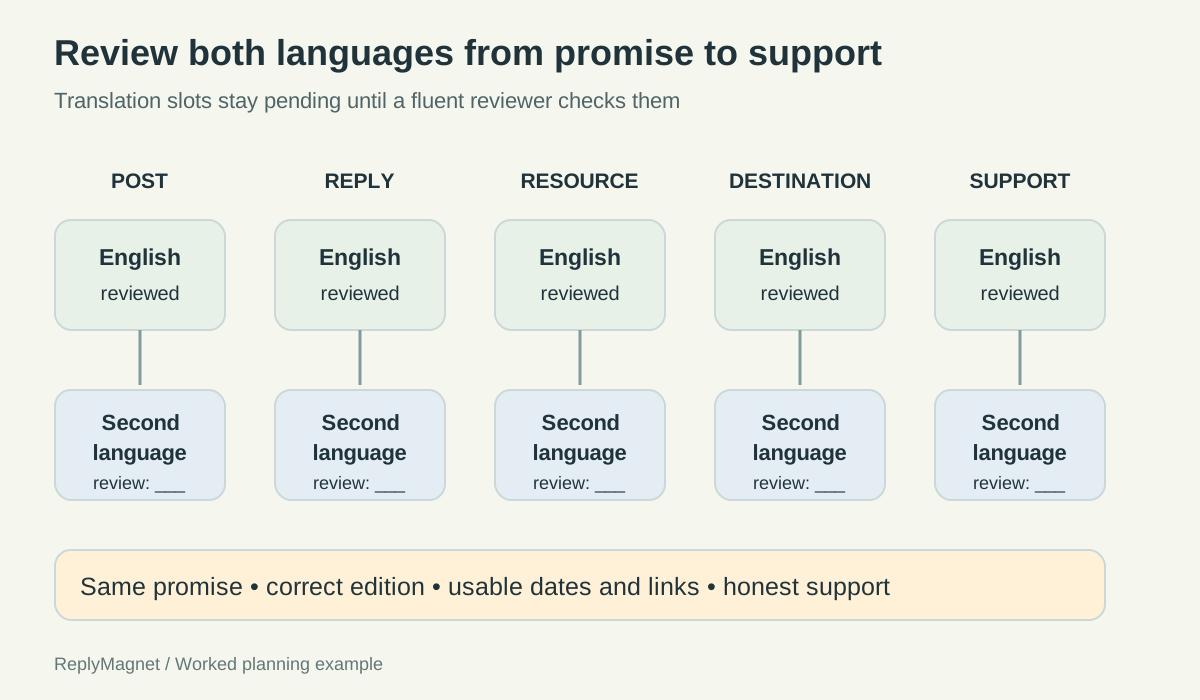
Original localization review map. The second-language row is an unfilled review plan, not an approved translation.
Paired review worksheet with unfilled translation slots
Journey part
Post promise
- Illustrative English wording or check
- Request the workshop preparation guide
- Second-language review
- Approved translation: ___
Journey part
Request instruction
- Illustrative English wording or check
- Use the exact request word shown in the post
- Second-language review
- Approved instruction and tested input: ___
Journey part
Reply
- Illustrative English wording or check
- Here is the preparation guide you requested
- Second-language review
- Approved translation: ___
Journey part
Resource
- Illustrative English wording or check
- Correct guide title, edition and usable text
- Second-language review
- File and version checked: ___
Journey part
Booking destination
- Illustrative English wording or check
- See current dates; requesting a guide does not reserve a place
- Second-language review
- URL, language and meaning checked: ___
Journey part
Support
- Illustrative English wording or check
- State the actual supported language and route
- Second-language review
- Reviewed support wording: ___
Ask fluent reviewers to follow the conversation, not just proofread it
A reviewer should inspect the intended meaning, rendered text and destination in context. A spellcheck alone will not reveal an incorrect branch, broken script or misleading booking promise.
Give reviewers the same short task: obtain the preparation guide and find how to check workshop dates. Do not show them the intended route before they try. Ask them to identify any phrase that feels unnatural, any requirement that is unclear and any point where the language changes unexpectedly.
If a script reads right to left, inspect how mixed numbers, URLs and punctuation appear on the actual device and destination. Do not assume that text pasted into a field will render as it does in your document. The W3C's web guidance covers direction and language handling; your platform and linked pages still need their own rendered checks.
Have a reviewer who understands the business confirm the operational meaning, even if a separate person performs the translation. Fluency does not establish whether a booking is actually confirmed or whether the resource is current.
Record a specific issue rather than “translation needs work.” For example: “The second-language message describes the date enquiry as a reservation, but the destination is only a contact form.” That note identifies the correction and why it matters.
When you cannot arrange fluent review, keep the edition unpublished or narrow the offer to language support you can verify. An unreviewed version should not be marketed as a complete supported experience.
Maintain both editions when the offer changes
Treat a change to the resource, date or support arrangement as a change to every affected language journey. Assign an owner and review status rather than assuming translations stay current.
Keep a small change record with the source text, meaning changed, affected messages and resources, reviewer, and completion date. Not every edit requires rewriting the whole campaign, but every factual change needs someone to check the corresponding edition.
If the workshop moves location, updating only the English booking page may leave the second-language PDF directing people elsewhere. Search for the old location across all the campaign materials, including images with embedded text and confirmation instructions.
The UAE campaign guide discusses keeping location and language choices explicit. The narrower lesson here is to review equivalence from the first promise through the final destination, rather than assuming geography determines language.
Begin with one supported offer in two complete editions. Fill the worksheet, verify the links, and have the reviewers walk the journey. A smaller campaign with a dependable second-language experience is easier to maintain than a wide language list that ends at the first reply.