Guides
Make the first email fulfill the Instagram signup promise
The first email should make a new reader recognize the publication they requested. It needs a familiar sender, the promised value and a clear explanation of what happens next. Write it against the actual signup route, not an assumed confirmation process.
Published by ReplyMagnet · Last updated
Put the signup promise beside the draft email
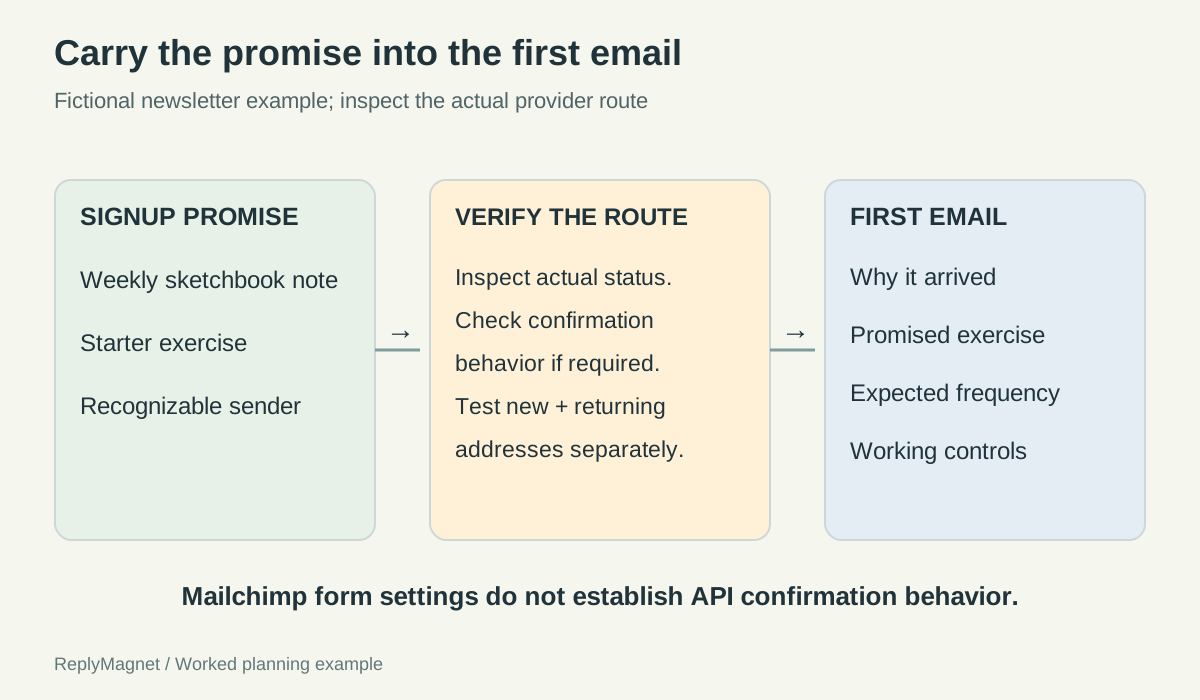
Record what the person was told they would receive, from whom and how often. The first email should fulfill that promise before introducing a different offer.

Generated editorial illustration of receiving promised content. It is not a sent email or provider screenshot.
Consider a fictional newsletter about practical sketchbook exercises. Its Instagram invitation says: “Join the weekly sketchbook note and receive the starter exercise.” A reader who explicitly joins that publication should recognize both the exercise and the ongoing weekly note in the first welcome.
This is an invented editorial example, not a real newsletter campaign or a claim about subscriber behavior. It assumes an explicit, clearly explained signup. A person who only requested a download has not necessarily made the same choice.
Copy the actual invitation into your working document before drafting the email. Include the form wording and any confirmation message, because the promise can change between the post and the destination. If one says “monthly” and another says “weekly,” fix the mismatch rather than choosing whichever frequency suits the email draft.
Decide what the email must deliver. If the resource was already available immediately, the welcome can provide a convenient return link and explain the publication. If the promise was delivery by email, the first appropriate message needs to make that resource easy to find.
The newsletter writer guide covers the acquisition context. Here the task is narrower: make the first email feel like the expected continuation of the specific signup.
Confirmation and welcome are different jobs
A confirmation request asks the person to complete a subscription step. A welcome introduces the publication after the appropriate state is established. Verify which messages your actual route sends.
In a double opt-in route, the confirmation message asks the person to verify the signup. The welcome then serves a different purpose: it delivers or introduces the promised publication. Do not write a confirmation message as though the required action has already happened.
Mailchimp’s double opt-in documentation describes the extra confirmation step and explicitly limits its audience-setting instructions to Mailchimp signup forms. API and other form integrations need their own behavior checked. Enabling a setting for Mailchimp forms does not establish how every connected service adds contacts.
This matters for ReplyMagnet’s current Mailchimp connection: it requests subscribed status when adding a new contact. It does not request the pending status used to initiate that confirmation route. Do not promise readers that Mailchimp’s form setting will automatically send a confirmation step for a ReplyMagnet-synced address.
If your intended signup process requires confirmation before subscription, use a route whose behavior has been verified to provide it. Test that route before enabling the welcome. Do not turn on a sequence and hope the provider’s settings will repair a mismatch in the acquisition process.
A provider status also does not replace the signup promise. A record marked subscribed is a system state; it is not, by itself, evidence that the person knowingly requested every message you intend to send. Keep the actual invitation and choice aligned with the publication.
ReplyMagnet transfers captured contact information; your email provider owns the email sending process. The email-sync documentation is the connection reference, but the destination record and controlled test are what reveal the behavior of your configured route.
A complete fictional first email
Use a recognizable subject, explain why the email arrived, deliver one useful item and state the ongoing expectation. Keep provider-managed subscription controls intact.
The following draft is for the invented weekly sketchbook newsletter. Bracketed destinations and sender details must be replaced with real, checked information. It is an editorial example, not an email that has been sent.
From: Sketchbook Note, [recognizable sender address]
Subject: Your starter sketchbook exercise
Hello,
You joined the weekly Sketchbook Note through our Instagram signup. Here is the starter exercise we promised: [Open the starter exercise].
For a first attempt, choose one ordinary object near you and draw its outline without trying to make a finished picture. The exercise page explains the steps and includes a small example. You do not need to complete it before the next issue arrives.
Each week, I will send one practical drawing prompt with a short explanation. The next note will look at how changing your viewing angle changes what you notice. If the schedule changes, I will say so rather than quietly increasing the number of emails.
If the exercise link does not work, use [the real help route] and describe what happened. Please do not send private information that is unnecessary to resolve the problem.
Thank you for joining,
[The actual writer or publication name]
[The email provider’s working subscription-management and unsubscribe controls, plus the sender details required by your configured process]
The draft starts with recognition and value. It does not demand a purchase, ask for a public endorsement or introduce several unrelated offers. The example drawing instruction is deliberately small so the email can be useful without reproducing the entire resource.
The final controls are not decorative placeholder text for production. Configure and test the actual provider controls before sending. This article is an editorial guide, not a jurisdiction-specific legal checklist.
Annotate the email against the promise
Every major element should have a clear purpose. Remove additions that distract from the requested value or create a new expectation the publication cannot keep.
Read the draft as someone who saw the Instagram invitation once and then returned to other work. Would the sender and subject help them recognize why it arrived? Would the first link take them to the promised item rather than a generic homepage?
Use descriptive link text. W3C’s writing guidance recommends meaningful labels and clear instructions. “Open the starter exercise” names the destination and the task. A row of unlabeled buttons makes the reader investigate each one.
Frequency deserves particular care. If the publication promises a weekly note, do not turn the welcome into an unannounced daily series. If there is a separate short course, explain that sequence during signup and in the first message. The reader should not need to reverse-engineer the schedule from their inbox.
A personal tone does not require pretending the email was individually typed for each subscriber. Write in the publication’s real voice and avoid fabricated observations such as “I noticed you loved our latest post.” A signup event does not establish that reaction.
Original promise-consistency map. Confirmation and welcome are distinct; ReplyMagnet is not the email sender.
Promise-consistency review for the fictional sketchbook email.
Email element
Sender
- What it must match
- The named writer or publication
- Useful check
- Would the signup reader recognize it?
Email element
Subject
- What it must match
- The promised starter exercise
- Useful check
- Does the main link fulfill it?
Email element
Opening
- What it must match
- The route and explicit signup
- Useful check
- Is the reason for arrival accurate?
Email element
Frequency
- What it must match
- The stated weekly publication
- Useful check
- Does the provider sequence agree?
Email element
Help
- What it must match
- A route someone actually monitors
- Useful check
- Can a reader report a broken link?
Email element
Controls
- What it must match
- The provider’s real subscription tools
- Useful check
- Do they work in a delivered test?
Test a new reader and a returning address separately
A new contact and an existing contact may take different paths. Inspect the destination state, triggered messages and final email rather than stopping at a successful sync notice.
Use addresses you control and the provider’s appropriate testing setup. Keep the test scoped so it does not send a draft to real subscribers. Record the route and version you are testing, including the invitation, capture step and provider configuration.
For a new address, inspect the destination contact state after the actual signup route. Note whether a confirmation request occurs, whether a welcome occurs and which action triggered each one. If the observed sequence differs from the promised sequence, stop the launch and correct the configuration or wording.
For an address already present in the destination, check whether the signup updates the existing record and whether it triggers another welcome. A repeated request should not automatically be treated as a first-ever subscription. The exact behavior depends on your provider configuration and should be observed rather than assumed.
Open the delivered email on the device context your readers are likely to use. Check the sender name, subject, main resource link, readable text and subscription controls. A preview can miss a broken destination or an unexpected real sender identity.
Record what the test does not establish. A successful delivery to your own address is not a deliverability guarantee for every recipient. A functioning resource link today does not remove the need to maintain that destination.
Keep the test record concise: expected state, observed state, email received, link outcome and correction needed. There is no need to store sensitive account credentials or a collection of subscriber details in an editorial checklist.
Treat the first email as a maintained promise
Review the welcome when the signup offer, resource, sender or schedule changes. An old welcome can contradict a new campaign even when both work technically.
Assign an owner to the welcome and its resource destination. If the starter exercise is replaced, inspect the email’s wording as well as the link. A new resource at an old URL may need different instructions.
When a publication changes frequency or focus, review active signup messages. New readers should learn the current promise before joining, while existing readers need whatever appropriate explanation your publication process provides. Do not let the first email quietly redefine what the post offered.
Use questions from readers to improve the welcome. “Why did I get this?” points toward a recognition or expectation problem. “Where is the exercise?” points toward the main action. Those are specific editorial signals; a single aggregate email metric may not explain them.
The lead record guide helps distinguish captured details from later outcomes. For the welcome, your completion standard is practical: the right reader enters through an explicit signup, the actual provider state is understood, and the first email delivers the value and expectations that were promised.