Guides
Answer buyer doubts without turning every concern into a sales trick
A buyer who asks about effort, cost or suitability is not necessarily resisting a sale. They may be trying to avoid the wrong purchase. Content becomes more useful when it helps them make that decision instead of treating every doubt as something to overcome.
Published by ReplyMagnet · Last updated
The short answer
Identify the uncertainty behind the concern, supply evidence that can address it and state the limits of the offer. A fair answer can lead to a purchase, a better question or a decision not to buy. Do not promise a sales lift from the wording alone.
Start freeDistinguish a missing fact from a genuine mismatch
Work out whether the reader needs information, evidence or an honest acknowledgment that the offer may not fit.
A fictional creator sells a self-paced digital sketching course. Three comments arrive: “How long are the lessons?”, “Will I actually make time for this?” and “I need feedback on my drawings.” They may look like objections, but they require different responses.
The first asks for a factual detail. Verify the current lesson structure and answer directly. The second concerns the person's circumstances and effort. The creator can explain the course's demands and show a realistic exercise, but cannot promise motivation. The third may reveal a mismatch if personal feedback is not included.
Labeling all three as “time objections” would flatten useful distinctions. It could lead to a generic reassurance such as “Anyone can do it,” which fails to answer the factual question and overpromises for the other two.
Use the actual language of questions where you have it, while protecting unnecessary personal details. Do not invent a list of objections and describe it as audience research. Fictional examples can teach a method, but they should be labeled as examples, as they are here.
Research-planning guidance from GOV.UK supports identifying what you need to learn before choosing a method. For content, that means understanding the uncertainty before drafting the persuasion. The digital-product seller page gives broader context for previews and resource delivery.

Generated editorial illustration of discussing an offer and its requirements. It is not a customer testimonial or measured sales result.
Try the resource flow for 30 days with 1,000 engagements. No card required.
Start freeMatch each concern to evidence that can answer it
Choose a demonstration, factual explanation or limitation according to the decision the reader is making.
The course creator makes an objection-evidence map. Concern: “I do not know what I receive.” Useful evidence: an accurate outline and a representative lesson preview. Concern: “I may not have time.” Useful evidence: the actual work involved and an example of how one lesson can be approached. Concern: “I need individual critique.” Useful answer: whether critique is included and, if not, a clear statement of the limitation.
A testimonial is not a universal substitute for these answers. Someone else's enthusiasm may show their experience, but it does not tell the reader what the course includes today. A screenshot of a finished drawing may illustrate an outcome without establishing how typical it is or what support produced it.
For price concerns, explain the contents and conditions of the offer without inventing a value calculation. “You receive these lessons and exercises” is inspectable. “Worth ten times the price” needs a defensible basis and may not help the person judge suitability. Avoid using a large imagined value to make the actual price seem inevitable.
For effort concerns, show the task rather than minimizing it. A short sample exercise can reveal whether the teaching style suits the reader. State what remains required: practice, materials or access to the format. The right answer may be that the course is not a good fit right now.
Google's helpful-content guidance encourages reliable information and useful original value. Apply that discipline to the evidence behind a sales explanation. It does not support a guarantee that answering objections increases conversion.
Evidence map for the fictional sketching course. No audience research or conversion result is claimed.
Concern
What do I receive?
- Appropriate evidence or answer
- Current outline and representative lesson
- Unsupported leap to avoid
- Every learner will get the same outcome
Concern
Can I make time?
- Appropriate evidence or answer
- Actual task and participation requirements
- Unsupported leap to avoid
- The course fits every schedule
Concern
Is the price right for me?
- Appropriate evidence or answer
- Current inclusions, exclusions and terms
- Unsupported leap to avoid
- An invented universal return on cost
Concern
Will I get individual critique?
- Appropriate evidence or answer
- Whether the offer actually includes it
- Unsupported leap to avoid
- Missing feedback is irrelevant to everyone
Example one: replace a time promise with a usable description
Show what participation requires instead of claiming the reader can succeed effortlessly.
Before: “Too busy to learn? Our course fits any schedule, so you have no excuses.” This sentence treats a real constraint as a character flaw and promises universal fit. It also provides no information about the work.
After, for the fictional offer: “The course is self-paced. You can review one lesson and try its exercise before moving on. The preview shows the teaching style and the materials used, so you can decide whether this is a realistic commitment for you.” The wording must match the actual course before publication.
The revision does three things. It states a verified format, describes a possible way to approach it and gives the reader evidence for a decision. It does not claim everyone will complete the course or that a particular amount of practice guarantees a result.
A useful visual would show one representative lesson and its exercise, labeled accurately. A polished montage of finished work might be attractive but would not answer the effort question as directly. If the example is staged or illustrative, say so rather than presenting it as a customer's progress.
The next action can be to view the sample. It does not need to be an immediate purchase. The reader is still resolving fit, and a relevant preview is a reasonable step in that decision.
Example two: answer the price question without inventing value
Explain what is included, what is excluded and where the reader can verify the current offer.
Before: “This is cheaper than one coffee a day and will transform your creativity.” The comparison may minimize a budget concern without explaining the product. The transformation claim adds a promise that the sentence cannot substantiate.
After: “The current offer includes the listed lessons and practice sheets. It does not include individual feedback. Review the sample lesson and the current purchase page before deciding whether those materials are useful for your goals.” This answer is less theatrical, but it gives the buyer concrete information.
If the offer has a price, renewal, access period or refund condition that materially affects the decision, verify it against the current purchase terms before discussing it. Do not infer those terms from an old post. A sales explanation can link to the authoritative page rather than repeating every changing detail in a carousel.
The creator can explain why the materials were designed as they were, but should distinguish that rationale from proof of value for every person. A structured sequence may help a learner follow the course; it does not establish a universal monetary return.
A good follow-up question is “Which part of the offer is still unclear?” That invites the missing information without pressuring someone to reveal their finances. A person may simply decide that the purchase does not fit their budget, and the content should leave that decision intact.
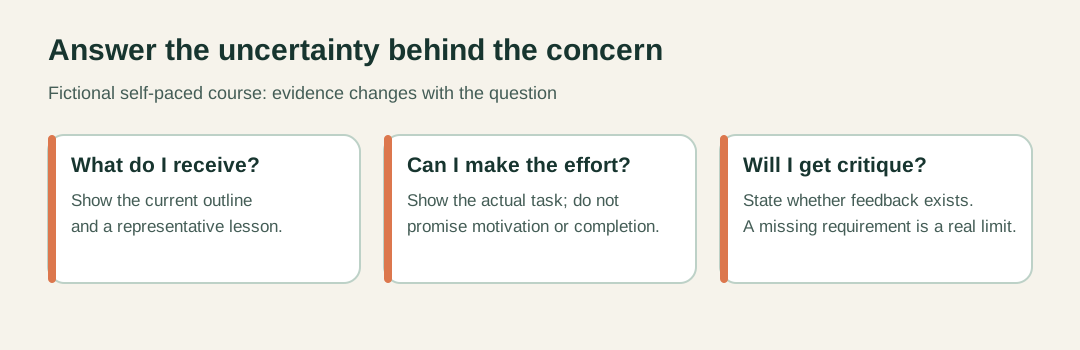
Original editorial evidence map, not customer research or a conversion result.
Example three: state a mismatch clearly
Tell readers when the offer lacks something important instead of reframing every limitation as a hidden benefit.
Before: “You do not need feedback; our method gives you everything.” If the reader specifically wants critique, this answer dismisses their requirement and expands the course's promise beyond its actual scope.
After: “This course does not include personal critiques. If individual feedback is essential to you, look for an offer that includes it. The sample lesson can help you judge whether the self-paced format is still useful for your needs.” The revision acknowledges the mismatch while leaving room for an informed choice.
Do not automatically turn the limitation into a selling point. Some readers value working independently; others need interaction. Both preferences can be legitimate. Explaining the tradeoff is more useful than declaring one universally superior.
The same approach applies to software, services and physical products. If the product does not support a required workflow, a friendly post cannot make it support that workflow. If a service does not include a deliverable, vague language about partnership should not imply that it does.
W3C's writing guidance supports clear, concise language. In a suitability explanation, clarity includes the word “not” when it communicates a real exclusion. Avoid burying the limit below several paragraphs of reassurance.
Choose a next step that matches the remaining uncertainty
Invite a preview, a specific question or a purchase only when it follows from the explanation.
After answering a factual question, the next step may be the current offer page. After explaining a teaching method, a sample lesson may be more useful. After identifying a mismatch, the appropriate conclusion may be to stop. There is no requirement that every educational sales post end with the same call to action.
If you offer a resource through Instagram, describe it accurately and keep delivery mechanics separate from the claim being made. The comment-to-DM guide covers the route, while resource delivery covers the artifact. Neither turns a request for a sample into evidence that the person is ready to buy.
Review the finished post against the original concern. Does it answer the question, show relevant evidence and identify any material limit? Could a reader reasonably infer a guarantee that the business does not intend? Does the example still represent the current offer?
After publication, examine the questions that remain. Repeated requests for an included-feature list may indicate that the explanation is still too abstract. Questions about a missing service may indicate a different audience need, not a copy problem to overcome.
Fair objection handling is a form of useful explanation. It makes the decision clearer, including the possibility of saying no. That gives the business a stronger basis for its promises and gives the reader a reason to trust the information they receive.