Guides
Calculate the cost of a qualified Instagram enquiry
An organic campaign can have no advertising bill and still consume design time, software and support work. Calling every captured address a qualified lead then makes the cost look lower than the business question warrants.
Published by ReplyMagnet · Last updated
The short answer
Define a qualified enquiry before the campaign, use a consistent cost scope and divide by the matching outcome count. Report contact and enquiry costs separately. These ratios describe the chosen records; they do not establish profit or prove the campaign caused every outcome.
Start freeAgree what counts before looking at the result
Use an observable qualification rule tied to the business task, and keep uncertain records outside the confirmed count.
A fictional design studio offers a project-planning checklist through Instagram. Many people request it. Some later ask about the studio's services. The team wants to understand the cost of producing relevant project enquiries, not merely the cost of distributing a file.
For this illustrative analysis, a qualified enquiry is a distinct project request within the studio's service scope, containing enough information for the team to decide whether to discuss it further. The rule does not require a purchase, and it does not turn every resource request into a sales opportunity.
Write the inclusion and exclusion criteria in ordinary language. A question about how to use the free checklist is support, not necessarily a project enquiry. A duplicated message about the same project is not a second opportunity. A request outside the studio's service scope is a recorded enquiry but does not meet this particular qualification rule.
Do not change the definition after seeing a disappointing total. If the original rule was inappropriate, revise it transparently and show how the revised count differs. A metric becomes difficult to compare when its denominator quietly changes from month to month.
The lead-generation guide discusses useful lead outcomes more broadly. This article focuses on the arithmetic and record choices needed to attach a campaign cost to a defined enquiry.

Generated editorial illustration of comparing counts and costs. The bowls are not a data chart or actual campaign figures.
Try the resource flow for 30 days with 1,000 engagements. No card required.
Start freeBuild a cost ledger with a clear boundary
Include the resources assigned to the campaign and explain how shared costs are allocated.
The fictional studio's ledger uses one campaign period and one currency. It includes eight hours of content production valued internally at 30 per hour, four hours of campaign setup and review at the same rate, 60 of allocated software cost and 80 paid for a specific design asset. The total is 500: 240 + 120 + 60 + 80.
These amounts are synthetic examples, not benchmarks or recommended hourly rates. The internal time valuation is a planning convention used consistently for this calculation. It is not necessarily the cash paid during the period, and it should not be confused with an accounting statement.
Record cash expenditure and valued internal time separately before combining them. A cash-only view answers a different question from a resource-cost view. Both can be useful, but the report must say which one it presents. Do not compare a cash-only campaign with a fully allocated campaign as if their totals were equivalent.
For shared software, choose and document an allocation method. The example assigns 60 to this campaign; a real team needs a defensible rule suited to its use. Avoid allocating the full monthly subscription to several campaigns simultaneously and then treating the summed result as the actual total spend.
Decide how reusable production work is handled. A resource created this month may support later campaigns. You can show its full creation cost in the first run or allocate it under a stated method, but do not switch approaches merely to make a later result look better. Consistency and disclosure matter more than a superficially precise number.
Synthetic campaign ledger in one unspecified currency. Values are assumptions, not rates or accounting advice.
Cost item
Content production time
- Calculation or allocation
- 8 hours × 30 internal value
- Amount
- 240
Cost item
Setup and review time
- Calculation or allocation
- 4 hours × 30 internal value
- Amount
- 120
Cost item
Software
- Calculation or allocation
- Stated campaign allocation
- Amount
- 60
Cost item
Design asset
- Calculation or allocation
- Campaign-specific cash cost
- Amount
- 80
Cost item
Total resource cost
- Calculation or allocation
- 240 + 120 + 60 + 80
- Amount
- 500
Three denominators tell three different stories
Use the same cost total with clearly labeled outcome counts to see what each ratio actually measures.
Suppose the synthetic campaign records 100 distinct captured contacts, 20 project enquiries and 10 qualified enquiries under the agreed rule. With a campaign cost of 500, the calculations are straightforward.
Cost per captured contact is 500 ÷ 100 = 5. Cost per project enquiry is 500 ÷ 20 = 25. Cost per qualified enquiry is 500 ÷ 10 = 50. These are three different ratios, not three competing answers to the same question.
The first describes the resource used per captured contact. The second describes the resource used per project enquiry. The third describes the resource used per enquiry that meets the studio's defined scope. None is customer acquisition cost unless the denominator is actually acquired customers under a suitable definition.
The ratios also do not equal return on investment. They contain no revenue, margin or profit calculation. A low cost per enquiry can coexist with poor commercial outcomes if the enquiries do not become suitable work. A higher cost can still be acceptable in a different context, but this example does not establish what any business should spend.
Manychat's Instagram ROI article provides inspiration for distinguishing activity from business outcomes. The ledger and arithmetic here are original synthetic examples. They use no industry cost benchmark and make no claim about expected performance.
Put the denominator name beside every number in the report. A dashboard tile labeled only “CPL: 5” conceals the decision that matters most: what the organization is calling a lead.
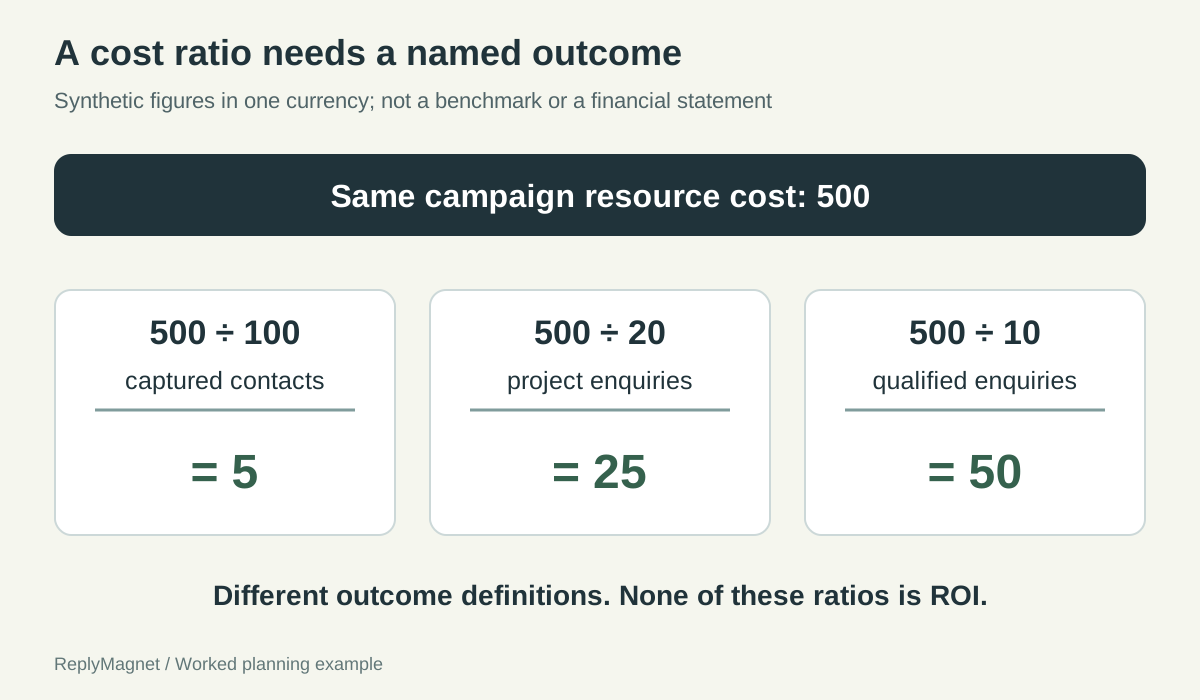
Original synthetic arithmetic diagram. The shared numerator does not make the three outcome definitions interchangeable.
Same synthetic cost, different denominators. These ratios are not ROI.
Outcome definition
Distinct captured contacts
- Count
- 100
- Calculation
- 500 ÷ 100
- Cost per outcome
- 5
Outcome definition
Project enquiries
- Count
- 20
- Calculation
- 500 ÷ 20
- Cost per outcome
- 25
Outcome definition
Qualified enquiries
- Count
- 10
- Calculation
- 500 ÷ 10
- Cost per outcome
- 50
Keep the cost period and outcome cohort aligned
Explain which requests belong to the campaign and how later qualification decisions will be handled.
A campaign that ends on Friday may generate enquiries that the team assesses the following week. If the report closes immediately, some records may remain unqualified simply because nobody has reviewed them yet. Choose a reporting cutoff and label provisional results.
For example, the studio can record requests received during the campaign and update their qualification status after a defined review period. The report should preserve the original cohort instead of adding unrelated later enquiries to improve the denominator. The chosen period is an operational decision, not a universal standard.
Keep duplicate handling explicit. If one person submits two genuinely different projects, the business may count two enquiries while still counting one contact. If several messages concern the same project, they should not automatically become several opportunities. Write the rule so another teammate can apply it consistently.
Attribution may be incomplete. A person can receive a resource on Instagram and later contact the studio through another route. A recorded association does not prove that the campaign caused the enquiry. Separate known campaign-linked records from unknown or mixed-source records rather than inventing certainty.
The Leads documentation describes relevant product records. Those records do not automatically supply your business-specific qualification decision or a complete acquisition-cost model. Maintain the additional classification in an appropriate system and use only the information needed for the analysis.
Handle zero and incomplete outcomes without hiding them
Report a zero denominator as undefined for the ratio, and explain the observed count and pending review state.
If the campaign costs 500 and produces zero qualified enquiries, do not report cost per qualified enquiry as zero. Division by zero does not produce a meaningful finite ratio. Report the cost, the zero count and the fact that the ratio cannot be calculated for that period.
If qualification is incomplete, distinguish “zero confirmed so far” from “all records reviewed and none qualified.” These states suggest different actions. The first may need operational follow-through. The second may call for a closer look at the offer, audience fit or qualification rule.
Small denominators also make ratios sensitive. With the same 500 cost, ten qualified enquiries produce 50 each; nine produce about 55.56; eleven produce about 45.45. One record changes the result noticeably. These arithmetic examples do not require a dramatic campaign story to explain the movement.
Avoid ranking two campaigns solely by a small difference in their ratios. Check whether their cost scopes, qualification rules, time periods and reporting completeness match. If they differ, describe the comparison as limited instead of pretending the numbers settle the decision.
A useful report includes a short uncertainty note: pending classifications, incomplete attribution, shared-cost assumptions and any unusual operational event. The note should explain the limits of interpretation, not bury the metric beneath a generic disclaimer.
Use the ratio to choose a focused next investigation
Connect the result to a specific operational question rather than assuming a lower ratio proves a better campaign.
If contact cost is low but qualified-enquiry cost is high, inspect what the resource attracts and what the invitation promises. The audience may value the free artifact without needing the service. That can be a legitimate educational outcome, but it is different from the acquisition objective used in this calculation.
If production cost dominates, examine whether the resource can support future work without repeating the entire creation effort. Keep the allocation method consistent when assessing that possibility. Do not claim savings before the reuse actually occurs.
If many enquiries remain unclassified, improve the review process before rewriting the campaign. A measurement problem can look like a marketing problem when the denominator is incomplete. If the definition itself is unclear, resolve it with the people who handle the enquiries.
Use the Analytics documentation for the events the product actually reports, and keep downstream business outcomes in the appropriate records. A message-delivery count should not silently become a qualified-lead count because it is easier to retrieve.
The final report can be brief: cost scope, period, qualification rule, counts, ratios and the next question. That makes the calculation useful without pretending it answers every commercial question. Its purpose is to support a better decision about the next campaign, not to manufacture a favorable number from an organic effort.