Guides
Audit the Instagram profile before asking for more enquiries
A visitor sees a beautiful grid and a bio that says “Creating unforgettable experiences.” They still cannot tell whether the business runs public workshops, designs private events or sells materials. A profile audit starts with that unanswered question.
Published by ReplyMagnet · Last updated
Give the visitor a reason to be there
Audit the profile against a realistic task. Ask whether a new visitor can identify the offer and find the information needed for that task without your explanation.
Imagine someone arriving after a friend shares a workshop photograph. They want to know whether beginners can attend, where the activity takes place and how to see available dates. That is a more useful audit scenario than “Does the profile look professional?”
Choose a task that reflects your actual business. A returning customer looking for support has different needs from a first-time visitor deciding whether to enquire. Audit them separately rather than assuming one profile element serves everyone equally well.
The GOV.UK moderated-testing guidance recommends observing relevant tasks without giving away the route. Apply that principle by asking a willing reader to find the information, not by telling them to tap the destination you want to test.
This is a content and comprehension audit. It does not require claiming that a particular profile layout improves distribution, or that a fixed number of seconds predicts sales. You are checking whether the promise is understandable before measuring business outcomes.

Storefront analogy for profile clarity, not an Instagram screenshot.
Check what the bio actually tells a stranger
A useful bio identifies the offer, its intended audience or context, and a clear next step. Replace vague claims with facts a visitor can use to decide whether the account is relevant.
Read the bio without looking at the photographs. Can you tell what the business does? “Thoughtful objects for everyday living” may establish a tone, but it does not necessarily explain whether the account sells finished products, takes commissions or teaches people to make them.
For a fictional printmaking studio, an illustrative rewrite could be: “Beginner printmaking workshops in our city studio. Public sessions and private groups. See current dates and access information below.” The actual location and destination must be supplied by the business. This example is not a claim about an existing profile.
Do not cram every service into the opening. Identify the offer the visitor is most likely trying to understand, then make the route to other services visible. If the business has several unrelated audiences, the destination may need to help people choose rather than forcing the bio to explain everything.
Keep factual boundaries honest. A business that occasionally hosts a beginner session should not imply a full weekly programme if one does not exist. A service delivered remotely should make that clear when a visitor might otherwise expect a local venue.
Avoid relying on a slogan as the only explanation. A recognizable voice can remain, but it should sit beside useful information rather than replacing it.
Follow the promise across the profile and destination
The bio, prominent content and linked page should describe the same offer. A clear opening fails when the next page changes the subject or hides the expected action.
A visitor who reads “See workshop dates” expects to find dates. If the linked page opens with a general agency portfolio, the profile has created a detour. The link may work technically while the promise fails.
Inspect the actual elements available in your current Instagram account, including prominent or pinned content where used. Do not design the audit around a fictional interface or an unverified character limit. Use the current rendered profile as the evidence.
Choose a small set of content that answers orientation questions: what the experience involves, who it suits and what happens next. A popular old promotion may no longer deserve a prominent position if its date has passed or its offer has changed.
The W3C writing guidance recommends clear instructions and meaningful link text. For the profile journey, name the destination by its purpose, such as current workshop dates or group enquiries, rather than an unexplained “more.”
Open the destination on a phone from a context without owner privileges. Check whether a visitor can read it, whether it refers to the right location and whether the next action matches the profile. A private document that opens for the owner is not a usable public destination.
Audit this fictional profile as a content system
Record the observation, its effect on the visitor’s task and the proposed correction separately. This makes the audit actionable without pretending that a mock profile is real evidence.
The example below is invented. It describes profile content in words and is not a screenshot of an Instagram account. Assume a printmaking studio wants first-time visitors to find a beginner workshop.
The audit does not score the account out of one hundred. A numerical score can conceal that one important destination failure matters more than several minor stylistic preferences. Prioritize the issue that stops the defined task.
For each proposed correction, identify the person who can verify it. The content owner can rewrite the bio, but the workshop manager may need to confirm beginner suitability and actual dates. The web owner may need to repair the destination. A single list of copy edits will not resolve all three responsibilities.
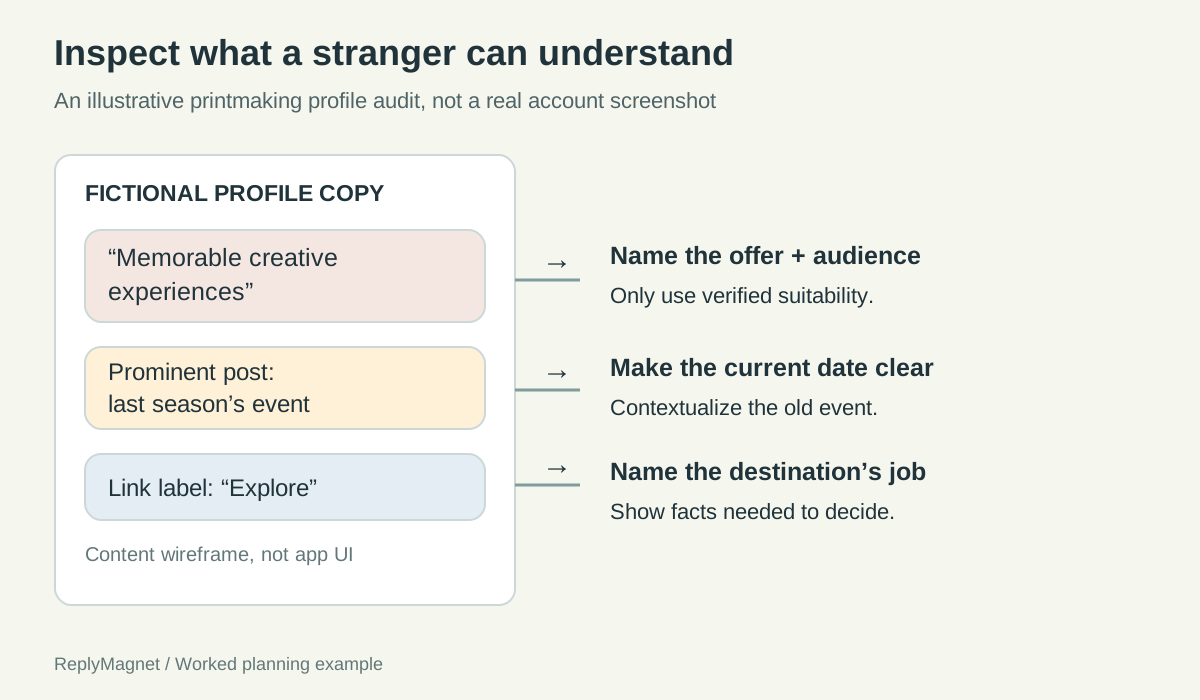
Original content wireframe for the invented profile. It does not reproduce Instagram’s interface or report an observed conversion result.
Fictional printmaking profile audit
Observation
Bio says “Memorable creative experiences”
- Visitor consequence
- Offer type and beginner suitability remain unclear
- Proposed correction
- Name public workshops and the verified audience
Observation
Prominent post advertises last season’s event
- Visitor consequence
- Visitor may think the old date is current
- Proposed correction
- Replace or clearly contextualize the outdated promotion
Observation
Link label says “Explore”
- Visitor consequence
- Destination purpose is uncertain
- Proposed correction
- Use wording that names the actual information
Observation
Landing page shows only photographs
- Visitor consequence
- Visitor cannot find dates or access details
- Proposed correction
- Add the facts needed to decide
Observation
A testimonial has no project context
- Visitor consequence
- Visitor cannot assess relevance
- Proposed correction
- Use authorized, attributable context or omit it
Observation
Contact route has no stated purpose
- Visitor consequence
- Sales and existing-booking questions mix
- Proposed correction
- Explain which route serves each need
Make proof specific enough to assess
Use verifiable work, clear examples and authorized customer evidence. Broad claims such as trusted or award-winning need context to help a visitor judge their relevance.
A photograph of the actual workspace can answer practical questions about the setting, provided it is current and shared appropriately. A sample of the finished work can show what participants or buyers should expect. These materials often provide more useful information than a row of unexplained badges.
When using a customer quotation, preserve its meaning and the permission for the intended use. Do not write a plausible quote yourself and attribute it to a customer. If a project result is mentioned, keep the timeframe and relevant limitations available rather than presenting a headline number alone.
If the business has a credential, explain what it concerns. A certification in one area does not automatically establish expertise in every service displayed on the account. If you cannot verify a claim, leave it out of the audit's proposed rewrite.
Proof also needs to match the visitor's decision. An experienced artist's exhibition history may be interesting, but a beginner deciding whether to attend may also need a clear description of the teaching format and required experience.
Avoid promising that adding proof will improve conversion by a particular amount. The audit identifies information that can help a visitor assess the offer. Its effect should be observed in your own context.
Use a brief first-impression check, then a real task
Ask what someone understood after a short look, then let them navigate. The first impression and the completed task reveal different problems and should be recorded separately.
You can show the profile briefly, for example for five seconds, and then ask: “What does this business offer?”, “Who does it seem to be for?” and “What would you expect to do next?” Treat this as an informal prompt for discussion, not a validated conversion score.
Then let the person inspect the profile normally and attempt the defined task. Ask them to find current beginner dates or the route for a private group. Observe where they look and what they expect from each link. Avoid correcting them until you have noted the misunderstanding.
A person may identify the business correctly but struggle to find the action. That suggests a navigation or destination problem. Another may find the link quickly while misunderstanding the service. That suggests the offer explanation needs work.
Record the exact observation or a clearly labeled paraphrase, the task, assistance given and the page reached. Do not interpret a hesitation as proof that the visitor dislikes the brand. Ask what caused it.
With a small number of willing readers, use the results to identify concrete edits. Do not describe the responses as representative of all visitors or infer a conversion rate from the exercise.
Fix the earliest confusion and review the next step
Prioritize the point where the visitor first loses the intended meaning or route. Recheck the complete journey after the edit, because clearer wording can expose a problem farther along.
If the bio does not explain the service, begin there. If it does, inspect the prominent content and destination before rewriting a working introduction. A visitor should not have to solve a different interpretation problem at every step.
Keep a short correction record: issue, evidence, owner, change and recheck. A revised link label deserves a destination check; an updated workshop description deserves factual confirmation. The audit is finished when the agreed task is understandable and the remaining gaps are documented, not when every sentence has been polished.
Once a visitor chooses to enquire, the welcome-message guide covers the separate incoming-message experience. The profile audit should not duplicate that setup. It determines whether the person understands why they would start the conversation at all.
Use the lead-quality worksheet later to inspect actual enquiries and outcomes. A clearer profile is a change worth checking, not automatic proof that subsequent sales were caused by the rewrite.
Give one unfamiliar reader one realistic task. Their first unanswered question is a useful starting point for the next edit.