Guides
Plan a joint Instagram campaign with clear responsibilities
Two creators can agree on a campaign idea while assuming different things about the work. One expects a shared resource; the other expects a mention. One plans to answer questions; the other expects the automation to handle everything. Write the operating agreement before making the public promise.
Published by ReplyMagnet · Last updated
The short answer
Define what the audience will receive, assign content and delivery ownership for each account and agree how changes and results will be handled. Test each supported route separately. A collaboration does not automatically create shared access, shared data or compatible triggers.
Start freeFind a useful reason for the partnership
Choose a reader problem that benefits from both contributors, rather than combining audiences without a clear offer.
Imagine a fictional illustrator and an independent print studio preparing an educational campaign. The illustrator can explain how to prepare artwork; the printer can explain what information is needed for a print quote. Together, they propose a short preparation checklist for people ordering their first small print run.
The partnership has a useful division of knowledge. It is not simply two accounts exchanging exposure. The shared reader question is “What should I prepare before requesting a quote?” Each partner can contribute relevant, verified information while staying within their own expertise.
Write the shared promise in one sentence. For this example: “A checklist that helps a first-time customer gather the information a printer needs to discuss a job.” The resource does not guarantee a price, turnaround time or successful print result. Those depend on the actual project and provider.
Check whether both partners can support that promise. If one wants a broad design tutorial and the other wants a sales inquiry form, resolve the difference before production. A resource with two incompatible goals will be difficult to describe honestly in either account's caption.
The lead-magnet ideas guide can help choose the artifact, but the partnership decision is about complementary contribution. The audience should be able to explain why these two people made the resource together.

Generated editorial illustration of a creative partnership. It is not a real campaign, partner agreement or performance result.
Try the resource flow for 30 days with 1,000 engagements. No card required.
Start freeWrite a two-account responsibility map
Name the person responsible for each deliverable and each customer-facing route.
The illustrator owns the explanation of artwork preparation and supplies an example they have the right to use. The printer owns the quote-information checklist and verifies the technical wording. Both review the complete resource because their names appear together, but each has a clear area of factual responsibility.
The campaign coordinator assembles the file and keeps a version record. Each account owner controls that account's public post and any supported delivery configuration. One partner may offer the resource directly while the other links to the agreed destination. The exact route must be verified before it is promised.
For incoming questions, assign a destination by subject. A question about the illustrator's example belongs with the illustrator. A project-specific print estimate belongs with the printer's normal inquiry process. Do not imply that either partner can answer for the other's prices, availability or service terms.
Record a named backup or a pause rule if someone is unavailable. “Both of us will keep an eye on it” leaves gaps when a time-sensitive correction is needed. A small campaign still benefits from knowing who can change a broken link or stop an inaccurate invitation.
The social-media manager use case covers multi-client operations, but this is a peer partnership rather than an agency-client arrangement. Neither party should be treated as having authority over the other's account merely because the content is shared.
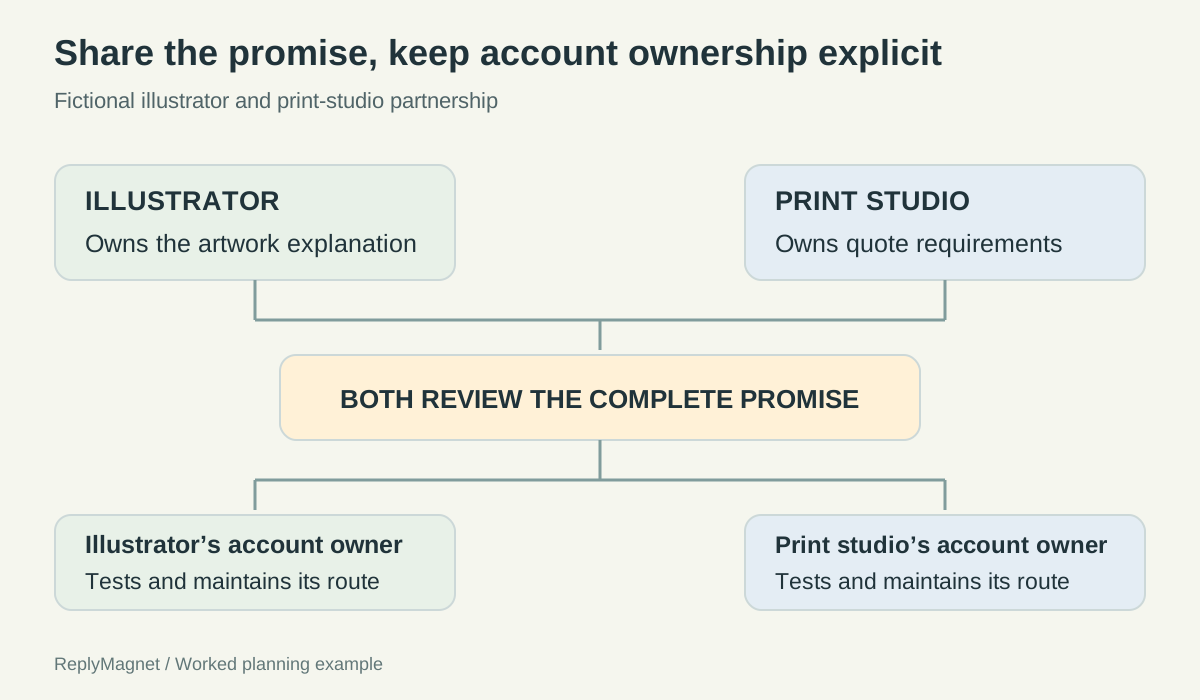
Original two-account responsibility map. Joint approval does not imply shared account access, contact data or trigger compatibility.
Responsibility worksheet for the fictional illustrator and print studio. Each account retains its own authority.
Work
Artwork explanation
- Owner
- Illustrator
- Shared check
- Accurate example and permitted use
Work
Quote requirements
- Owner
- Print studio
- Shared check
- No guaranteed price or result
Work
Resource assembly
- Owner
- Named coordinator
- Shared check
- Correct version and links
Work
Public route on each account
- Owner
- That account’s authorized owner
- Shared check
- Test each route independently
Work
Complete reader promise
- Owner
- Both named reviewers
- Shared check
- Approve caption and resource together
Work
Project-specific enquiry
- Owner
- Print studio’s normal process
- Shared check
- Do not imply the illustrator can quote
Work
Campaign review
- Owner
- Both partners
- Shared check
- Separate account counts and unknown overlap
Keep account access and customer information separate
Use authorized access for each account and share only the information needed for the agreed work.
A joint campaign does not require exchanging account passwords. Each partner should use its own authorized access and the appropriate collaboration mechanisms for the tools involved. Do not create an informal dependency in which one person's personal login becomes the only way to maintain both sides of the campaign.
Likewise, do not assume a shared resource means a shared customer list. Decide what information each partner needs and what people have been told about its use. Aggregate counts may be enough for a campaign review. Individual contact details require a separate, appropriate basis and handling process.
Keep the resource itself free of unnecessary customer information. Use original examples, approved material or clearly labeled fictional data. A partner's real job file can contain names, project details or commercial information that does not belong in a public educational download.
If both accounts use automation, verify each account's configuration independently. Do not assume a collaboration post, shared caption or partner mention makes a trigger work across accounts. This article makes no claim about automatic cross-account trigger compatibility. The comment-to-DM setup guide describes supported setup separately.
Document which account owns each delivery route and which destination it uses. When something fails, that record helps the team inspect the correct configuration instead of asking both partners to change settings at once.
Agree how a shared claim gets approved
Review the complete promise and define who can approve factual changes, visual edits and publication timing.
The printer may approve its checklist section while the final caption adds “Everything you need for perfect prints.” That broader claim has not been established by approving the checklist. Review the resource, caption and invitation together so the complete public promise remains accurate.
Use a simple version label and decision record. “Resource version three, caption version two, approved by both named reviewers” is clearer than a scattered trail of enthusiastic reactions. If approval depends on changing a line, record the condition and verify the revision before publication.
Divide change authority according to the content. A technical correction needs the responsible expert. A visual crop may need the rights holder and the person accountable for the final design. A changed offer or delivery destination needs both partners because it affects the shared promise.
Agree a response when a material error appears after publication. Who checks the report? Who can pause their own campaign? How will the other partner be notified? The plan should be practical enough to use while someone is busy, not a lengthy document nobody can find.
This is an operating process, not an assertion that ReplyMagnet includes native partner approvals or shared version history. Keep the review record in an appropriate shared document. Product configuration and editorial approval are related tasks, but they are not the same capability.
Test the two routes as separate journeys
Follow each account’s invitation through to the resource and the appropriate next step.
The illustrator's caption promises a preparation checklist, and the printer's caption promises the same artifact. Test both routes using authorized demo interactions. Confirm that each reaches the correct version and that any access requirement is described consistently.
Check the resource's next step. If it directs readers to the printer for a quote, make that clear without implying the illustrator provides or guarantees the printing service. If it offers an educational example from the illustrator, identify that contribution separately. Shared branding should not blur commercial responsibility.
Review the file on a phone and inspect links. A partner logo can accidentally link to an old page, while a caption can use a resource name that differs from the file title. These small mismatches make the reader work harder to confirm they received the promised item.
The resource delivery guide covers delivery checks. A successful test on one account does not validate the other account's permissions, campaign settings or destination. Record the result for each route and note anything that could not be verified.
Do not test by sending unexpected messages to real customers. Use an appropriate controlled route and avoid creating live inquiries that someone might mistake for genuine project requests. The aim is to verify the customer experience without adding confusion to the partners' normal operations.
Measure a shared campaign without inventing one clean funnel
Agree definitions for each count and keep account-level activity distinct from shared outcomes.
Before launch, define what each partner will report. A resource request, a delivered message, a captured contact and a qualified project inquiry are different events. A campaign can produce several of them for the same person, so adding all counts together does not create a meaningful audience total.
If the same reader interacts with both accounts, deduplication may be impossible or inappropriate with the available information. State that limitation. It is better to report “requests recorded separately by account” than to claim a unique-person total the evidence cannot support.
Keep business outcomes in the system that records them. The printer's quote or order records may contain relevant outcomes, but a campaign association is not automatically proof of causation. Someone may have known the printer already or arrived through another route. Record unknown attribution rather than forcing a story.
At the joint review, compare the original promise with what happened operationally. Which questions appeared? Which partner carried more support work than expected? Did the resource need a correction? These observations can improve the next collaboration even when revenue attribution is incomplete.
Manychat's marketing-calendar article offers coordination inspiration, but the responsibility map here is an original example. The useful result is a campaign both partners can explain and maintain: one shared reader benefit, distinct account responsibilities and evidence that does not exceed what the systems actually recorded.