Guides
Ask the questions that change the next step
A request can be relevant without being ready for a sales call. It can also sound promising while asking for work you do not offer. Good qualification helps both people discover that distinction without turning a short enquiry into an interrogation.
Published by ReplyMagnet · Last updated
Define fit as a relationship between the request and the service
A suitable enquiry matches work you offer and conditions you can meet. Qualification should assess the request, not assign a value to the person asking.
Consider a fictional design studio that creates brand identities for small businesses. It does not build websites or provide printing. Its next available project start is a date the owner has confirmed. Those facts are enough to create an initial qualification rule without guessing somebody's income or seriousness from their profile.
The first useful question is about the project: “What are you hoping to create or change?” A reply about replacing an existing identity points toward the service. A request for emergency website repairs points elsewhere. Neither person is a “bad lead.” One request matches the studio's present offer and the other does not.
Write your own rule in terms a teammate can apply. “We take identity projects with a clear decision-maker and a feasible start date” is inspectable. “We want high-quality clients” leaves too much room for personal judgment.
Keep the existing lead-quality worksheet for counting outcomes. This guide addresses the earlier decision: which answers you need before suggesting a useful next step.

Illustrative conversation planning. No client interview or measured qualification result is represented.
Separate hard constraints from useful preferences
Treat an unsupported service as a constraint and an unclear requirement as a question to clarify. Do not automatically reject someone because they cannot yet provide a detailed brief.
The studio might prefer clients who already have a written brief. That preference is different from a requirement that the project concern identity design. A newcomer without a brief may still be a good fit and need help describing the work.
Use three categories: must be true, helpful to know, and unknown. The unknown category prevents an incomplete answer from being silently converted into a rejection. Assign a next action for each uncertainty, such as one clarifying question or a manual review.
The GOV.UK question-page guidance recommends knowing why each question is needed and allowing uncertainty when it is a valid answer. Adapt that principle to the conversation; it does not mean copying an entire government form into Instagram.
Keep a reason beside each requirement. If a location restriction reflects actual service coverage, explain it. If it is merely a habit, reconsider whether it belongs in the rubric. Preferences should not become hidden barriers that nobody can defend.
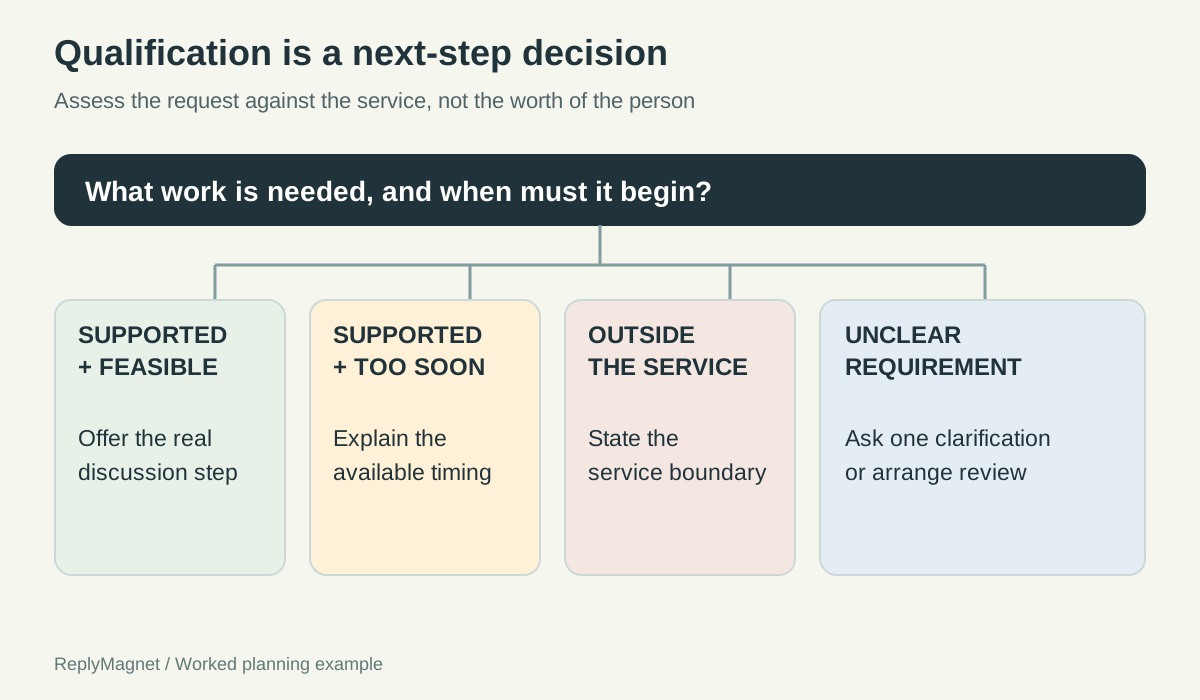
Original rubric diagram for the fictional studio. Unknown scope is not treated as automatic rejection.
Illustrative design-studio fit rubric
Criterion
Identity design requested
- Meaning
- Work the studio offers
- Next action
- Continue to timing and scope
Criterion
Website repair requested
- Meaning
- Work outside this studio’s offer
- Next action
- Explain the boundary and end the sales screening
Criterion
Start date feasible
- Meaning
- Owner has checked capacity
- Next action
- Offer the real enquiry or discussion step
Criterion
Start date too soon
- Meaning
- Present capacity does not fit
- Next action
- Explain availability and let the person decide
Criterion
Scope unclear
- Meaning
- Not enough information
- Next action
- Ask one useful clarification or arrange manual review
Criterion
No written brief
- Meaning
- Preference not met, not automatic exclusion
- Next action
- Offer a short project-description prompt
Ask in an order that makes sense to the person
Begin with the need, then ask about constraints that affect whether you can help. Explain a question’s purpose when the reason would otherwise be unclear.
A practical sequence for the fictional studio is project need, timing, and the work already in place. Each answer changes the next action. The studio does not need a long company history before discovering that the request is for printing it cannot provide.
Start with “What would you like help creating?” If the reply fits, ask “When would you need the project to begin?” Then, if it matters, ask “Are we creating a new identity or replacing an existing one?” Avoid combining all three questions into a dense paragraph that invites a partial answer.
The GOV.UK guidance on designing questions emphasizes language people understand and information they can supply. In this setting, “What are you making?” is easier to answer than “What is your strategic brand transformation objective?”
Ask about budget only when it is necessary to choose the next step and you can explain why. A published starting range may answer the fit question with less disclosure. Do not request account balances, income or financial documents in a casual DM screening process.
If someone has already volunteered the required detail, do not ask again merely because it appears next in your script. In a manual conversation, acknowledge the answer. In a configured flow, only promise this behavior if the implementation actually supports it. A worksheet describing sensible conversation is not proof of automatic extraction from free text.
Write the question and its decision side by side: “Need a start before our available date? Explain current timing.” If no answer would change what you do, remove the question.
Four fictional enquiries, four different outcomes
The next step should follow the stated need and verified constraints. A discussion invitation, a later option, a clear decline and a clarification are all legitimate outcomes.
These invented transcripts demonstrate reasoning. They are not customer conversations, tests or automated product output. Assume the studio's available start date is 10 November in the example.
1. Suitable for a discussion now
Visitor: “I need a new identity for a bakery opening next year.”
Studio: “Are you creating the identity from scratch or updating an existing one?”
Visitor: “From scratch. We have a name and can start in November.”
Studio: “That matches the kind of work we offer. Our next available start is 10 November. Would you like our project-enquiry page to describe the bakery and request a discussion?”
The work type and timing justify the next step. The reply does not claim that the project has been accepted, priced or scheduled.
2. Relevant work, unsuitable timing
Visitor: “We need a new identity ready for an event next week.”
Studio: “We create identities, but our next project start is 10 November. We cannot meet next week's deadline. If your timing changes, you can review our process here.”
Visitor: “Thanks, the event date is fixed.”
Studio: “Understood. We would not be able to help with this deadline.”
The timing constraint ends the screening politely. There is no need to collect a full brief or push a call that cannot solve the stated problem.
3. Work the studio does not offer
Visitor: “Our checkout page is broken. Can you fix it?”
Studio: “We work on visual identities and do not provide website repair. You will need someone who supports your website platform.”
Visitor: “So you cannot look at the payment problem?”
Studio: “Correct, that is outside our service. Please contact your website support provider through their usual support channel.”
The reply avoids pretending to diagnose the technical problem. A referral should only name a provider when you have a sound basis to recommend them; a made-up recommendation is not helpful.
4. A request that needs clarification
Visitor: “Our business looks wrong online.”
Studio: “Do you mean the logo and visual identity, or how the website works?”
Visitor: “I'm not sure. People say the pages feel inconsistent.”
Studio: “That could involve more than one kind of work. If you would like, use our enquiry page to describe the pages you mean, and we can review whether our service fits.”
Uncertainty remains visible. The studio does not classify the person as unsuitable merely because they have not used professional design terminology.
Write a respectful ending before writing the sales invitation
When the fit is poor or uncertain, state the relevant boundary and a truthful next option. Do not use a rejection as an opportunity to collect unnecessary information.
A useful decline has a reason the person can understand: “We cannot meet that date,” “We do not provide repairs,” or “This service only covers the named product.” It should not imply that the person failed a test.
For a later opportunity, ask whether the later timing is useful rather than silently adding the person to a follow-up list. Asking about one service is not agreement to every future promotion. Make any optional subscription or later contact arrangement explicit.
For uncertainty, use a real review route. “A person will look at this” requires an owner and a process. If the business only has an enquiry form, say that the person can submit it for review, not that a staff member is already handling their request.
Prepare the boundary messages before launch. Otherwise the flow may have polished copy for a suitable prospect and an abrupt dead end for everyone else. The quality of those endings is part of the service experience.
Review the rubric with whoever performs the work. A marketing assistant may believe the studio handles packaging because examples appear in its portfolio, while the owner may only offer that work as part of a larger identity project. Resolve the distinction before turning it into a yes-or-no question.
Review exclusions and only then automate a small part
Have a person inspect uncertain and declined enquiries for mistaken assumptions. Use configured questions and conditions only when their behavior has been verified against the rubric.
Start by applying the rubric manually to a few relevant enquiries you are authorized to review. Note which question changed the next step, which answer remained unclear, and whether a later human review reversed the initial decision. An incomplete answer is a useful signal about your question, not automatically a signal about the prospect.
Do not report a tiny review as proof of a qualification rate or improved sales. Its immediate purpose is to find confusing language and unsupported exclusions. Keep actual enquiry details restricted and remove unnecessary identifiers from shared notes.
If the process is stable enough for structured automation, the ReplyMagnet flow builder guide explains Question and Condition steps. The Instagram builder requires Pro or Agency, including valid trials, and an owner can edit and publish. This guide does not claim automatic lead scoring, income inference or unrestricted interpretation of free text.
Preview the paths you configure, including uncertainty and no answer. Preview checks logic without sending messages or saving conversation data; actual delivery remains a separate test. Keep a real contact route available for questions outside the prepared choices.
Your first revision can be small: remove one unnecessary question, explain one hard constraint, and make the uncertain route usable. A short conversation that reaches the right next step gives both sides more useful information than a long qualification script nobody wants to finish.