Guides
Set an Instagram enquiry response standard you can staff
A quick acknowledgement can tell someone their message arrived. It cannot tell them that the work is done. A useful response standard explains who will act, during which hours and what happens when an enquiry needs more time.
Published by ReplyMagnet · Last updated
Define the three moments you will measure
Record acknowledgement, first useful action and resolution separately. Otherwise a fast automatic reply can hide a long wait for the person who can actually help.

Generated editorial illustration of staff coverage. It is not an observed support team or a measured response result.
A customer asks a small studio whether a requested project is feasible. An acknowledgement arrives immediately, but the person authorized to assess the work does not see it until the following afternoon. Reporting only the acknowledgement time would conceal the delay that mattered to the customer.
Use three definitions. Acknowledgement means the person receives an accurate indication that the enquiry was received or where to take it. First useful action means someone advances the request, for example by answering the question or asking for a necessary missing detail. Resolution means the defined issue has reached an appropriate outcome.
A request can have useful action before resolution. Checking a project requirement with the customer may be necessary, while a final answer depends on another person. Do not mark it resolved merely because staff sent a message.
This article uses an invented design-studio rota and synthetic timestamps. They are planning examples, not response benchmarks, actual service results or evidence of a conversion effect.
The human handoff guide explains when prepared replies should stop. The task here begins with the manual workload after that boundary: making sure someone can own and progress it.
Study your own arrivals before promising a deadline
Look at when enquiries arrive, what kinds of work they require and how much staffed time is available. A public target should follow that evidence, not a generic speed claim.
Review a representative period of your own enquiries using the business’s approved records. Separate ordinary questions from work that needs investigation, specialist judgment or information from the customer. Count the work that remains open, not only the new arrivals.
Record arrival patterns in enough detail to make a staffing decision. A daily total may hide a concentration of requests after an evening post. A weekly average may hide a busy launch day. You do not need to publish those patterns; you need to understand what the team is promising to handle.
Estimate handling time from observed work where possible, and keep uncertainty visible. A reply that takes one minute to type may require longer to investigate. Include handover, checking and follow-up work rather than counting only the visible message.
GOV.UK’s guidance on managing user support treats support as a service that needs planning and improvement. For a small business, that means matching the contact route and staffing to the work people bring to it.
Do not copy another company’s response target without understanding its coverage and request types. A team staffed continuously has different constraints from a studio whose owner also delivers client work. State hours you can actually cover and review them when demand changes.
If your data is limited, begin with a modest internal planning assumption and observe whether it holds. Do not present an untested assumption as an achieved service level.
Build a rota around ownership, not visibility
Every covered period needs a responsible person and an overflow route. Seeing an enquiry in a shared channel is not the same as accepting responsibility for its next action.
The fictional studio uses a morning owner, an afternoon owner and a named backup. These are responsibilities in an existing manual workflow, not native ReplyMagnet assignments or a business-hours scheduler.
The morning owner checks new enquiries and the open list. Before leaving coverage, they identify unfinished requests, the next action and any promise made to the customer. The afternoon owner accepts the handover rather than simply assuming the inbox will reveal everything important.
A backup needs a trigger. “Help when busy” is vague. A more useful rule might be that the primary owner asks the backup when the remaining work cannot be handled within the stated coverage or an absence prevents the next check. Define that trigger from your actual capacity.
The rota should also say who can make a decision. A team member may acknowledge a price enquiry while only the owner can approve a bespoke quote. The handover must preserve that distinction so the customer is not given an unauthorized answer merely to meet a timer.
Keep a short absence plan. If both people are unavailable, revise the visible expectation and provide the actual route the business can support. Do not leave a response promise active because the calendar forgot a holiday or a delivery day.
Fictional studio coverage rota. Times and roles are illustrative, not a recommended universal schedule.
Coverage
09:00–12:00
- Primary responsibility
- Morning owner checks new and open enquiries
- Handover or overflow
- Record next action before leaving
Coverage
12:00–13:00
- Primary responsibility
- No routine coverage in this example
- Handover or overflow
- Public hours must make the gap clear
Coverage
13:00–17:00
- Primary responsibility
- Afternoon owner accepts the open work
- Handover or overflow
- Ask named backup when capacity is insufficient
Coverage
After 17:00
- Primary responsibility
- Next staffed period handles ordinary enquiries
- Handover or overflow
- Do not imply continuous human coverage
Coverage
Owner-only decisions
- Primary responsibility
- Business owner checks scope or quote exceptions
- Handover or overflow
- Keep enquiry open until the decision is made
Make the public expectation understandable
Say when people can expect a human action and what the contact route can handle. Avoid promising a complete answer when the team can only promise an initial review.
“We reply quickly” gives no useful boundary. “Our team reviews enquiries during the stated weekday hours” is clearer, provided those hours are accurate and visible. If you publish a specific time target, explain whether it means staffed hours or elapsed time and whether it concerns first action or resolution.
For the fictional studio, a draft acknowledgement could say: “Your project question needs a person to review it. Our team checks this route during the hours shown on our contact page. We will respond there with an answer or the next detail needed.” Add a concrete target only after the business has chosen and tested one it can support.
Do not imply that the acknowledgement itself transferred a ticket to a named colleague unless the actual workflow does so. ReplyMagnet is not being presented here as a universal inbox, assignment system or SLA timer. Staff need to manage ownership in the tools they actually use.
Consider the reader’s next decision. If the enquiry concerns a deadline the business cannot meet, say that promptly rather than keeping the person waiting for a fuller reply that will not change the outcome. If a different contact route is required, make the reason and destination clear.
Avoid asking the customer to send the same context repeatedly. Carry the known request, last promise and unresolved question into the manual record, while keeping sensitive details only where they are needed.
Read a synthetic busy day without hiding the waiting
Use timestamps to distinguish queue time, work in progress and dependency delays. The same enquiry can look fast or slow depending on which event you count.
The following three enquiries are invented. All timestamps are in one fictional local time zone on one day, except the explicitly noted next-day resolution. They illustrate interpretation, not performance targets.
Enquiry A arrives at 09:10, receives an acknowledgement at 09:11 and a useful answer at 09:40. It is resolved at that point. The first useful action took 30 elapsed minutes, even though the acknowledgement took one minute.
Enquiry B arrives at 11:50 and receives a first useful action at 12:00: staff ask for a missing project specification. The customer supplies it at 14:20. The studio resolves the request at 15:00. The elapsed time to resolution includes a period waiting for the customer; record that dependency without pretending it never happened.
Enquiry C arrives at 16:40 and needs owner review. The afternoon owner acknowledges it at 16:45, records the next action and hands it over. The first useful owner action occurs at 09:30 the next day, with resolution at 10:15. Whether this meets the business’s target depends on the actual target and its treatment of staffed hours. The acknowledgement alone cannot answer that question.
Do not average these examples into a service benchmark. In your real review, preserve enough detail to find the failure mode: no owner, unclear question, missing authority or too little capacity.
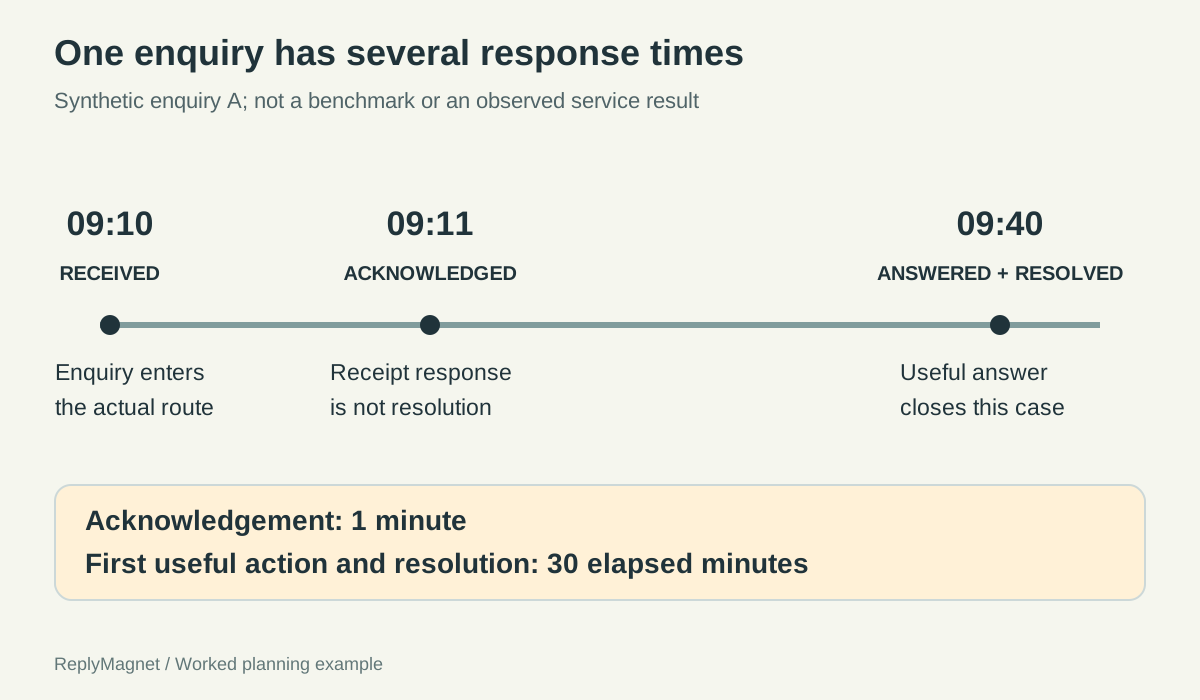
Original response timeline using the fictional enquiry A; spacing is not to scale. No performance improvement or recommended service target is claimed.
Synthetic timestamp worksheet. Blank dependency notes should be completed from real records, not assumptions.
Enquiry
A
- Received
- 09:10
- First useful action
- 09:40
- Resolved
- 09:40 same day
- Context
- Answered directly
Enquiry
B
- Received
- 11:50
- First useful action
- 12:00
- Resolved
- 15:00 same day
- Context
- Customer information arrived at 14:20
Enquiry
C
- Received
- 16:40
- First useful action
- 09:30 next day
- Resolved
- 10:15 next day
- Context
- Owner decision and handover required
Review missed commitments as an operational problem
Compare the promised event with the recorded event, then fix the cause. Report delays honestly instead of redefining an acknowledgement as a completed response.
For each missed commitment, identify what failed. Did the request arrive outside stated coverage? Was the promise unclear? Did the primary owner fail to hand over? Did the team need authority or information it could not obtain in time?
A useful review produces a change tied to the cause. It may adjust the rota, clarify a contact route, improve the enquiry instructions or narrow an unrealistic public promise. Adding a faster acknowledgement does not solve a queue waiting for a specialist decision.
Tell the customer when an existing commitment will be missed, using the appropriate supported channel and an honest next step. Do not invent a new resolution time just to replace the old one. If the timing remains uncertain, explain what is being checked and who owns it.
Keep the measurement definitions stable across review periods. If you change from elapsed hours to staffed hours, label the change rather than presenting the new number as an improvement in actual waiting. Separate unresolved work from resolved cases so difficult enquiries do not disappear from the report.
The lead diagnosis guide connects enquiries to broader outcomes. For response operations, the immediate standard is simpler: someone owns the work, the customer understands the next step and your records show the real interval between receiving, acting and resolving.