Guides
Put setup and exception time into the automation cost calculation
The software fee is easy to find. The harder number is how much work remains after the routine reply is automated. A useful estimate includes that work, the time spent maintaining the campaign and the cost of getting the first version right.
Published by ReplyMagnet · Last updated
Measure a repeatable task before valuing the tool
Time the same complete task under the manual and proposed workflows. Compare like with like, including checking the request and handling the remaining follow-up.
Choose one ordinary task, such as supplying the correct preparation guide after a clear request. Start the manual timer when the person begins dealing with the request and stop when the promised task is complete. Record interruptions separately so one unusual conversation does not become the assumed average.
Do not compare the time to type a sentence manually with the entire automated campaign lifecycle. Equally, do not assume the automated case consumes zero staff time. Someone may still review exceptions, maintain the file, inspect failures or answer questions after delivery.
Record several normal observations when practical and keep the range visible. A familiar request might take less time than one requiring a resource lookup. If you only have an estimate, label it as an estimate and identify the observation needed to replace it.
The result should describe a defined case, not “Instagram work” in general. Bespoke advice, complaints and purchase discussions may remain manual. Count those separately rather than pretending that every conversation benefits from the same time reduction.

Editorial illustration of a planning ledger, not a measured customer saving.
Keep cash spending and the value of time separate
A reduction in staff minutes can create capacity without reducing the amount paid that month. Report actual cash costs separately from an estimated value assigned to time.
If an owner saves an hour and uses it to improve a resource, no cash necessarily enters the bank account. The hour can still be valuable. Name it as capacity or opportunity cost rather than an observed payroll saving.
Similarly, a salaried teammate may spend less time copying links while receiving the same salary. The organization gains time for other work only if that time is usable and reassigned. Small fragments between interruptions may be less valuable than a continuous block.
Make two columns in your record. Cash costs include software charges and any contractor invoice specifically incurred for the campaign. Time includes setup, routine handling, maintenance and exceptions. You can later apply a chosen hourly value to the time column, but keep the original minutes visible.
The SBA business-planning guidance distinguishes one-time and recurring costs and treats break-even calculations as estimates. The model below applies that general cost discipline to a workflow; it is an original operational estimate, not the SBA's sales break-even calculator.
Use your actual subscription and implementation costs. The hypothetical software amount in this article is not a ReplyMagnet price or a recommendation about which plan to buy. Current entitlements belong in the plan documentation and your account's billing information.
Build the monthly time equation
Subtract remaining handling, maintenance and allocated setup time from the manual baseline. Add exception work explicitly if it is not already included in the remaining handling estimate.
Use these variables for routine requests of the same type:
- N: number of routine requests in the month.
- m: manual minutes per request.
- a: remaining staff minutes per request with automation.
- M: recurring campaign maintenance minutes per month.
- A: setup minutes allocated to this month.
The estimated net time released is N × (m − a) − M − A.
If exception work is not included in a, subtract its total minutes as another term. Do not count it in both places. If difficult cases take the same time under both workflows, they cancel in a comparison of the two, but they still need staffing in the actual operating plan.
Setup allocation is a planning choice. If you spend 180 minutes initially and expect to use the campaign for three months, allocating 60 minutes to each month can show an average operating view. The actual first month still contains all 180 setup minutes. Keep both views if you need to plan immediate workload.
Choose a realistic useful life. A one-week event campaign should not have its setup cost spread over a year merely to make the calculation positive. If the resource changes every month, some apparent setup work may really be recurring maintenance.
The formula does not value faster responses, customer satisfaction or extra sales. Those may deserve separate observation, but adding guessed revenue would obscure whether the basic time case works.
Work through three explicitly hypothetical scenarios
Changing request volume can reverse the conclusion when maintenance and setup are substantial. Use several scenarios instead of treating one optimistic demand estimate as a forecast.
All assumptions below are invented for teaching. They are not ReplyMagnet customer results, measured task times or current product prices.
Assume manual handling takes 3 minutes, remaining handling takes 1 minute, recurring maintenance takes 60 minutes a month, and allocated setup takes another 60. Assign time a hypothetical value of 30 currency units per hour. Assume software costs 20 currency units monthly, with no other incremental cash cost.
For 100 routine requests, the gross reduction is 100 × (3 − 1) = 200 minutes. After maintenance and setup allocation, 200 − 60 − 60 = 80 minutes remain. Their assigned value is 80 ÷ 60 × 30 = 40. Subtracting the assumed software fee gives a modeled net value of 20 currency units.
This is a value estimate, not 20 units of demonstrated cash savings. The result depends on the chosen hourly value and the reality of the time difference. If remaining handling is higher than assumed, the result falls.
The lower-volume case is negative because maintenance and allocated setup exceed the routine reduction. A negative value is useful information. It may suggest a simpler campaign, a lower-maintenance resource, or continuing manually until the task is frequent enough.
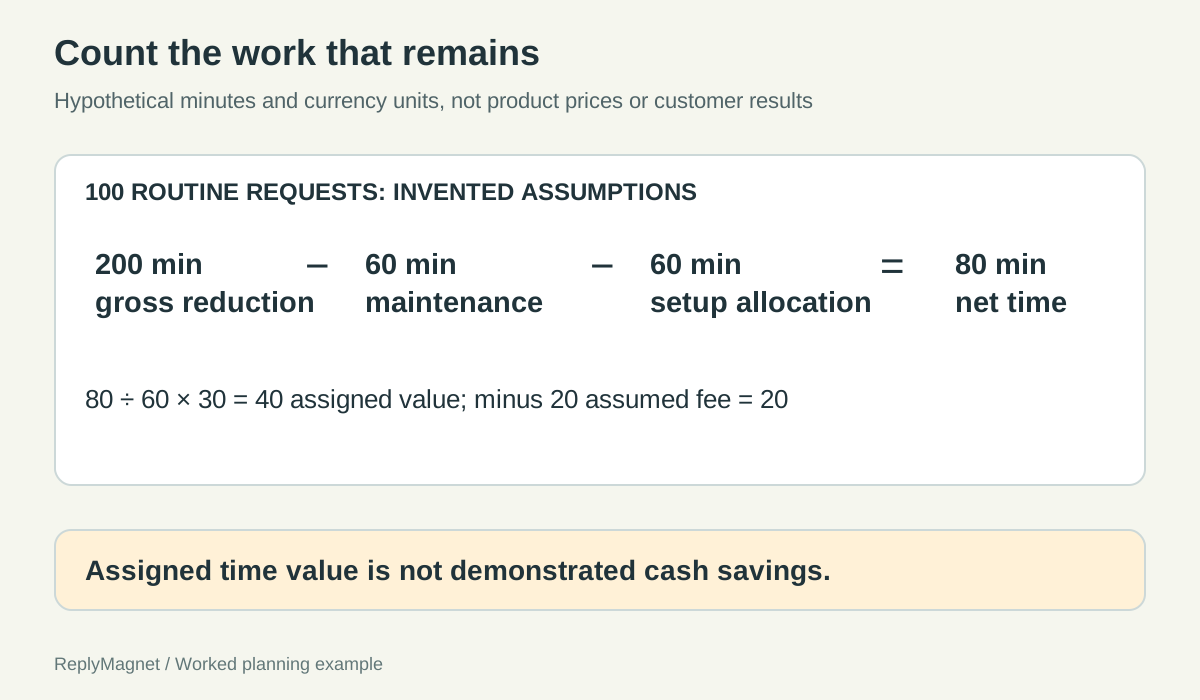
Original arithmetic diagram with the article’s hypothetical assumptions. No actual saving is claimed.
Synthetic monthly scenarios with identical time assumptions
Routine requests
25
- Net minutes after M and A
- −70
- Assigned time value
- −35
- Value minus assumed 20 fee
- −55
Routine requests
100
- Net minutes after M and A
- 80
- Assigned time value
- 40
- Value minus assumed 20 fee
- 20
Routine requests
300
- Net minutes after M and A
- 480
- Assigned time value
- 240
- Value minus assumed 20 fee
- 220
Calculate a threshold only when the assumptions make sense
A modeled break-even volume is the point where assigned time value covers incremental cash cost. It is not a guarantee of profitability or a universal minimum number of messages.
Let V be the chosen value of an hour and S the monthly incremental software cost. With the same assumptions, modeled net value is:
[N × (m − a) − M − A] ÷ 60 × V − S.
When m is greater than a and V is positive, the modeled threshold is:
N = [M + A + (60 × S ÷ V)] ÷ (m − a).
Using the fictional assumptions, that is [60 + 60 + (60 × 20 ÷ 30)] ÷ 2 = 80 routine requests. At 80, the net time is 40 minutes, valued at 20 units, which equals the assumed fee.
If automation leaves the same or more staff time per request, the positive time-saving threshold in this form does not exist. Do not divide by zero or a negative difference and present the output as a buying recommendation. Investigate why the workflow adds work.
Additional contractor costs, variable charges or exception handling belong in the model if they change because of the decision. Keep shared costs out unless you are deliberately allocating them and can explain the basis.
A threshold of 80 under these invented assumptions does not imply that 80 is right for another business. Someone with a ten-minute manual task and a complex monthly review will have a different calculation from someone sending a familiar link in a few seconds.
Stress the assumptions that can change the decision
Vary handling time, maintenance and campaign lifetime separately. A result that is positive only under one favorable estimate deserves a cautious operating trial rather than a confident savings claim.
Start with remaining handling time, because it is easy to underestimate. If each automated request still needs two minutes instead of one, the per-request reduction halves in the example. The same demand no longer supports the same time value.
Next, increase maintenance to include the work you are likely to forget: correcting a file, checking destinations, reviewing failed deliveries and explaining changes to teammates. Maintenance is not only time spent in the campaign editor.
Then inspect campaign lifetime. A resource you can use for several months may justify setup effort that a short-lived promotion cannot. Treat a later reusable version as a new observation rather than assuming in advance that every campaign will become an evergreen asset.
Finally, review the chosen hourly value. It might represent an actual billable opportunity, a staffing cost assumption or the owner's subjective value of an hour. Those are different interpretations. Keep the label beside the number and avoid describing all three as recovered revenue.
If your purpose is to estimate customer acquisition cost, use a separate analysis of spending and verified outcomes. The Instagram lead worksheet helps define those outcomes; this model concerns the operating work around a request.
Replace estimates after the first operating period
Compare expected and observed handling, maintenance and exception time. Keep the original assumptions so the review explains what changed instead of rewriting the forecast to match reality.
Use a record with these fields: task definition; manual observations and dates; automated-case observations; routine volume; exception minutes; maintenance minutes; setup total and allocation period; cash charges; hourly value and its meaning; remaining uncertainty.
At the review, ask whether the same kinds of request were compared. If the campaign began attracting complicated questions, the mix changed. A higher remaining-handling average may reflect that change rather than failure of the resource-delivery step.
Check service quality alongside minutes. Saving time by sending the wrong resource or leaving exceptions unanswered is not a useful improvement. Note complaints, repeated requests and broken destinations without pretending that every issue can be priced accurately.
Review the plan limits before assuming the modeled volume can run under the selected subscription. Capacity, eligibility and messaging windows remain operational constraints; a cost spreadsheet cannot remove them.
Time one routine task, write down the work that would remain, and run the low-volume scenario first. That gives you a concrete reason to test a small automation or to keep the task manual. Both can be sensible decisions when the assumptions are honest.