Guides
Write a customer story the evidence can support
A strong customer story helps another buyer understand a decision. It shows what changed, why that change mattered and how much of the outcome you can actually explain. The impressive number comes later, if there is a defensible number at all.
Published by ReplyMagnet · Last updated
Start with the decision, not the testimonial
Choose one customer decision that readers could learn from. A narrow account of a real change is more useful than a broad success claim with missing context.

Suppose a service business changed how it explains its packages to prospective customers. The story could investigate why people were confused, which information the business changed and what happened to the questions it received. That is a useful subject even if nobody can establish a revenue effect.
This is an instructional scenario, not a ReplyMagnet customer case. There are no customer quotations or claimed results in it. Use the method below on your own authorized records, then decide which claims survive examination.
Write the editorial question first: “What did customers need to know before choosing a package?” This invites an explanation. “How did our product transform this business?” assumes the conclusion before anyone has checked the material.
The distinction affects the interview. Ask someone to describe the old process, show an example of the difficulty and identify the decision they made. Ask what was awkward after the change as well as what improved. If you only ask for benefits, your notes may tell you more about the interview than the project.
Google’s helpful content guidance asks whether a page provides original information and demonstrates experience or knowledge. For a customer story, that means inspectable project detail. A polished adjective cannot stand in for the work that happened.
Build an evidence folder before writing the opening
Keep each proposed claim beside its source, definition, timeframe and limitations. A screenshot can support what a screen displayed; it does not explain everything that produced it.
Create a small evidence folder with a clear owner and access limited to the people doing the work. Collect only material relevant to the story. Remove customer identifiers from working copies when the identifiers add nothing to the explanation.
The folder should let an editor trace a sentence back to a record without asking the writer to remember what they meant. For a process change, that might include the old resource, the revised resource, the date it changed and notes explaining the choice. For a measured outcome, it needs the underlying measurement and its definition.
Record the period precisely. “After launch” could mean the first afternoon, a full month or several busy seasons. Also record exclusions: whether internal tests were removed, which accounts were included and whether a campaign changed partway through the period.
Preserve the difference between a system event and a business outcome. A delivered DM is not a qualified enquiry. An enquiry is not a booking. A person requesting two resources is not necessarily two people. The Instagram lead measurement guide helps separate these stages before you use them as evidence.
If you cannot reconstruct a baseline, say so in the working notes. Do not build one retrospectively from a customer’s general impression. An honest process story can describe the change and the current workflow without publishing a before-and-after comparison.
Evidence checklist for a real project; these are required records, not supplied results.
Proposed material
A workflow change
- Record to collect
- Dated old and new versions
- Question before use
- What changed besides the wording?
Proposed material
A count or rate
- Record to collect
- Export, definition and period
- Question before use
- Are numerator and denominator comparable?
Proposed material
A customer quotation
- Record to collect
- Recording or approved written wording
- Question before use
- Does the quote retain its original context?
Proposed material
An image
- Record to collect
- Original and authorized publication scope
- Question before use
- Does it expose unrelated personal information?
Proposed material
A business result
- Record to collect
- Relevant business record
- Question before use
- Can this be linked to the described activity?
Separate the observation from the explanation
An observed change and its cause are different claims. Report the change at the level your records support, then describe alternative explanations that matter.
A customer may sincerely believe that a clearer resource caused better enquiries. Their interpretation is useful, but it remains an interpretation unless the evidence supports a causal claim. Attribute it as their view, with approved wording, rather than converting it into the narrator’s certainty.
Look for other changes during the same period. Was there a promotion? Did the audience grow? Did paid distribution begin? Did the offer, price, staffing or qualification definition change? Were the comparison periods equally long and similarly seasonal? A customer does not need a laboratory study to share a story, but readers need to know when several changes happened together.
Use three separate notes while drafting: what the record shows, what the customer thinks it means and what remains unresolved. This prevents an explanation from quietly becoming a fact as the draft gets shorter.
Be especially careful with percentages. A percentage without its starting count can make a small change look more substantial than it is. If permission and context allow, show the counts and calculation alongside the percentage. If the underlying counts are unavailable, remove the percentage rather than decorating it with a vague qualification.
Do not manufacture precision by estimating missing values. If a customer recalls saving time but never recorded the duration of the old and new process, describe the specific manual steps removed. “They no longer copied the same resource link into each reply” is a process claim that can be checked. A weekly hours-saved claim needs additional evidence.
GOV.UK’s research planning guidance recommends deciding what you need to learn and choosing research that addresses it. Applied here, define the claim before choosing the evidence, then remain willing to narrow the claim.
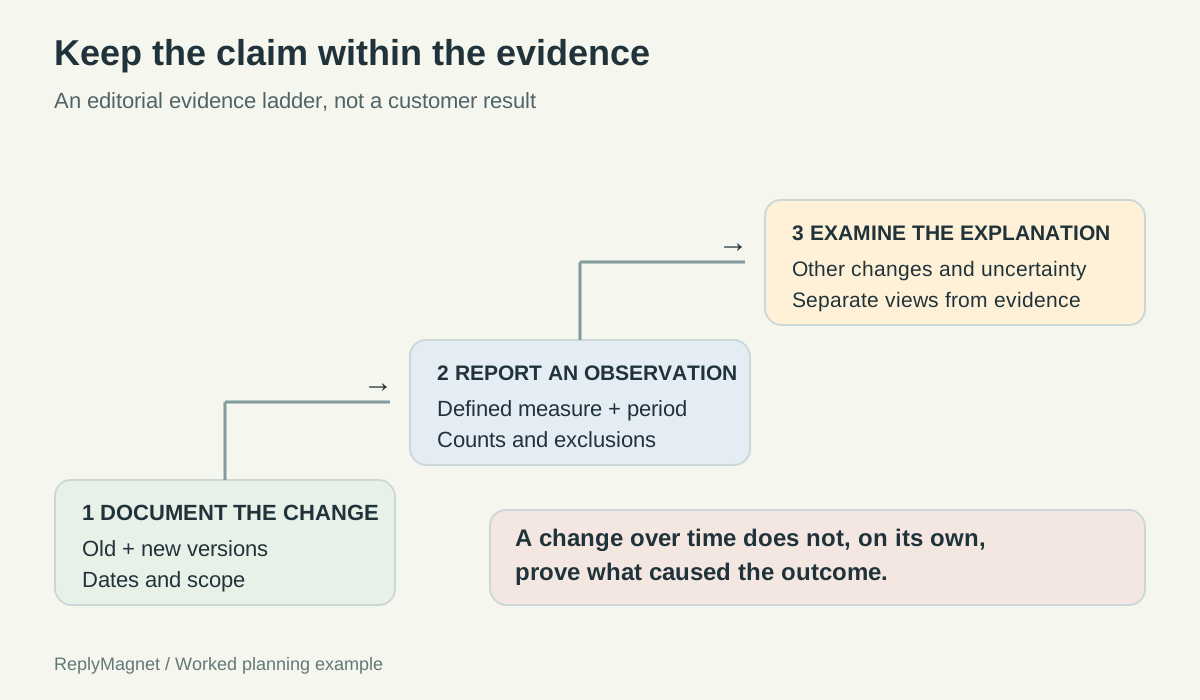
Original evidence-to-claim diagram. It contains no customer result, quotation or claim that a causal effect has been established.
A narrative skeleton that leaves room for uncertainty
Draft the story as context, decision, implementation, observation and limits. Leave placeholders unresolved until real evidence supplies them.
The following skeleton is deliberately incomplete. It is a writing aid for a real, approved project, not a ready-made success story. Do not publish the brackets or fill them with plausible inventions.
Context: [The business and the relevant offer], serving [the audience relevant to this decision], had [a documented difficulty]. The difficulty mattered because [the specific consequence supported by the customer’s account or records].
Decision: The team considered [documented alternatives] and chose [the actual change]. Their reason was [an approved explanation]. They kept [a relevant constraint] because [the reason it mattered].
Implementation: Between [dates], the team changed [specific material or process]. [Named roles, if approved] handled [responsibilities]. The new process still required [manual work or unresolved step].
Observation: During [defined period], [source] recorded [the supported observation]. The measure means [plain-language definition]. It does not include [important exclusion].
Limits: During that period, [other relevant changes] also occurred. The records do not establish [claim beyond the evidence]. The team plans to examine [a real next question, only if confirmed].
Useful lesson: A reader facing [a similar condition] could consider [bounded decision]. A reader with [different conditions] should not assume the same result.
Notice that the lesson is conditional. A local workshop with one offer and a staffed inbox may make a different decision from an agency managing several accounts. Keeping that difference visible helps the reader decide whether the story applies to them.
If you have no outcome evidence, end after the implementation and limits. A detailed walkthrough of a real decision can stand alone. Do not label an unmeasured process change a proven conversion improvement.
Approval should cover the actual material people will see
Ask the customer to check factual details, quotation wording and publication scope on the finished draft. Approval of an interview does not settle every later use of its contents.
Prepare a review copy that includes the headline, body, images, captions and any social excerpts you intend to publish. An accurate paragraph can become misleading when its headline removes the qualification. A quotation can change meaning when a carousel separates it from the surrounding explanation.
Ask specific review questions: Is the timeframe right? Are the roles described accurately? Does this quote convey what you meant? Are these identifying details appropriate to publish? Is there confidential information in the screenshot? Record the approved version and the scope agreed with the customer.
Keep factual review separate from pressure to supply a stronger endorsement. If a customer corrects an outcome claim downward, update every occurrence. If they prefer anonymity, check whether the combination of sector, location, dates and project details still identifies them.
This is an editorial workflow, not a statement of universal legal requirements. Your organization may have additional approval rules. If approval remains unclear, keep the material private and publish a general instructional article that contains no identifiable customer material.
A useful evidence folder also records who approved the version and when. If the offer or product changes later, that record helps an editor determine whether the story remains current or needs a dated note. It does not give unlimited permission for unrelated future reuse.
Adapt the lesson for Instagram without overstating it
Choose one decision from the approved story for a post, and keep the context and limitations attached. Link to the full account when readers need the detail.
A carousel could explain the confusing old question, the decision the team made and the revised resource. A short video could show the actual approved process. A caption could focus on the tradeoff: what became easier and what still needed a person.
Carry the evidence boundary into the shorter version. If the full article says a change coincided with a result, the caption must not say it caused that result. If the outcome applies to one account during one period, do not turn it into a promise for every account.
Use the post’s next action to serve the lesson. Readers might inspect the resource, read the full case or compare their own workflow using a checklist. The guide for social media managers covers the operational context when the next task is organizing client work.
Before release, have someone who did not write the story underline every claim that implies an outcome. They should be able to find the supporting record or an explicit attribution for each one. Remove any sentence that needs the writer in the room to explain why it is technically true.
The finished story should leave readers understanding a decision more clearly. Its credibility comes from the details you can show and the boundaries you preserve.