Guides
Ask customers for content they actually want to contribute
A customer photo can answer a practical question that a product image cannot. It may show how an item fits in an ordinary workspace or how someone uses a resource. But a public post or a friendly reply is not a complete plan for reusing that contribution.
Published by ReplyMagnet · Last updated
The short answer
Ask for one small contribution, explain the intended use and record the agreed scope before publication. Keep participation optional, preserve the contributor’s meaning and seek a new decision when your proposed use changes.
Start freeStart with the question the contribution would answer
Choose a contribution because it helps another reader understand something specific, not simply because customer content feels authentic.
A fictional stationery shop wants to show how people organize a small desk with its notebook holder. The useful buyer question is “How much working space does this leave?” A customer photograph taken in an ordinary workspace could help illustrate context. A generic request for “content we can share” gives the customer much less direction.
Decide what you need before asking. In this example, one photograph showing the holder beside an everyday object can be enough. A short note explaining the setup may add useful context. The shop does not need a full testimonial, a home tour or a claim that the product improved productivity.
Keep the contribution separate from evidence of an outcome. A photo can show one person's arrangement. It does not establish that the product saves time, fits every desk or represents typical results. If you want to make a stronger claim, you need evidence suited to that claim rather than a more enthusiastic caption.
Google's helpful-content guidance encourages useful original value. That is a reason to seek a specific perspective, not permission to reuse someone else's work. The editorial decision and the permission decision are separate.
For ecommerce businesses, the brand use case covers resource and conversation workflows. This guide concerns a different task: inviting a willing person to contribute material and keeping the eventual publication consistent with what they agreed to.

Generated editorial illustration of reviewing a contribution. It is not a real customer, permission record or testimonial.
Try the resource flow for 30 days with 1,000 engagements. No card required.
Start freeWrite a request small enough to understand
Explain what to send, why it would help, where it may appear and that saying no will not affect the customer relationship.
The stationery shop drafts this illustrative invitation: “We are preparing an Instagram post about small-desk setups. If you would like to contribute, could you send one photo showing how you use the notebook holder, plus a sentence about the space it occupies? We would discuss the exact image, caption and credit with you before using it. Taking part is optional.”
This is an example of clear editorial communication, not a legal release. It gives the person enough context to decide whether they want to continue. It also limits the initial request to a manageable contribution rather than asking for an open-ended bundle of marketing material.
Avoid embedding pressure in a friendly tone. “As one of our best customers, we know you'll help us” makes refusal harder. “Your support means everything to our small business” may be sincere, but it can shift the request away from an informed choice. A simple invitation is enough.
If you offer a payment, gift or other incentive, state it plainly and review the applicable disclosure requirements before publication. Do not quietly exchange a benefit for a positive opinion or require praise as the condition for participating. The article does not provide a universal legal or endorsement-disclosure formula; requirements depend on the use and jurisdiction.
Do not send mass unsolicited requests merely because a person commented on a post. Use an appropriate, authorized route and respect the platform's messaging constraints. The automation rules guide is relevant when Instagram is the communication channel. A contribution request is not a reason to assume unrestricted follow-up permission.
Record the scope before the asset becomes a post
Track the exact material, intended channels, edits, credit and approval evidence in a simple working record.
A useful permission record identifies the contributor, the specific asset and the proposed use. “Customer said yes” is too vague if the team later wants to crop the image, add text, use it in an advertisement or publish it on a website. Record what the person actually agreed to, not what the business hoped their answer implied.
For the illustrative desk photo, the working record might contain: asset “desk-photo-01”; proposed use “one organic Instagram carousel”; edit “crop empty edge, no change to the product or room”; caption “customer's setup, described without a performance claim”; credit “agreed handle”; final review “pending.” These are example fields, not completed permission evidence.
Keep the original request and response with the record in an appropriate internal location. If approval was conditional, preserve the condition. If the person wants a different credit or asks you to remove a visible object, update the proposed use and obtain clarity before publishing.
Ownership can be more complicated than who sent the file. The U.S. Copyright Office's permission FAQ explains that permission can be requested from the copyright owner and that owning a copy of a photograph is distinct from owning rights in the photograph. Use that as a reason to clarify authority when it is uncertain, not as a complete legal checklist for every jurisdiction.
A public post is not an instruction to treat its contents as freely reusable. Nor does tagging the creator settle every question about the use. For complex or paid commercial reuse, get appropriate advice about the required permissions instead of stretching a casual DM into a universal release.
Unfilled contribution-use record. This is an editorial worksheet, not permission already obtained or a legal release.
Field
Specific asset
- Record before publishing
- File/version and contributor reference
Field
Intended use
- Record before publishing
- Named channel, organic or paid context, proposed placement
Field
Edits and context
- Record before publishing
- Crop, rewritten wording and surrounding claim
Field
Credit
- Record before publishing
- Exact approved attribution or anonymity choice
Field
Approval evidence
- Record before publishing
- Actual response, conditions and version reviewed
Field
Publication and reuse
- Record before publishing
- Location, owner and any new-scope review needed
Edit the contribution without changing its meaning
Improve clarity and presentation while preserving the context, qualifications and actual experience the person supplied.
Suppose the customer writes, “This fits my narrow desk if I keep the lamp on the shelf.” Removing the second half would make the statement simpler and more favorable, but it would also remove the condition that makes it accurate. Preserve that context or choose a different excerpt with the contributor's agreement.
The same issue appears in image editing. A tighter crop can improve composition, but it may hide the feature that explains scale. Removing an inconvenient object could make the workspace look more spacious than the original. Decide whether the edit changes what a reasonable viewer would infer, not merely whether the picture looks cleaner.
Use captions that distinguish observation from generalization. “One customer's arrangement on a narrow desk” describes the example. “The perfect solution for every small desk” expands it into an unsupported claim. A contribution does not become more useful when the brand exaggerates it.
When rewriting a short note for grammar or length, show the proposed version to the contributor if that is part of your agreed process. Keep their intended meaning and do not invent a more polished personality. If the original contribution is unclear, ask a specific follow-up rather than filling the gap with marketing language.
This workflow is different from building a customer case study. A case study requires careful evidence for its claims and outcomes. A modest contribution can remain modest: one photo, one contextual sentence and a clear explanation of why it is included.
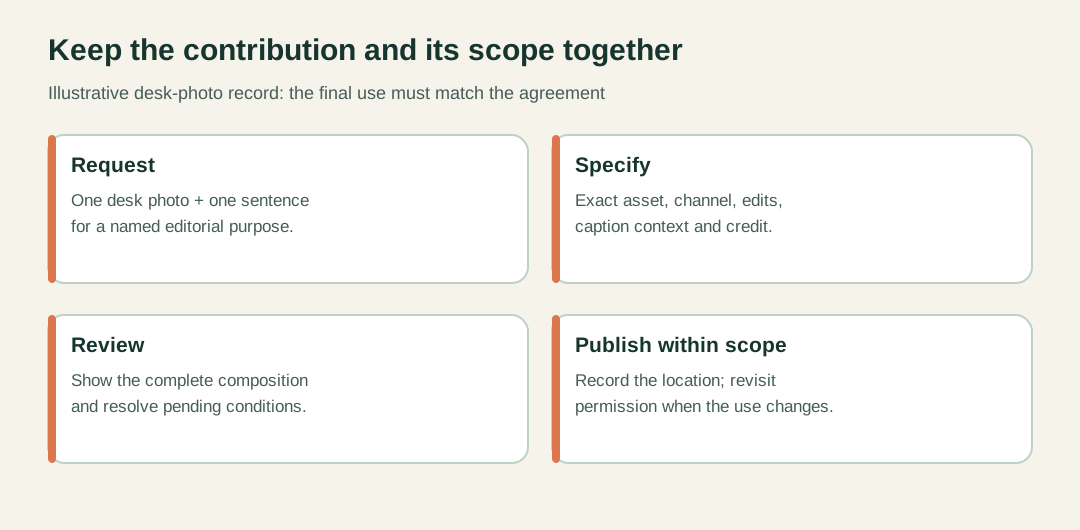
Editorial permission workflow example, not a legal release or evidence of an actual customer agreement.
Review the final composition, not just the raw file
Check the complete post because headlines, neighboring images and calls to action can change what the contribution appears to endorse.
A customer may approve a photograph without having seen the headline placed above it. The final composition can imply a claim that the photograph alone did not make. Review the whole post against the recorded scope, including the caption, labels, credit and any surrounding offer.
For the stationery example, a neutral comparison of workspace arrangements is different from a paid ad saying “Customers prove this doubles your productivity.” The second use introduces a performance claim and a different context. Do not assume the earlier permission covers it.
Check the credit exactly as agreed. A contributor may prefer a handle, a first name, another attribution or no public identifier. Do not publish extra personal details because they happen to appear in the original message. The content only needs the information relevant to its purpose.
Maintain a clear route for questions about the published use. If someone identifies an error or raises a concern, the team should know which asset and agreement to review. Avoid promising that every copy can be recalled from the internet, but act on the surfaces you control according to the applicable agreement and responsibilities.
If the post is also a giveaway or contest, that introduces a different set of rules and participant expectations. The giveaway guide covers that separate workflow. The contribution process here is deliberately noncompetitive: no prize mechanics are needed to ask for a useful optional perspective.
Close the loop and keep the record usable
Tell the contributor what happened as promised, and revisit the scope before reusing the material in a new context.
After publication, follow through on the communication you promised. Share the published use through the agreed route if appropriate, thank the contributor without implying a future obligation and record the publication location in the internal log. A clean record helps the next teammate avoid treating an old file as a blank license.
If the contribution is not used, do not invent a reason or leave a promised decision unanswered indefinitely. A brief explanation that the editorial plan changed can be enough. Keep any retained material according to your stated process and applicable responsibilities.
Before reusing the photo months later, read the scope again. A new channel, paid promotion, substantial edit or different claim may require a new agreement. The practical question is simple: is this the use the person understood when they agreed? If not, clarify it before proceeding.
Review the request itself after a few contributions. Did people understand what to send? Did the team repeatedly need details that were missing from the invitation? Improve the specificity rather than expanding the request into a demanding production brief.
The strongest customer contribution is not necessarily the most polished. It is a relevant piece of real context, presented honestly and used on terms the contributor understands. That combination helps the reader and protects the trust that made the contribution possible.