Guides
Make useful content decisions when the numbers are small
One post produces eight relevant requests. The next produces eleven. It is tempting to call the second approach a winner, until you notice that it reached a different audience on a different day and promoted the offer for longer.
Published by ReplyMagnet · Last updated
Two published posts are usually an observational comparison
Sequential posts can suggest what to investigate, but they do not isolate the effect of a single change. Different exposure, timing and audiences can explain part of the difference.
A small account can learn from publishing deliberately. The useful distinction is between a practical comparison and a randomized experiment. You do not need to call every change an A/B test for it to inform your next decision.
In a randomized design, the compared treatment is assigned randomly to experimental units, as explained in the NIST introduction to completely randomized designs. Publishing caption A on Tuesday and caption B on Friday does not create that assignment. The people who see each post may differ in ways you cannot observe.
Suppose the only planned change is a more specific resource name. The later post might also benefit from a product launch, a collaborator's mention or a different visual. Even if the recorded request count increases, those other changes remain plausible explanations.
Describe the work honestly: “We compared two posts with different resource wording.” That allows a useful discussion of what happened without claiming you proved what caused it. This guide does not imply that ReplyMagnet provides native randomized experimentation.

Editorial illustration. The comparison is not represented as a controlled experiment.
Write the decision before the result arrives
State what you expect to change, what you will observe and what decision the evidence could support. Include an inconclusive outcome so uncertainty does not become an invented winner.
A useful question is smaller than “Which content performs best?” Try: “Does naming the exact checklist make the request easier to understand?” That question can be investigated through both observed requests and direct comprehension checks.
Write a short comparison card before publishing. It need not be a formal research registration. Its purpose is to prevent the success definition from changing after you see an attractive number.
An illustrative card might say: “We will compare the vague phrase free guide with weekend packing checklist while keeping the offered file and destination the same. We will inspect relevant requests during a defined period and note any requests showing confusion. If the evidence is sparse or exposure differs substantially, we will not declare a performance winner.”
Specify the action you could reasonably take. You might retain clearer wording because readers understand it, while remaining uncertain about its effect on requests. That is a defensible editorial decision. It does not need to become a claim that the new phrase increased conversion.
Decide when you will review the data. Repeatedly checking until a preferred version happens to look better makes the stopping point part of the problem. If an operational issue requires stopping early, record that reason and treat the comparison as interrupted.
A practical pre-publication comparison card
Field
Question
- Write before publication
- Which uncertainty would change our next editorial decision?
Field
Planned change
- Write before publication
- One change we can describe precisely
Field
Kept comparable
- Write before publication
- Offer, destination and observation period
Field
Observed outcome
- Write before publication
- Defined request or action, with its data source
Field
Context to record
- Write before publication
- Dates, audience changes, promotion and technical problems
Field
Decision options
- Write before publication
- Retain, revise, investigate again or inconclusive
Field
Review point
- Write before publication
- Date and reason for any early stop
Keep the comparison interpretable even when you cannot control everything
Hold the offer and measurement definitions steady where practical, and record other differences. Documentation cannot remove confounding, but it can prevent an unjustified conclusion.
Use the same resource version if your question concerns how it is introduced. If the second post offers a substantially better file, you have changed both the wording and the value of the offer. That may be useful business work, but it answers a broader question.
Give each post a defined observation period. Comparing a month of requests for A with one afternoon for B is difficult to interpret. Keep the timezone and review cutoff visible, and separate later outcomes from the initial period.
Record distribution changes. Was one post shared by a partner? Was one promoted through another channel? Did the audience already see the first version? These details can matter even when the two captions differ by only a few words.
Check the destination and delivery before interpreting the numbers. A broken resource link can suppress completed activity while leaving request counts intact. The campaign examples guide helps you keep the offer and response aligned; it does not turn different posts into a controlled test.
Do not try to fix every difference with a ratio. Dividing by reach can add context, but it does not make the audiences equivalent or prove that each reached account had the same chance to act. Your metric definition still needs to match the observation.
Read this fictional result without choosing a winner
Keep both counts and denominators visible. A larger number of requests can coexist with a lower request-to-reach ratio, and neither alone establishes a causal advantage.
All figures in this example are invented. They are not account analytics, benchmarks or results from a test performed by ReplyMagnet.
Post A reaches 200 accounts and produces 8 relevant requests. Post B reaches 350 accounts and produces 11. The simple request-count-to-reach ratios are 8 ÷ 200 = 4% and 11 ÷ 350 ≈ 3.14%.
B has three more requests. A has the higher ratio. You cannot choose the truth by selecting whichever measure supports the version you prefer. Decide what each number actually represents and return to the question written before publication.
If requests include repeated actions by the same person, neither ratio is a unique-person conversion rate. If the reach figures use different definitions or periods, the comparison needs correction before interpretation. A person can also encounter the offer more than once before requesting it.
The dataset does not establish statistical significance. It has no randomized allocation and only a small number of observed outcomes. We have not calculated a p-value or supplied a universal minimum sample because those require an appropriate design and assumptions.
A reasonable note is: “B recorded more requests and more reach; A had a higher request-count-to-reach ratio. Different exposure and the small outcome counts prevent a confident causal conclusion. We will retain the clearer promise and investigate remaining confusion.”
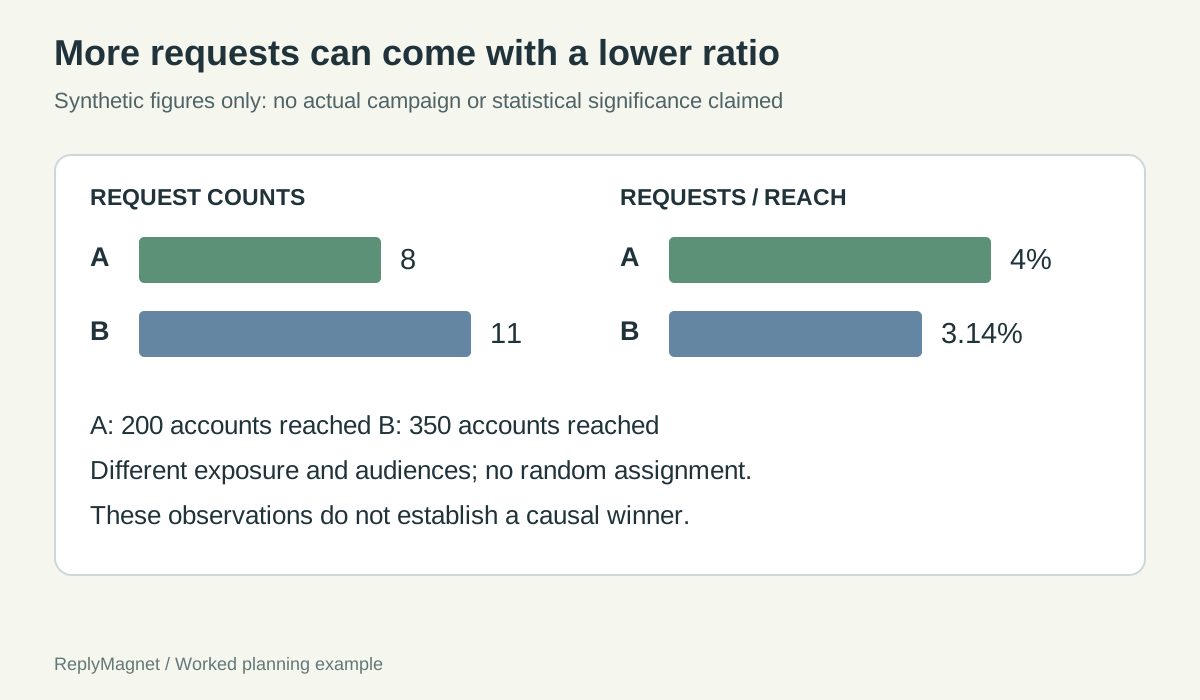
Original chart using invented figures. Request-count-to-reach ratios are not verified unique-person conversion rates.
Synthetic two-post comparison, not a measured campaign result
Observation
Accounts reached
- Post A
- 200
- Post B
- 350
Observation
Relevant request count
- Post A
- 8
- Post B
- 11
Observation
Requests divided by reach
- Post A
- 4%
- Post B
- About 3.14%
Observation
Random assignment
- Post A
- No
- Post B
- No
Observation
Same audience established
- Post A
- No
- Post B
- No
Observation
Conclusion
- Post A
- No causal winner established
- Post B
- No causal winner established
Distinguish a useful operational choice from a proven effect
You may choose clearer or easier-to-maintain content while remaining uncertain about its numerical advantage. Explain the basis of the choice rather than overstating the evidence.
If two versions have similar observed activity but one describes the resource accurately, use the accurate one. You do not need a large experiment to stop making a misleading promise. Correctness is a requirement, not a variant to optimize away.
If the new wording takes more work to maintain, include that practical cost in the decision. A caption that embeds changing prices may need more frequent review than one linking to a current price page. That difference can matter even when the response numbers cannot distinguish performance.
When a choice has a substantial business consequence, a small observational comparison may be insufficient. Seek a better measurement design rather than pretending the available data is decisive. The NIST experiment terminology explains why randomization and replication matter when separating effects from variation.
Keep the conclusion proportional. “We prefer the specific resource name because it reduces ambiguity” is an editorial judgment. “The specific name causes more bookings” is a causal claim requiring different evidence. Write those as separate statements if you have evidence for only the first.
Preserve an inconclusive result. It stops the team from repeatedly rediscovering the same uncertain comparison and helps the next reviewer see which unanswered question remains.
Use conversation when counts cannot explain confusion
Ask willing relevant readers to explain the offer and expected next step. Qualitative observations can reveal misunderstandings that a small request total cannot explain.
If very few people act, the numbers alone may not tell you whether the offer is unclear, irrelevant or unseen. A short conversation with a relevant reader can help distinguish those possibilities.
Show the post without explaining it. Ask what the resource contains, who it is for and what they would do to obtain it. Record their answer as an observation, then inspect where it differs from your intent. Do not ask only whether they like the caption.
The GOV.UK research planning guidance recommends selecting a method for the question you need to answer. A comprehension question and an estimate of population conversion are different research problems. Several useful conversations do not establish how common the misunderstanding is across the whole audience.
A reader may understand the offer perfectly and still not need it. That is an offer or audience issue rather than evidence that the call to action is poorly written. Keep that possibility in the notes instead of revising the same sentence endlessly.
Combine the observations carefully: the post comparison shows what was recorded under particular conditions; the conversations suggest reasons worth investigating. Neither should be used to claim certainty the other does not provide.
Keep a record that makes the next comparison better
Save the planned change, actual conditions, definitions and conclusion together. Carry forward the unresolved question rather than repeating the same test with a new headline.
After the review, add the observed counts, known differences and decision to the original comparison card. Include broken links, changed offers or missed observation periods. A clean-looking record that omits those events is less useful than a candid one.
For business outcomes, use the lead worksheet to define the people and outcome you are actually following. Do not replace relevant enquiries or confirmed bookings with a convenient activity total when those outcomes are unavailable.
Your next action might be to repair delivery, ask readers about the resource, or repeat a carefully described comparison. It might also be to stop testing a minor phrasing difference and improve the offer itself.
Choose one question you can answer with the evidence available. A small audience can still teach you where the promise is unclear and which requests matter. The discipline is to keep the conclusion no larger than the observation.