Guides
End an Instagram campaign with decisions worth keeping
A campaign review can become a tour of charts followed by “do more of what worked.” That phrase is difficult to act on when the team never established what worked, why it worked or which part of the process should change.
Published by ReplyMagnet · Last updated
The short answer
Recover the original promise, place operational events beside outcomes and separate observations from explanations. Finish with a small set of supported decisions, named owners and a check-in date. A retrospective improves the next decision; it does not prove causation.
Start freeBring back the decision the campaign was meant to support
Start with the original objective and assumptions so the review does not drift toward whichever metric looks best.
A fictional workshop business runs a month-long campaign offering a preparation checklist. The original objective is to help prospective attendees understand what a beginner session requires and generate relevant enquiries about the offer. The team also assumes that the checklist title will be clear and that the delivery route will remain stable.
At the review, the team retrieves the original brief, the published versions and the operational notes. It does not begin by choosing the largest number in the report. A large resource-request count may be useful, but it cannot replace the original question about whether the campaign attracted relevant enquiries.
Write the original promise in the room's shared document. Then list the assumptions that could have affected the result: the offer's relevance, the clarity of the caption, the accuracy of the resource and the availability of someone to handle questions. These are hypotheses to inspect, not excuses for a disappointing outcome.
If the objective changed during the campaign, record when and why. A campaign that began as a lead exercise and later became a customer-support resource should not be judged as though its purpose stayed constant. The change itself may be an important lesson about planning.
The lead-generation guide can help clarify the distinction between activity and useful enquiries. The retrospective's job is to recover the specific decision context for this campaign, not to restate a general marketing dashboard.

Generated editorial illustration of a retrospective. It is not an observed campaign review or evidence of results.
Try the resource flow for 30 days with 1,000 engagements. No card required.
Start freeBuild a timeline before telling a success story
Place changes, interruptions and review decisions beside the available outcomes.
The fictional campaign record contains four dated events. In week one, the checklist launches. In week two, the team corrects an ambiguous materials sentence. In week three, the booking page changes its session dates. In week four, the owner is unavailable for two days and enquiries wait longer for review.
These are invented events for the worked example, not a report of an actual campaign. Their purpose is to show why outcomes need operational context. A change in enquiry count could coincide with a clearer resource, a different public post, a schedule change or a delay in classification. The timeline helps the team identify what it does and does not know.
Keep the events factual. “Materials sentence changed on day ten” is a record. “The change increased trust” is an explanation that would need evidence. Put the explanation in a separate column rather than letting it become part of the event description.
Attach source locations where appropriate: the revised file, the campaign change note or the system that recorded an outcome. Avoid copying unnecessary personal data into the review. The team usually needs the relevant event and its meaning, not a collection of private customer conversations.
The timeline should remain short enough to inspect. Include events likely to affect the campaign or its measurement. A complete diary of every design adjustment can obscure the material changes the review needs to consider.
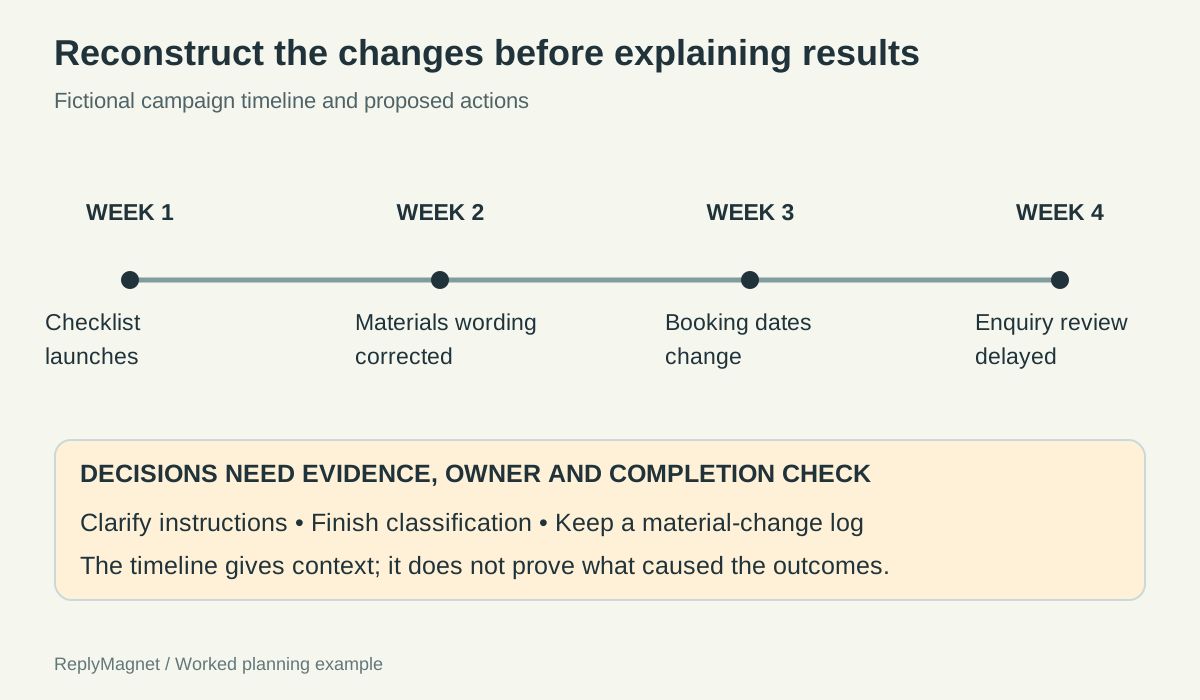
Original retrospective timeline. Events are invented for instruction; their sequence does not establish causal effects.
Use three columns: facts, explanations and open questions
Let several explanations coexist until evidence supports a narrower conclusion.
For the example, the team records a fact: several support questions asked whether paper was provided. A possible explanation is that the original checklist wording was unclear. An open question is whether the same confusion appeared among people who did not contact the team. The observed questions support a wording review, but not a prevalence estimate for the entire audience.
Another fact is that some late enquiries remained unclassified at the reporting cutoff. A possible explanation is the owner's absence. The open question is how many will meet the qualification rule after review. Reporting them all as unqualified would confuse an incomplete process with an unfavorable outcome.
A third fact is that the team has no reliable link between individual resource requests and later bookings. The explanation is not “the campaign failed to sell.” The supported statement is that booking attribution is incomplete. The next action may be to improve the record design, while recognizing that perfect attribution may still be unavailable.
GOV.UK's guidance on analyzing research sessions offers a useful discipline of working from observations toward findings and actions. A campaign retrospective uses different records, but the distinction between what happened and what you infer remains valuable.
Invite disagreement about explanations. A teammate who handled support may notice a condition absent from the dashboard. Someone who created the content may remember a changed example. The purpose is to improve the account of events, not to reward the most confident storyteller.
Fictional retrospective reasoning sheet. These observations are invented for the example.
Fact in the example
Materials questions recurred
- Possible explanation
- An instruction may be ambiguous
- Open question
- Does the revised wording answer the uncertainty?
Fact in the example
Late enquiries remained unclassified
- Possible explanation
- Owner absence delayed review
- Open question
- How many meet the unchanged qualification rule?
Fact in the example
Bookings cannot be reliably linked
- Possible explanation
- Available records omit part of the route
- Open question
- Which limited record improvement is feasible?
A worked decision record with three supported actions
Choose changes that follow from the evidence and give each one a responsible owner.
Decision one: clarify the materials instruction. Evidence: the repeated question and the ambiguous sentence in the first version. Action: the content coordinator revises the instruction and asks an unfamiliar reader to explain what they need to bring. Owner: coordinator. Completion evidence: the revised wording and the review note. This action does not require a claim that the change will increase bookings.
Decision two: complete the pending enquiry review. Evidence: records are waiting for classification at the cutoff. Action: the owner reviews them using the existing qualification rule, then updates the report while preserving its original date and provisional status. Completion evidence: the number still pending and the finalized count. The team does not quietly rewrite the historical report as though it had always been complete.
Decision three: improve the next campaign's event record. Evidence: important changes were reconstructed from memory and attribution remained incomplete. Action: the campaign owner records material resource, destination and configuration changes as they occur. Completion evidence: a short log used during the next run. The team does not promise that a better log will establish causality or identify every customer's path.
These actions are deliberately different. One improves content, one finishes an operational task and one improves future evidence. A review that produces only new content ideas can miss the process failures that make results hard to interpret.
Set a check-in date appropriate to the work. An owner without a date can become a vague intention; a date without an owner can become nobody's responsibility. Keep the number of actions small enough that the team can actually complete them before the next review.
Illustrative action record; no actual campaign improvement is claimed.
Action
Clarify materials instruction
- Owner
- Content coordinator
- Completion evidence
- Revised wording and comprehension review
Action
Finish pending classification
- Owner
- Campaign owner
- Completion evidence
- Finalized count with original cutoff retained
Action
Log material changes next run
- Owner
- Campaign owner
- Completion evidence
- Dated resource/destination/configuration record
Decide what to repeat, stop and investigate
Preserve useful work, remove unsupported effort and define questions that need a separate test.
Repeat the parts that have a clear operational value. The preparation checklist may remain useful because it answers a genuine question, even if the campaign's booking effect is unknown. Record the reason for keeping it so the next team does not interpret “repeat” as proof of commercial success.
Stop work that has no defensible purpose or repeatedly creates avoidable confusion. If two nearly identical posts compete for production time without adding a different explanation, the team can consolidate them. That is an editorial decision, not a claim that fewer posts always perform better.
Investigate questions the retrospective cannot settle. Perhaps readers prefer one resource format, or a caption creates a misleading expectation. A focused future test may help. Do not turn a retrospective discussion into a confident experiment result when the campaign changed several things at once.
Use current Analytics documentation to understand the events the product actually exposes. Keep external outcomes in their appropriate records. Do not substitute message delivery for reading, understanding or purchase simply because the delivery count is easy to obtain.
The resource delivery guide can support the operational checks identified by the review. If the issue lies in the resource's content, fix that content. If it lies in a destination or configuration, inspect that route. The review should point to the right kind of work.
Keep the retrospective short enough to be reused
Save the context, evidence limits and decisions in a record the next campaign owner can understand.
A one-page record can contain the original promise, the review period, material events, the strongest observations, unresolved questions and the three agreed actions. Link to supporting records rather than embedding every screenshot and conversation into the summary.
Label incomplete evidence plainly. “Bookings not reliably attributable” is more useful than a vague footnote saying data may vary. “Six enquiries pending review” is more actionable than calling the report preliminary without explaining why. Use actual counts only when supported by the real records; the example here supplies no campaign results.
At the next planning session, open the previous decisions before proposing a new campaign. Check which actions were completed and whether the original problem remains. Otherwise, the team can repeatedly identify the same issue while changing the creative theme around it.
Keep accountability focused on the work. A retrospective should reveal where instructions, ownership or evidence failed, not turn incomplete information into a judgment about a teammate's effort. Specific observations make that conversation easier because they replace broad blame with a fixable condition.
The most useful result is a better starting point for the next run. The team knows what it will keep, what it will change and what it still needs to learn. That is a stronger outcome than a polished success narrative that nobody can use to make the next decision.