Guides
Plan Instagram campaign capacity before the promotion begins
A new promotion does not run in an empty workspace. Yesterday’s evergreen guide may still receive requests while tomorrow’s launch starts. Capacity planning begins by putting those overlapping demands on the same sheet.
Published by ReplyMagnet · Last updated
Use the product’s counting unit, not a follower estimate
Estimate the activity that consumes the relevant allowance. Followers, raw comments, unique contacts and billable engagements are different quantities and should not be substituted for one another.
For ReplyMagnet comment campaigns, the billing documentation states that a matched comment's public reply and DM share one engagement, and that campaigns share the workspace allowance. A repeated matching request can therefore matter even when it comes from someone already recorded as a lead.
Begin with the unit your account actually counts. Do not multiply an audience size by an arbitrary percentage and call the result a reliable request forecast. A post's offer, distribution and audience history can change its response substantially.
If your launch uses a different trigger or a multi-step flow, confirm the applicable accounting and allowance in the current product before translating activity into capacity. This guide's numerical exercise concerns a defined set of comment campaigns; it should not be silently applied to every message type.
Copy the remaining allowance and reset date from the account you will actually use. Feature access during a trial does not establish the same allowance as a paid plan. Do not plan from a remembered pricing table or from the capacity of another workspace.

Planning illustration, not a live usage dashboard or prediction of demand.
Build low, central and high cases from explainable assumptions
Use your own comparable records where available, and mark guesses when history is missing. Scenarios show how the plan behaves under different demand; they are not promised traffic levels.
Look for prior campaigns with a similar offer, distribution route and observation period. Record why each is comparable and where it differs. A giveaway promoted by a large partner is not an obvious baseline for a quiet educational post.
Separate existing demand from the new promotion. An evergreen resource might have a reasonably stable recent pattern, while a new collaboration has little history. Use different confidence notes instead of giving both the same precise-looking estimate.
The central case is the working assumption you can justify, not the number that makes the launch budget comfortable. The high case should explore a plausible burden worth preparing for. It is not a claim that the promotion will go viral.
When you have no useful history, say so. You can prepare a conservative monitoring plan and start with a smaller invitation rather than inventing a forecasting model. Update the assumptions after observed activity gives you better evidence.
Keep the time horizon consistent. A monthly capacity allowance, a two-day launch peak and a weekly staff schedule address different constraints. Your sheet needs the remaining billing period for capacity and the expected busy hours for monitoring.
Put the overlapping campaigns on one sheet
Add scenario demand across every campaign sharing the allowance. Compare the combined requirement with actual remaining capacity after accounting for work already pending.
The figures below are entirely hypothetical. They show three comment campaigns over one chosen planning period. They are not ReplyMagnet plan quotas, measured traffic or recommendations for a specific account.
The low case totals 120 + 80 + 50 = 250 engagements. The central case totals 300 + 160 + 90 = 550. The high case totals 650 + 300 + 180 = 1,130. Each row uses the same product counting unit and time horizon.
Now add your own fields below the table: remaining allowance from the account; time checked; reset date; known pending work; other expected workspace use; and the person responsible for reviewing changes. Keep pending work distinct so you do not count it twice in both the forecast and an existing queue.
Compare the scenarios with the current account figure. If the central estimate nearly uses the remaining capacity, the plan deserves attention before further promotion. If only the high case exceeds it, decide what you will monitor and what action is available if activity moves toward that case.
These comparisons do not create a separate reserved quota for each row. The allocation is a planning record. All campaigns still use the product's actual shared accounting.
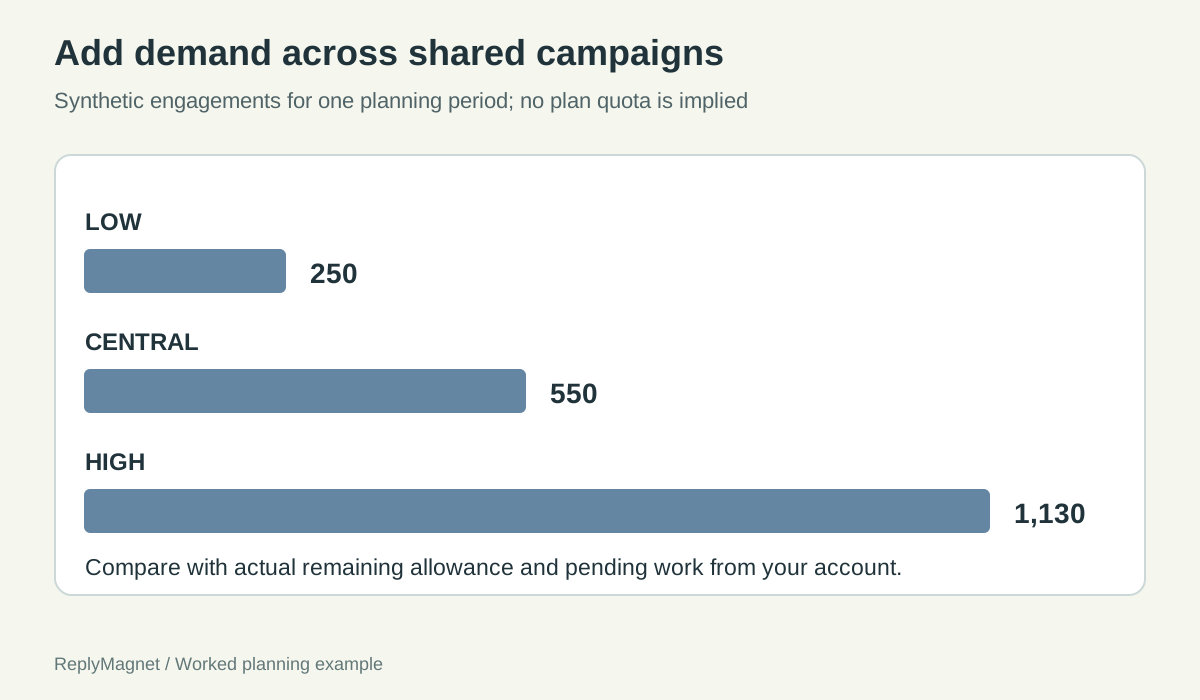
Original scenario chart. The values are assumed demand, not an account allowance or traffic prediction.
Synthetic demand scenarios for one planning period
Comment campaign
New workshop guide
- Low
- 120
- Central
- 300
- High
- 650
Comment campaign
Partner resource promotion
- Low
- 80
- Central
- 160
- High
- 300
Comment campaign
Existing evergreen checklist
- Low
- 50
- Central
- 90
- High
- 180
Comment campaign
Combined planned demand
- Low
- 250
- Central
- 550
- High
- 1,130
Keep subscription capacity separate from delivery eligibility
Available allowance is only one condition for sending. Account status, campaign state, platform constraints and messaging windows can still prevent or delay delivery.
The comment-to-DM overview explains the mechanism and its platform limits. The capacity worksheet does not replace those checks. A larger allowance cannot make an expired request eligible again.
ReplyMagnet's billing documentation describes over-limit work as pending before the workflow sends. Do not assume that a public reply has already appeared while its DM waits. A reset or plan change may create capacity, but each pending request still needs to satisfy the applicable delivery checks.
That is why a queue should not be entered in the plan as guaranteed future success. Record pending, delivered, failed and expired states according to the actual product evidence. If an offer ends soon, delayed delivery may no longer serve the original promise even when the account has capacity later.
Keep provider constraints separate from subscription capacity. A workspace can have unused allowance while encountering another delivery issue. Repeatedly increasing the forecast headroom will not diagnose that issue; inspect the recorded reason through the appropriate operational view.
Avoid planning around bypasses or unlimited sending. The useful response to a constraint is a smaller, better-timed invitation, an appropriate plan within the product's rules, or an honest alternative destination. The worksheet exists to expose those decisions early.
Assign the checks that matter during the launch
Name who will inspect usage, pending work and the customer-facing offer, and when they will report a problem. A forecast without an owner will not notice when its assumptions stop being true.
Monitoring should follow the actual promotion schedule. A short burst after a partner post may need closer attention than a quiet evergreen resource. Choose review points that fit the expected activity and the team's availability rather than copying a universal interval.
The GOV.UK support-planning guidance discusses understanding demand and the work needed to handle it. Applied here, the owner should plan both product activity and the manual work caused by exceptions.
Use a small rota with roles rather than unnecessary customer data. One person may fill several roles, but the responsibilities should still be explicit. The person who can inspect activity may not be the person authorized to change billing or pause a promotion.
Include a handover note between shifts or review periods: current usage, newly observed demand, pending issues, changes made and the next check. A percentage with no timestamp is difficult for the next owner to act on.
Monitoring rota to fill before publication
Responsibility
Usage and pending work
- Named owner
- ___
- Evidence and action
- Record account values and timestamp; flag variance
Responsibility
Resource and destination
- Named owner
- ___
- Evidence and action
- Check availability and offer accuracy
Responsibility
Customer exceptions
- Named owner
- ___
- Evidence and action
- Handle questions through the real support process
Responsibility
Promotion decision
- Named owner
- ___
- Evidence and action
- Authorize pause or change when the stated condition occurs
Responsibility
Next review
- Named owner
- ___
- Evidence and action
- Record date, time and unresolved issues
Decide the response to pressure before it happens
Prepare specific actions for a capacity shortfall or a failing offer. Do not wait until requests are pending to decide who may change the promotion or what customers should be told.
A useful trigger is tied to the account's actual state and the remaining campaign period. For example: “If observed demand makes the remaining allowance insufficient for the planned invitation, the promotion owner reviews the next scheduled post before it goes out.” Fill in the account evidence and decision process for your team.
Possible actions include reducing further promotion, correcting a misleading caption, using an existing direct information page, or choosing an appropriate capacity change. Each has different consequences. A direct page can help people obtain information, but it does not retroactively turn failed messages into successful deliveries.
If the offer itself is no longer available, stop inviting the same request. Do not keep sending an outdated event date merely because the automation is functioning. The resource owner and promotion owner need a shared understanding of when the offer ends.
A pause also has scope. Pausing one campaign may not stop unrelated campaigns in the same workspace; changing a public caption may not remove requests from older posts. Review the actual surfaces affected instead of using “pause the launch” as an undefined instruction.
Record changes and their time. If demand drops after promotion is paused, the comparison with the original forecast should reflect that intervention. It is not evidence that the original audience estimate was necessarily wrong.
Review the forecast using observed activity and the same units
Compare the original scenarios with actual usage, pending outcomes and manual work for the same period. Keep surprises as evidence for the next plan rather than adjusting the old forecast after the fact.
At the end of the period, enter the observed engagement use beside each campaign where the product provides reliable attribution. If you cannot allocate part of the shared total confidently, keep it unassigned instead of forcing it into a row.
Explain material differences: a partner posted late, an asset link failed, the offer changed, or an existing resource received unexpected attention. These notes make the next forecast more useful than a single accuracy percentage.
Review the operating burden too. A promotion may stay within quota but produce more individual questions than the team can answer. Capacity for automated activity and capacity for human support are different planning problems.
Keep the original low, central and high assumptions. Update a new version with what you learned and mark which estimates now have better evidence. Do not describe a single successful launch as a guarantee for the next one.
Before your next promotion, open the current workspace billing information, list the campaigns already running and name the person who will monitor the invitation. Those three actions turn a vague hope about capacity into a plan someone can operate.