Guides
Sell a defined Instagram automation service
“We will automate your Instagram” sounds like a service until the client asks whether it includes writing the resource, answering customer complaints and rebuilding the checkout. A useful package makes those boundaries visible before the work starts.
Published by ReplyMagnet · Last updated
Describe the finished service in observable terms
Define the customer problem, the campaign behavior and the evidence that marks completion. A tool connection is an input to the service, not the whole deliverable.
A workable service might help a client deliver one approved resource after a specific request. Another might create a short inbound conversation with two supported paths. Those are understandable packages because the behavior and its limits can be inspected.
Begin with the client's task. “Make the preparation guide available to people asking for it under the launch post” is more concrete than “build a chatbot.” It tells the agency what to implement and the client what to expect.
PMI's discussion of scope statements distinguishes purpose, deliverables and completion criteria. Although the article is a dated project-management reference, that distinction remains useful for describing this service. It is not a legal contract template or a pricing benchmark.
Avoid making follower totals, sales or lead volume the acceptance test for a configuration project. The agency can commit to the specified work and verification, while commercial outcomes depend on the offer, audience, distribution and other conditions.

Editorial illustration of service planning, not a client project or reported result.
Separate the launch package from the operating service
Launch work creates and verifies a defined campaign. Recurring maintenance keeps agreed parts current. Neither should quietly expand into unlimited campaign creation or customer support.
The launch package could include discovery of the request, a campaign map, copy for the agreed messages, configuration, test evidence and handover notes. The client supplies the approved resource and destination unless content creation is explicitly included.
Maintenance could include a defined review of the campaign, checking the linked resource and a limited class of copy corrections. It does not automatically mean writing new offers, building integrations or answering every DM on the client's behalf.
Write the unit of service. “One campaign” can still hide substantial variation. Specify the entry point, number of supported paths, resource and external destinations. A two-choice flow with one resource differs from a multi-service conversation with several systems.
State what happens if the business changes the offer after launch. A corrected spelling is one kind of work. Adding an event booking branch is another. The agency should be able to explain the difference without inventing a rule after receiving the request.
The social media manager guide covers account ownership and operating client campaigns. This scope exercise concerns what work is being sold and how much effort it reasonably includes.
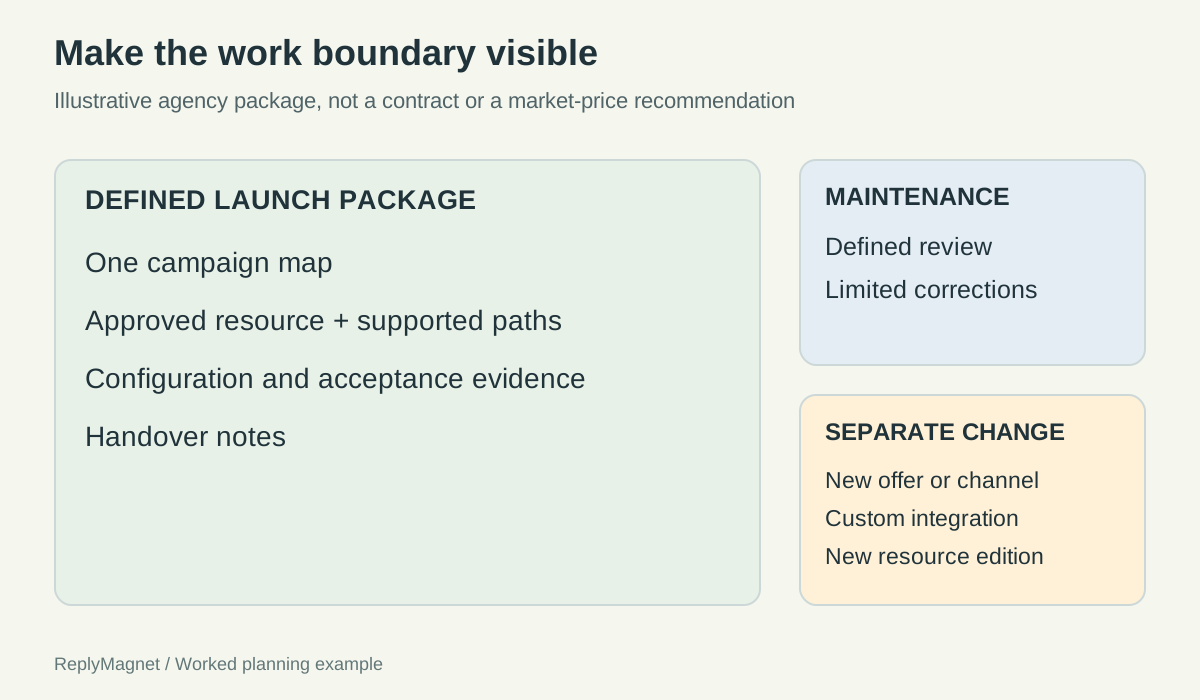
Original scope diagram for the illustrative agency package. Actual commercial terms must be agreed separately.
Illustrative division between launch and maintenance
Launch deliverable
Map one request and its paths
- Recurring item if agreed
- Review the existing map when facts change
- Separate change to scope
- Add a new offer or audience journey
Launch deliverable
Configure approved messages
- Recurring item if agreed
- Correct current copy within the agreed limit
- Separate change to scope
- Write a new campaign sequence
Launch deliverable
Attach approved resource
- Recurring item if agreed
- Check its destination remains usable
- Separate change to scope
- Create a new resource or edition
Launch deliverable
Record acceptance tests
- Recurring item if agreed
- Repeat agreed checks after small updates
- Separate change to scope
- Develop new integration tests
Launch deliverable
Provide handover notes
- Recurring item if agreed
- Maintain named ownership details
- Separate change to scope
- Train a new team beyond the agreed service
Estimate the tasks before choosing the fee
Estimate effort from the actual work, then price it using your own costs and commercial judgment. A generic retainer number does not explain the workload or margin.
List the work someone must perform, including communication and testing. An estimate that counts only configuration time can miss the hours spent clarifying an incomplete offer or waiting for the correct resource version.
The following hours are invented to demonstrate arithmetic. They are not market rates, standard delivery times or a recommendation for what an agency should charge. The example totals 10 hours: 1.5 for discovery, 1.5 for copy and mapping, 2 for configuration, 2 for testing, 1.5 for revisions and 1.5 for handover.
Keep a range or risk note for uncertain work. If the client's destination requires changes by another vendor, treat that dependency explicitly. Do not hide unknown integration work inside an optimistic configuration estimate.
Separate working time from calendar duration. Ten hours of work can stretch across several days if the client needs time to provide information or review a draft. State which input must arrive before the next stage can begin.
Software subscriptions, paid external services and third-party production costs should be visible separately from agency labor. Check the current ReplyMagnet plan requirements for the intended capability; do not assume the plan name alone defines your service package.
Synthetic effort estimate for a small launch package
Task
Discovery and dependency check
- Illustrative hours
- 1.5
- Assumption
- One offer with an available owner
Task
Message copy and campaign map
- Illustrative hours
- 1.5
- Assumption
- Existing approved resource
Task
Configuration
- Illustrative hours
- 2
- Assumption
- Supported behavior, no custom integration
Task
Controlled tests and evidence
- Illustrative hours
- 2
- Assumption
- Test accounts and destinations available
Task
One agreed revision round
- Illustrative hours
- 1.5
- Assumption
- Scope remains unchanged
Task
Handover and notes
- Illustrative hours
- 1.5
- Assumption
- One client contact
Task
Total illustrative effort
- Illustrative hours
- 10
- Assumption
- Replace every estimate with your own evidence
Name the client inputs that make delivery possible
Specify who supplies the resource, factual claims, destinations and account authorization. Missing inputs should create a visible dependency, not a guess by the agency.
The client should identify the account owner and provide access through the appropriate authorized process. A password sent casually in a message is not a substitute for a supported account connection and role arrangement.
Ask for the final resource, the post or request that will promote it, the intended audience and the real next action after delivery. If the offer includes a booking page, confirm who maintains availability. If the content describes a product, the client must verify the relevant product facts.
Decide who owns contact handling. The agency may configure a capture destination without becoming responsible for sales follow-up or support. The scope should say who receives the enquiries and who acts on them.
Give the client a concise input list with a due date or dependency status. “Awaiting final workshop dates from the studio owner” is actionable. “Client feedback pending” often conceals several unrelated missing decisions.
Do not invent facts to keep the schedule moving. A placeholder price, unverified testimonial or guessed support promise can survive into publication if nobody notices it. Mark incomplete material clearly in the draft and exclude it from a live campaign until confirmed.
Keep approval responsibility specific, while leaving the detailed revision-tracking process in the team's operating documents. The scope needs to identify the decision-maker and what they are approving; it does not need to duplicate every internal review step.
Define completion as evidence, not a screenshot of the editor
Acceptance should show that the agreed behavior works in the tested scenario and that the client can maintain it. A configured screen alone does not prove delivery or a usable destination.
For a resource campaign, useful evidence includes the intended account and entry point, the correct resource arriving in a controlled test, the destination opening on a phone and any agreed capture destination receiving the authorized test record.
For a flow, include the relevant branches and exception paths. A Preview record can demonstrate logic, but it does not establish real Instagram delivery. Keep those checks separately labeled so the client understands what each proves.
Write the acceptance criteria beside the deliverable. For example: “The approved preparation guide is delivered for the agreed test request, and an unrelated test comment remains outside the configured scope.” Avoid wording that implies every future request will always be delivered regardless of platform constraints.
Include handover materials that another responsible person can use: what the campaign promises, where the resource lives, which destinations it uses, who monitors it and how changes are requested. The client should not need to reverse-engineer the agency's naming system to update a date.
If an acceptance check fails, record the issue and the relevant correction. Do not replace evidence with a statement that the campaign is “all set.” Completion should be assessable by someone who did not build the configuration.
Use this scope outline as a discussion document
A scope outline can make work boundaries concrete before a formal agreement. Adapt it to the service and have contractual terms reviewed appropriately rather than treating this example as a legal document.
The following is an illustrative service outline, not a completed contract or a guarantee of enforceability.
Purpose: help the client respond to one defined incoming resource request with the approved material and an appropriate next step.
Included work: one campaign map; one approved resource destination; up to two supported conversation paths if required; message copy within the agreed offer; configuration; recorded logic checks where relevant; controlled delivery evidence; and handover notes.
Client inputs: authorized account access; final resource; verified offer details; working external destination; named review contact; and a person responsible for received enquiries.
Completion: the agreed acceptance scenarios pass, known limitations are documented, and the client receives the operating notes. Preview and real delivery evidence remain distinct.
Maintenance option: a defined periodic review, destination checks and the agreed class of minor copy corrections. State the frequency and work limit in the actual proposal rather than using “ongoing support” without a boundary.
Separate work: new offers, new channels, custom integrations, substantial resource production, additional language editions, extensive retraining and customer-service handling unless specifically included.
Costs: agency labor and any agreed external expenses, with platform subscriptions identified separately. The actual fee follows the agency's estimate and agreement, not the hypothetical hours in this article.
Limitations: the service does not promise a number of leads, purchases or followers, nor does it remove platform eligibility or messaging constraints.
Change process: describe the requested change, its effect on deliverables and timing, and the decision required before added work begins.
This outline is useful because it gives the discussion objects to point at. A client can say that they need a translated resource or an additional branch, and the agency can estimate the change before either side assumes it is included.
Check the package against the first month of actual work
Review time spent and recurring requests after delivery. Use that evidence to refine the next scope, while honoring the commitments already made to the current client.
Compare the task estimate with your recorded work. If resource clarification took longer than configuration, improve the input requirements. If small updates consumed the maintenance allocation, examine whether the offer changes more often than the package assumed.
Distinguish a one-off surprise from a repeated pattern. One difficult account connection does not establish a universal setup time, but several projects with incomplete assets may justify a stronger readiness requirement.
Review the quality of the handover too. Repeated questions about ownership or destinations may mean the notes were insufficient. Improving those materials can make the service easier for both the client and agency to operate.
Before selling the next package, write one sentence describing the client problem, one list of concrete deliverables and one testable completion standard. Then estimate the work those commitments require. That is a more dependable foundation for an automation service than promising everything the tool might eventually support.