Guides
Invite followers to a research conversation that is worth their time
Comments can reveal a recurring question without explaining the situation behind it. A focused interview can help you understand what happened, what someone tried and why a decision was difficult. The invitation should make that learning purpose clear.
Published by ReplyMagnet · Last updated
The short answer
Recruit people with relevant experience, explain the session and ask about a real occasion before discussing solutions. Keep research participation separate from sales and marketing permission. A small interview round reveals context; it does not estimate demand across your entire audience.
Start freeChoose what you need to understand
Write a learning question about the person’s experience rather than a request to approve your idea.
A fictional independent course creator wants to understand why people abandon their search for a beginner photography class. The creator is considering a new resource, but begins with the experience: how do people compare options, what information do they look for and where does the search become difficult?
“Would you download my class comparison guide?” is a different question. It asks for a reaction to a proposed solution and encourages polite predictions. The discovery interview should first establish whether comparison is the relevant problem and what it actually involves.
Write a decision the research can inform. The creator might need to decide whether to explain course formats, improve the existing class page or create a separate comparison resource. Those are plausible outcomes. The interview is not designed to prove that the resource must be built.
The GOV.UK guidance on in-depth interviews describes using interviews to understand people's circumstances, needs and experiences. Apply that purpose narrowly. A conversation about one person's search can be rich evidence about that experience without representing everyone who follows the account.
The lead-magnet ideas guide can help later when choosing an artifact. At this stage, keep the solution open enough that the research could change your plan.

Generated editorial illustration of preparing for a conversation. No interview or participant experience is represented as having occurred.
Try the resource flow for 30 days with 1,000 engagements. No card required.
Start freeDescribe relevant experience without selecting only supporters
Screen for the situation you need to learn about, not for enthusiasm about your business.
The creator looks for people who recently considered a beginner class and compared at least two options. Some may have booked; others may have stopped. Both experiences can help explain the decision. Requiring that participants already love the creator's teaching would exclude useful perspectives.
Use a small number of screening questions. “Have you looked for a beginner photography class recently?” and “Did you book, postpone or choose not to book?” identify relevant experience. Ask only for additional details that affect the research question. You do not need a full demographic profile to learn how someone compared class descriptions.
Avoid screening by the answer you hope to hear. “Do confusing course descriptions frustrate you?” tells the person what the researcher expects. A neutral question about what they did allows difficulty, ease or indifference to emerge naturally.
Guidance on finding research participants supports recruiting people relevant to the service and research needs. Consider whose experience may be missing from your recruitment route. Followers who volunteer publicly are not necessarily representative of quieter readers or people who never found your account.
If access needs affect participation, provide a way to discuss suitable arrangements. Do not treat one communication format as the only possible route. Keep the screening process proportionate and explain how the information will be used.
An invitation that explains the commitment
State the topic, format, approximate time, voluntary nature and any incentive before someone agrees.
An illustrative public invitation could read: “Have you recently compared beginner photography classes? We are speaking with people about how they made that choice, including people who decided not to book. The conversation will take about half an hour by an agreed call format. It is research, not a sales call. If you are interested, use the research sign-up route for details. Taking part is optional.”
The time in this example is a planning choice, not a recommended interview length for every project. Replace it with a realistic estimate for your actual guide. If you offer an incentive, describe it clearly and avoid making it conditional on favorable comments.
Before the session, explain who will attend, whether recording is proposed, how notes will be used and how the participant can stop or ask questions. GOV.UK's informed-consent guidance provides a useful primary reference for making research participation informed and ongoing. Your organization should use a process appropriate to its own responsibilities.
Do not convert a research sign-up into a hidden newsletter subscription. Someone's willingness to discuss their experience is not a general invitation to market to them. Keep the purpose and follow-up aligned with what they agreed to.
If Instagram is used to direct interested people to details, respect its messaging rules and use an authorized route. The automation rules guide covers that separate constraint. Research recruitment does not justify scraping profiles or sending unsolicited messages at scale.
Ask about the last real occasion
Use a recent example to explore sequence, context and tradeoffs without leading the participant toward your proposed product.
The creator's original discussion guide begins with: “Tell me about the last time you looked for a beginner photography class.” Follow with “What prompted the search?” and “What did you do first?” These questions invite an account of events instead of a prediction about future behavior.
Then explore the comparison. “Which options did you consider?” “What information did you look for?” “What made an option easier or harder to judge?” If the participant mentions a confusing phrase, ask what they understood it to mean. Do not immediately explain what the provider probably intended.
Ask about the decision point. “What happened next?” and “What mattered most when you decided?” can reveal a practical constraint such as timing, travel or a need for feedback. Avoid assuming that the obstacle was the class description just because that was your initial hypothesis.
Where useful and appropriate, invite the participant to describe materials they used, but do not require them to expose private messages or account information. A recollection has limitations; record those limitations rather than pressuring someone for evidence they are uncomfortable sharing.
Save discussion of your proposed resource until the relevant experience has been explored, or conduct it in a separate session with a clearly different purpose. Otherwise, the interview can become a product pitch and the participant's answers may begin to mirror your explanation.
The guide is a set of prompts, not a script that must be read word for word. Follow relevant detail while keeping the learning question in view. If someone goes off topic, return gently at a natural point rather than interrupting useful context merely to complete every question.
Keep observations separate from the story you want to tell
Record what the participant said or described, then distinguish interpretation and open questions.
A hypothetical note might say: “Participant compared three class pages and could not tell whether equipment was provided.” The interpretation could be: “Equipment information may influence the decision.” An action to explore could be: “Check whether our own page states what is provided.” These are different levels of reasoning.
Do not rewrite the note as “People will buy if we add an equipment checklist.” That conclusion introduces a general population, a causal claim and a purchase outcome that the observation does not establish. The interview can point to a useful improvement without proving its commercial effect.
Use participant codes rather than unnecessary identifiers in the analysis material. Keep contact information and research notes appropriately separated and accessible only to people who need them. GOV.UK's participant-privacy guidance discusses responsible handling of research information. Avoid retaining recordings or personal details without a defined purpose and process.
Compare different experiences without forcing them into one narrative. A person who booked quickly may have had a clear recommendation; someone who stopped may have faced a scheduling conflict. Both matter, and neither should be edited into the creator's preferred explanation.
Any quotations intended for public content require a separate decision about permission and context. Internal research participation should not silently become a testimonial. The interview's purpose is learning, and that boundary should remain visible throughout the workflow.
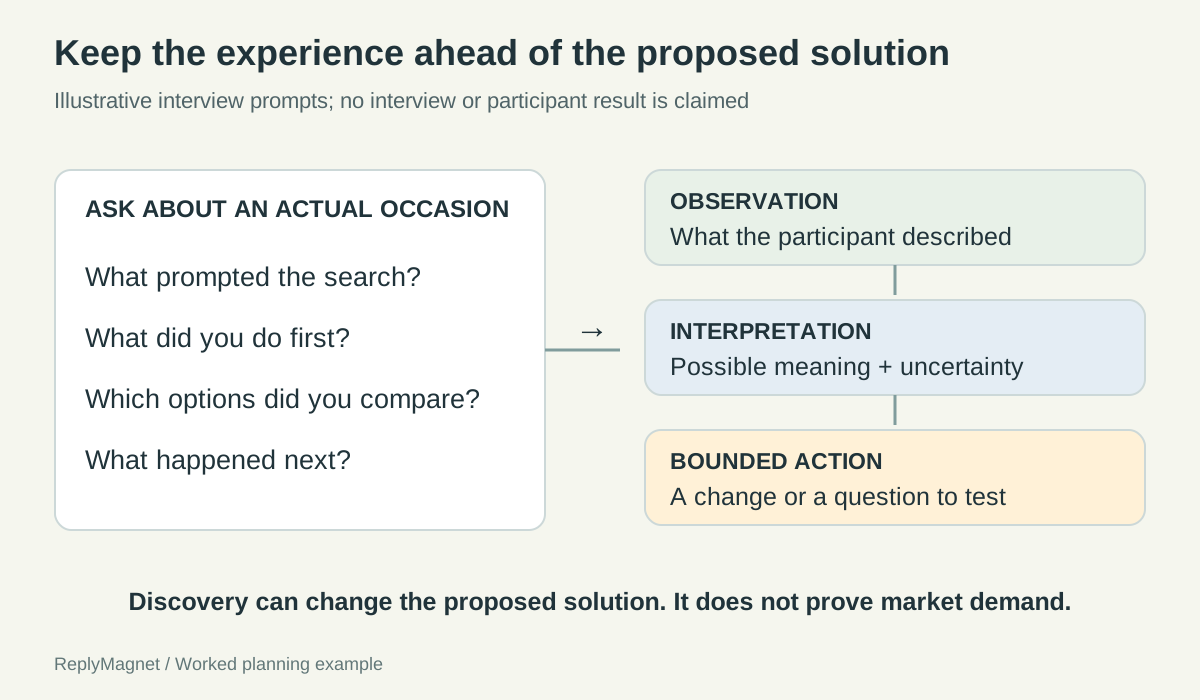
Original discovery-interview reasoning map. It represents a method, not completed research or a testimonial.
Hypothetical analysis note. No interview was performed for this example.
Level
Observation
- Example
- Person described comparing three pages without finding equipment information
- Limit
- A reported experience, not a market count
Level
Interpretation
- Example
- Equipment information may affect that decision
- Limit
- A hypothesis to compare with other evidence
Level
Possible action
- Example
- Check the equipment explanation on our own page
- Limit
- Does not prove a purchase effect
Level
Open question
- Example
- Was timing or format also important?
- Limit
- Keep alternatives in view
Turn the learning into a bounded decision
Choose an action supported by the evidence, record uncertainty and follow through on what you promised participants.
After the round, list the observations relevant to the original decision. Perhaps equipment information was unclear, while class format was easy to understand. The next action may be to improve a page rather than produce a new guide. That is a useful result even if it changes the creator's original plan.
Write a short decision record: what was learned, what remains uncertain, what will change and who owns the change. If the evidence is too thin or contradictory, define the next question instead of declaring validation. A few interviews do not provide a market-size estimate or a reliable percentage of followers with a particular problem.
Follow up as promised. If you offered an incentive, provide it through the agreed process. If you promised an update about the research, keep it concise and avoid turning it into an unexpected sales sequence. Respect the participant's decision if they do not want further contact.
When an eventual resource is ready, test its usefulness separately before building a full campaign. The delivery guide becomes relevant once there is an artifact worth delivering. Recruitment, discovery, prototype testing and campaign performance answer different questions.
A good research invitation opens a conversation in which the creator can be surprised. Keeping the request clear, the questions grounded in real occasions and the conclusions proportionate makes that conversation more useful for both sides.