Guides
Build content pillars around decisions, not broad labels
A furniture maker can post about craftsmanship every week and still leave a buyer unsure whether a table will fit through the door. A useful content pillar groups the questions behind a decision, so attractive posts also help someone move forward.
Published by ReplyMagnet · Last updated
Give the pillar a job a reader can recognize
A content pillar is a durable group of related questions. Define it by the decision it helps a reader make, then specify which questions belong and which do not.
“Education,” “inspiration” and “behind the scenes” describe broad publishing categories. They can help a team vary formats, but they do not tell a writer which uncertainty a piece should resolve. Almost any post could fit under education.
For a custom-furniture business, “Choose a table that fits your room and delivery route” has a more useful boundary. It includes measuring the space, allowing room around the table and checking delivery access. It does not include every woodworking technique simply because the business uses wood.
Begin with the reader's situation. Someone replacing a dining table may need to choose dimensions, compare materials, understand the order process and care for the finished piece. Those decisions suggest a small architecture that can hold both Instagram posts and deeper resources.
The GOV.UK research planning guidance recommends identifying the questions you need to answer rather than treating assumptions as established needs. Your first pillar map is a working hypothesis. Validate it against real enquiries and existing content before calling it an audience finding.

Editorial illustration of planning. No keyword demand or research result is represented.
Map twelve questions before naming four clusters
Write the actual uncertainties first and group them afterward. This reduces the temptation to force every idea into a familiar marketing category.
The twelve questions below are invented for a fictional furniture maker. They are not extracted from customer conversations or search-volume research. They demonstrate how a writer can build boundaries around distinct tasks.
The first group concerns physical fit. The second concerns comparing the offered product choices. The third concerns what happens during an order. The fourth concerns ownership after delivery. A single person can move between these groups; they are not fixed personality segments.
Keep a question in the group where its answer is most useful. “Can the legs be removed for delivery?” belongs with access even though the answer concerns construction. Grouping it under craftsmanship would make the business's internal process more prominent than the buyer's decision.
Do not publish all twelve as separate long articles automatically. Some could become sections of one strong guide, while others deserve a standalone explanation. The map organizes coverage; it does not create a page-count quota.
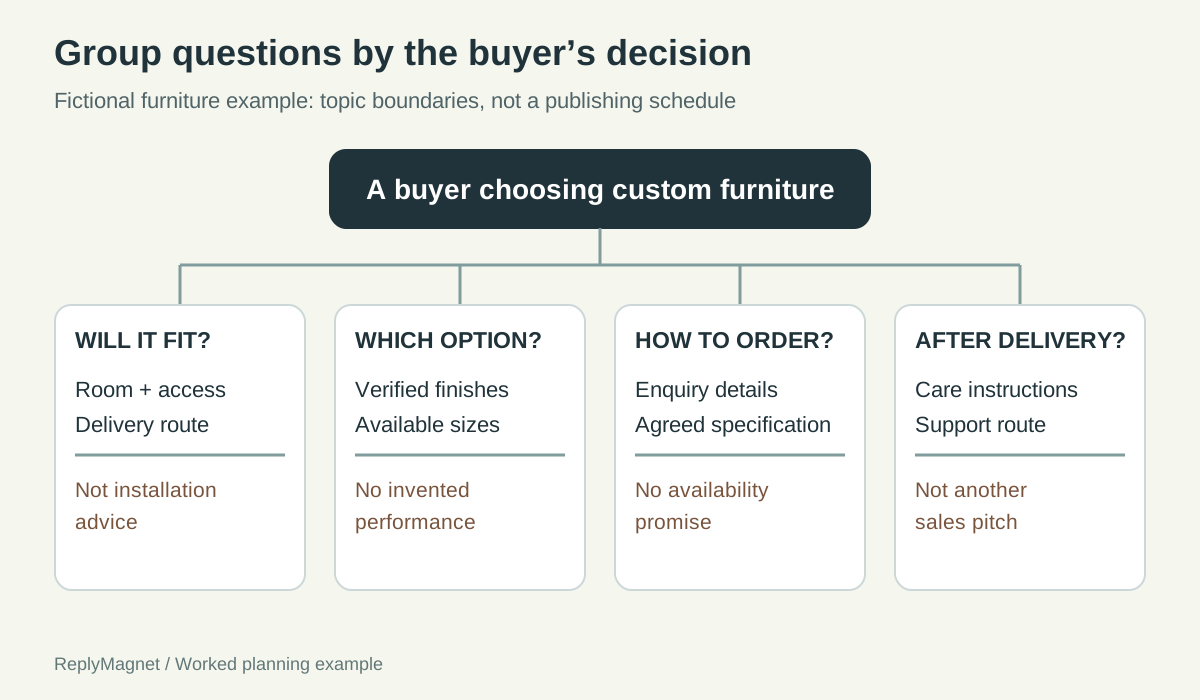
Original topic architecture diagram for the fictional furniture example. The branches describe distinct reader decisions; they are not measured keyword demand.
Twelve fictional buyer questions grouped by decision
Cluster
Will it fit?
- Questions
- What size fits the room? How much surrounding space is needed? Can it pass through the delivery route?
- Boundary
- Physical fit and access; not structural installation advice
Cluster
Which option suits my use?
- Questions
- How do the offered finishes differ? Which dimensions are available? What changes the design choice?
- Boundary
- Verified range comparisons; no invented performance claims
Cluster
What happens when I order?
- Questions
- What information is needed for an enquiry? How is the specification agreed? When is delivery timing confirmed?
- Boundary
- Actual ordering process; not a promise of immediate availability
Cluster
How do I live with it?
- Questions
- Which care instructions apply? Who answers a problem after delivery? Where is the product record?
- Boundary
- Current ownership support; not another sales pitch
Write inclusion and exclusion rules for each pillar
A short boundary statement helps different writers make consistent decisions. Include the reader task, required evidence and topics that belong elsewhere.
For the fit pillar, the rule could be: “Include questions a buyer must resolve to check space and delivery access. Use verified product dimensions and the business's delivery requirements. Exclude detailed joinery lessons unless they change the fit decision.”
For product comparison, specify the actual range. A guide comparing finishes should use the finishes the business sells, with facts checked by the maker. Do not add a generic claim about stain resistance because a competitor's article includes one. The pillar is an editorial assignment, not a license to infer product properties.
For the order-process pillar, identify who verifies operational details. The person writing social captions may not know when production timing becomes committed. That answer belongs with the owner who actually controls the process.
For ownership, record the support boundary. A care guide can explain the maker's approved instructions and where to ask about a problem. It should not become broad repair advice beyond the business's competence.
These rules can fit in four short records. A lengthy taxonomy that nobody consults is less useful than a map a writer can use to reject an off-topic idea. Keep a place for uncertain questions so they can be discussed without immediately creating another pillar.
Find repetition by comparing the decision and the answer
Two titles are duplicates when they help the same reader make the same decision with substantially the same answer. Different wording or format alone does not establish a new topic.
Suppose the backlog contains “How to measure for a dining table” and “Choose the right table size for your room.” Read their proposed answers. If both explain the same measurements and end with the same worksheet, one page probably should own that task.
A short Instagram demonstration can still point to the deeper guide. That is an adaptation for a different surface, not a reason to create a competing article with a new slug. Record the parent guide so later writers know where the substantive answer lives.
By contrast, checking a delivery route may deserve a separate resource if it requires different information and a distinct next action. The distinction should come from the task, not the desire to fill another publishing slot.
Audit the published library alongside the proposed map. An old guide may already answer most of a new brief, even if it sits under a different category. Read the closest page before commissioning. Updating a useful existing answer is often more coherent than making a new version compete with it.
Google's people-first content guidance asks whether content provides original value and a satisfying answer. Applied to this map, the question is what the new piece contributes that the existing answer does not.
Treat gaps as unanswered tasks, not empty boxes
A coverage gap matters when a relevant reader lacks information needed for a decision. An unused format or a thin category does not automatically justify a new article.
Your map might contain many attractive product photographs and no clear explanation of how a custom order is agreed. That is a meaningful gap if people need that information before enquiring. It may require one accurate process page rather than a month of generic educational posts.
An apparently empty ownership pillar may have a complete care document delivered with each purchase. In that case, the gap could be discoverability rather than missing content. Make the existing answer easier to find before writing another version.
For each gap, record the question, evidence of need, existing partial answer and proposed response. Mark demand as unknown when no relevant observation exists. Do not invent keyword volumes or ranking difficulty to give the idea false authority.
Prioritize a gap you can answer well. A maker with detailed knowledge of its own dimensions and order process can contribute more there than in a broad article about global interior-design trends. First-hand operational facts can be useful without being presented as a customer study.
Separate missing evidence from missing prose. If the team cannot confirm a finish property, assigning the article to a writer will not solve the underlying problem. The next action is to verify the fact or narrow the claim.
Give each cluster one useful next action
Match the next step to the reader’s decision. A measuring guide, product comparison and support answer should not all end by demanding the same sales conversation.
The fit cluster might offer a blank measurement record. The comparison cluster might link to the current product specification pages. The order-process cluster could explain how to submit an enquiry. Ownership content should direct a customer to the appropriate care or support resource.
The lead magnet ideas guide can help choose a format once the task is clear. A worksheet is useful when it helps the reader gather dimensions; it is less useful when it merely repackages a short answer behind another step.
Keep the connection visible in the article. If the guide teaches someone what measurements matter, the resource should let them record those measurements. A general catalogue at the end would leave the immediate task unfinished.
Not every pillar needs a capture form. A public support answer may do its job when someone reads it. If the business offers follow-up, explain the purpose and let the reader understand what they are agreeing to.
The lead-quality guide distinguishes resource activity from relevant enquiries and business outcomes. Use that distinction when evaluating the map. A busy fit guide and a useful order enquiry page can contribute in different ways without sharing one success metric.
Keep architecture separate from the publishing calendar
The pillar map determines what belongs and how answers relate. A calendar determines when work is produced and published. Revise the map when the reader task or offer changes.
Once the clusters and page owners are clear, a calendar can schedule the actual work. Do not let an empty Friday slot create a new pillar or turn the same question into another article. Timing should serve the coverage plan.
Review the map when products, service scope or repeated enquiries change. Add a question to an existing cluster when it fits. Create a new cluster only when the decision is meaningfully different and deserves a maintained set of answers.
Keep a compact record for each pillar: reader decision; included questions; excluded topics; authoritative owner; existing answer; missing evidence; next action. That record is enough to guide a new writer without forcing every article into identical headings.
Start by mapping the questions already addressed in your library. Then choose one verified gap the business can answer with useful detail. A coherent set of answers gives the next post somewhere meaningful to lead, even before the calendar becomes more ambitious.