Guides
Build an Instagram calendar around decisions people need to make
A calendar full of dates can conceal an empty editorial plan. “Carousel Tuesday” specifies a format but says nothing about why someone should read it. Start with the decisions your audience is trying to make, then allocate the work your team can actually complete.
Published by ReplyMagnet · Last updated
The short answer
Give each planned post a reader decision, a useful contribution, an owner and a realistic production allowance. Sequence related explanations across the month while making every post understandable on its own. Leave capacity for questions and corrections.
Start freeStart with the unfinished decisions
List the questions that prevent a reader from choosing, preparing or taking the next useful action.
A fictional neighborhood art studio is planning a month of Instagram content. Its team includes an owner who teaches, a part-time content coordinator and an assistant who handles routine information. The studio has plenty of possible topics, but only a limited number of hours to create and review posts.
Instead of beginning with dates, the team lists four decisions people commonly need to make in its illustrative scenario: whether a beginner session fits their interests, which activity to choose, what to prepare and which current date works for them. These are editorial hypotheses based on the example, not research findings about a real studio.
Each decision suggests a different contribution. A demonstration can show what happens in a session. A comparison can explain the difference between activities. A preparation checklist can reduce uncertainty before attending. A current-information post can direct someone to verified dates.
Notice that these are not broad topic pillars such as inspiration, education and promotion. Pillars help organize a continuing body of content. This calendar decides what specific work should happen during a particular month, in what order and within whose capacity. It needs dates and dependencies as well as themes.
Use actual audience questions where you have them, while removing unnecessary personal details from the planning document. GOV.UK's research-planning guidance encourages connecting questions to decisions. The application here is editorial: identify the uncertainty the post is meant to reduce before allocating production time.

Editorial illustration, not a product screenshot.
Try the resource flow for 30 days with 1,000 engagements. No card required.
Start freeCalculate capacity before promising a frequency
Estimate creation, review and maintenance work, then choose a schedule that fits the available time.
The studio reserves six staff-hours per week for this illustrative plan. That includes selecting examples, writing, filming or designing, reviewing facts and checking the final export. It does not mean every business should use six hours or publish the same number of posts.
The coordinator estimates that a comparison carousel will take five hours in total: two hours gathering and checking its source material in week one, then three hours writing, designing and reviewing it in week two. A short demonstration using existing materials may take two hours. A simple answer to a current question may take one hour. These are planning assumptions for this team, not production benchmarks.
Reserve some time for corrections and unexpected questions. If the full six hours are committed before the week begins, a changed workshop date creates an immediate conflict. The studio chooses to plan five hours of work and keep one hour available. If nothing urgent appears, that hour can improve the next draft or update an existing resource.
Consider the owner's review time separately. A post may take only an hour to assemble but still depend on ten minutes from the person who knows whether the session description is accurate. Put that dependency in the calendar. Otherwise, several apparently small tasks can queue behind one unavailable reviewer.
Manychat's marketing-calendar article offers inspiration for coordinating content. It does not establish the right frequency for this studio. Use your own production evidence to revise estimates after the first cycle. A sustainable schedule is a capacity decision, not an assumption about how often an algorithm wants you to post.
A four-week calendar with a purpose for every item
Use dates to organize distinct contributions, and record the decision each item helps someone make.
Week one: understand the experience. Tuesday's demonstration shows what a beginner does during one verified activity. Reader decision: “Does this look like something I want to try?” The owner supplies the demonstration; the coordinator edits it. Estimated work: two hours. Friday's question-and-answer post explains who the session is designed for using confirmed information. The assistant gathers recurring questions and the owner reviews the answer. Estimated work: one hour. Two hours remain for preparing next week's comparison, plus the reserved hour.
Week two: compare options. Wednesday's carousel compares two actual workshop formats using the same criteria for each. Reader decision: “Which activity fits what I want to explore?” The coordinator owns the draft, with the owner confirming the session details. Estimated work this week: three hours, in addition to the two preparation hours recorded in week one. Saturday's brief post answers one relevant question raised by the comparison. Estimated work: one hour. The remaining planned hour checks the preparation resource for week three.
Week three: prepare with confidence. Tuesday's post explains what attendees need to bring and what the studio provides. Reader decision: “Can I arrive prepared without buying unnecessary materials?” The assistant checks the current list and the coordinator produces the post. Estimated work: two hours. Friday's resource invitation offers a preparation checklist with the same verified information. Reader decision: “Would a saved checklist help me prepare?” Estimated work: two hours. One planned hour is used to verify the final week's current-information links.
Week four: choose a next step. Wednesday's current-information post directs readers to the authoritative session page. Reader decision: “Which available date can I investigate?” The assistant checks links and dates immediately before publication. Estimated work: one hour. Saturday's demonstration addresses a different, specific uncertainty observed during the month. The owner selects an example that can be explained accurately. Estimated work: two hours. Two hours remain for reviewing the month and preparing the next plan.
This calendar contains eight planned public posts and preparation work between them. That count is a consequence of the example's capacity, not a recommendation for every account. No claim is made that the sequence produces a particular reach, lead count or booking outcome.
The schedule also avoids treating every post as a resource promotion. Some pieces explain, some compare and some invite a next action. Each should be useful even if a reader encounters it without seeing the preceding week.
Add the fields that prevent last-minute confusion
A working calendar needs ownership, evidence, dependencies and a readiness state alongside its publication date.
For each item, record the reader decision, the proposed contribution, the owner, the factual reviewer and the required source material. Add a draft deadline and a publication date separately. The person assembling the post needs to know when the verified information must arrive, not merely when the finished post should appear.
Use readiness states that describe real progress. “Idea,” “draft,” “awaiting fact check,” “ready” and “published” can be enough. Avoid marking a post ready because the artwork is finished while its link or session details remain unverified. The status should reflect whether the customer-facing promise is accurate.
Record dependencies explicitly. The week-three preparation post depends on a current materials list. The resource invitation depends on the finished checklist and a tested delivery route. The week-four date post depends on current availability information. These dependencies explain why a post may need to move even when the design is complete.
Keep the lead-magnet delivery guide available for the resource route, and use the campaign examples when choosing how an invitation should work. ReplyMagnet is not being presented as a scheduler for this public content calendar. Planning and publishing the posts remain separate responsibilities.
A simple document or spreadsheet can hold these fields. The value comes from clear decisions and current ownership, not from an elaborate calendar interface. If a field never changes what the team does, remove it. If a repeated error has no place to be recorded, add the smallest field that addresses it.
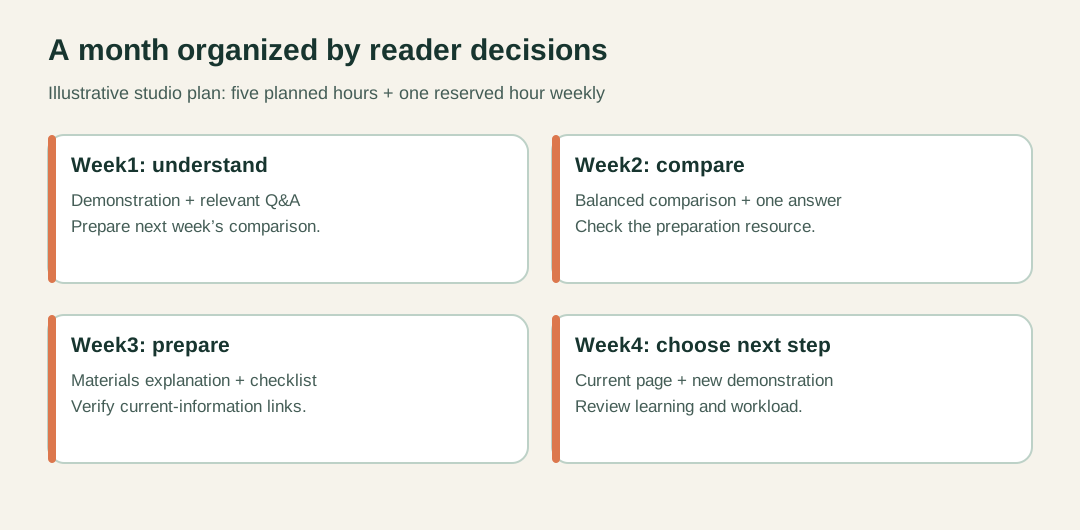
Original capacity example. Eight posts and six weekly hours are planning assumptions, not benchmarks.
Leave space for questions without losing the month
Use the reserved capacity for relevant corrections and new evidence, and move planned work deliberately when necessary.
Suppose people respond to the comparison with a question about whether they need prior experience. First check whether the carousel already answers it clearly. The issue may call for a wording correction rather than a completely new post. If it reveals a meaningful gap, use the reserved time for a concise answer or revise the next scheduled item.
Do not let every comment become an urgent content assignment. Some questions concern an individual booking, some are already answered on a current page and some fall outside the studio's expertise. Choose the appropriate response rather than forcing all of them into the public calendar.
When an important change consumes more than the reserved hour, move something else. Name the tradeoff in the plan: “The second demonstration moves to next month so we can correct the changed session information.” Pretending both tasks still fit encourages rushed checking and an inaccurate calendar.
Keep evergreen explanations distinct from time-sensitive information. A comparison of activities may remain useful, while available dates can change. Schedule a verification step close enough to publication for changing facts, and avoid embedding them into unrelated resources when a maintained page is a better source.
The lead-magnet ideas guide can help when a new question deserves a practical artifact. It should not turn every audience uncertainty into another download. Sometimes the most useful contribution is a clear public answer that takes a paragraph.
Review the decisions, not just the completed slots
Ask what each post clarified, what remained confusing and whether the production estimates were realistic.
At the end of the month, begin with the purpose assigned to each post. Did the comparison generate more specific questions about the activities, or did people still confuse them? Did the preparation post expose a missing instruction? Did the resource invitation accurately describe what readers received? These questions help the team improve content even when broader conversion evidence is limited.
Keep observations separate from conclusions. A comment asking about a date indicates a question about availability. It does not prove the carousel caused a booking. A resource request indicates interest in that offer. It does not establish that the checklist was used. Avoid attributing an entire customer decision to one post without supporting evidence.
Review workload too. Compare estimated hours with the team's rough actual effort. If the five-hour carousel repeatedly takes seven, reduce the next month's commitments or simplify production. Do not treat the gap as a personal failure; it is planning information.
Carry forward the unresolved decision, not automatically the same format. If people still need help comparing sessions, a concrete demonstration may serve them better than another carousel. If the answer is now clear, move to a different useful question rather than repeating the topic to fill a familiar slot.
The next calendar should contain fewer guesses than the first. Its dates matter because they coordinate real work. Its content matters because each piece has a reason to exist for the reader. Keeping those two responsibilities connected produces a plan the team can maintain and improve.