Guides
Write a content brief that gives the creator room to think
A brief can fail in two opposite ways. “Make something engaging” leaves the creator to guess the purpose. A rigid script leaves them no room to find the best explanation. A useful brief specifies the problem and evidence while allowing the form to follow the work.
Published by ReplyMagnet · Last updated
The short answer
Define what the reader needs to decide, what original contribution the piece should make and which claims require verification. Describe the visual task and acceptance criteria without prescribing a universal hook, slide count or prose formula.
Start freeCommission a useful contribution, not a content shape
Start with the reader’s uncertainty and the change in understanding the piece should create.
A fictional gardening educator wants two Instagram pieces for people choosing containers for a small balcony. One should explain how to read a product's stated dimensions. The other should help compare two container options against a reader's available space. The audience is similar, but the creative jobs are different.
A weak brief says “Create two educational carousels with a strong hook.” It specifies an output shape without explaining the contribution. The writer may produce two versions of the same generic advice about small spaces.
A stronger brief states the decision. For the first piece: “Help a reader distinguish external container dimensions from the usable space described by the seller.” For the second: “Help a reader compare options using their own measured location and verified product information.” The examples should remain about reading specifications, not plant health or structural safety claims.
Write what the reader should understand after seeing the piece. This is not the same as a conversion goal. A business may want enquiries, but the content still needs a useful reason for the reader to spend time with it.
Google's helpful-content guidance emphasizes original value and satisfying the reader's purpose. In a brief, that becomes a practical requirement: name the contribution that would make this piece worth creating instead of repeating information already available.

Generated editorial illustration contrasting demonstration and comparison. The article’s briefs concern reading specifications, not plant-care or structural advice.
Try the resource flow for 30 days with 1,000 engagements. No card required.
Start freeBrief A: commission a demonstration
Specify the action and evidence the creator needs to show, while leaving the presentation open.
The first original brief is for a demonstration. Reader: someone comparing containers on a phone who is unsure what a listed measurement refers to. Problem: the reader may treat every dimension as interchangeable. Contribution: show how a labeled product diagram and the seller's description identify what is being measured.
Source material: one real product specification that the business has permission to show, verified close to production. If that is unavailable, use a clearly labeled fictional diagram with simple numbers and do not imply it represents a product for sale. The creator must preserve the distinction between an illustration and evidence of an actual item.
Creative task: show the measurement label, point to the corresponding part of the object or diagram and explain why the label matters. The piece can be a video, a carousel or another suitable format. The brief does not prescribe a dramatic opening line or a fixed number of panels.
Claim boundaries: do not infer load capacity, suitability for a particular building or plant-growing performance from the dimensions. Those are different questions requiring appropriate evidence. The piece teaches how to interpret a stated specification, not whether a balcony can safely hold an object.
Acceptance criteria: an unfamiliar reviewer can identify what the displayed measurement refers to, distinguish the illustrative example from a real product claim and understand where to check the seller's current details. A relevant next step is to save a measurement note or view a more complete product-specification explanation.
The brief is specific about the learning and the evidence, but leaves room for the creator to find a clear visual treatment. That is the intended balance.
Brief B: commission a comparison
Use the same audience with a different decision, evidence set and acceptance test.
The second original brief is for a comparison. Reader: someone who has measured an available location and is considering two containers. Problem: attractive product photos do not make the dimensional tradeoff easy to inspect. Contribution: demonstrate a simple comparison record using the same verified criteria for both options.
Source material: current dimensions and relevant product descriptions for both options, or an explicitly fictional pair used only to explain the method. The comparison must use matching units and identify any information that is unavailable. Missing data remains unknown rather than being filled with a plausible guess.
Creative task: show the reader's available measurement and the two options side by side. Explain which question the comparison can answer and which questions remain outside scope. A simple table may be more useful than a long narrative, but the creator can propose another form if it communicates the tradeoff more clearly.
Claim boundaries: no universal “best container” verdict, no inference about building safety and no unsupported performance ranking. If an actual product is shown, the final copy needs a source and a verification date. If the example is fictional, all relevant visuals and captions must make that status clear.
Acceptance criteria: the reviewer can compare the same dimension across both options, identify the source of the numbers and explain why the piece does not settle every suitability question. The next action can be to complete the reader's own comparison sheet or check the seller's current specifications.
This brief would produce a different artifact from Brief A even if both use the same visual style. One teaches interpretation of a measurement. The other supports comparison across options. That distinction is what prevents a batch of content from becoming a set of interchangeable topic substitutions.
Two fictional commissions with different jobs. Shared brief fields do not prescribe a shared creative outline.
Brief decision
Reader uncertainty
- A: explain a measurement
- What does this dimension refer to?
- B: compare options
- How do two options compare against my space?
Brief decision
Evidence
- A: explain a measurement
- Labeled specification or declared illustration
- B: compare options
- Matching criteria and units for both options
Brief decision
Visual job
- A: explain a measurement
- Connect a label to part of the object
- B: compare options
- Make the same dimension inspectable side by side
Brief decision
Acceptance
- A: explain a measurement
- Reader identifies what was measured
- B: compare options
- Reader compares criteria and names unknowns
Brief decision
Outside scope
- A: explain a measurement
- Structural or growing-performance advice
- B: compare options
- Universal best option or safety conclusion
Give evidence a place in the assignment
List claims that need sources and distinguish verified facts, editorial recommendations and illustrative examples.
A creator should not have to discover at final review that every number in the draft needs verification. Identify the evidence requirements when commissioning the work. For a product comparison, that includes the source and date of each material specification. For a demonstration, it includes whether the object shown is the actual product or an illustration.
Create a short claim list. “Option A is this width” requires current product evidence. “Use matching units when comparing measurements” is an editorial instruction. “This fictional option is forty units wide” is part of an invented example and must not appear as a real product fact.
Name who can answer unresolved questions. If the writer cannot verify a detail, they should know whether to ask the product owner, omit the claim or mark the gap. A brief that demands confident copy while withholding access to evidence creates avoidable revision work.
Do not use sources as decoration. A link about social-media engagement does not substantiate a container dimension. W3C's writing guidance can support clear labels and instructions, but it cannot verify the product itself. Match each claim to evidence capable of supporting it.
Keep source material separate from wording to copy. The assignment should ask the creator to understand and explain the relevant facts in an original way. A competitor article can suggest a useful question, but it should not become the structure and prose of the commissioned piece.
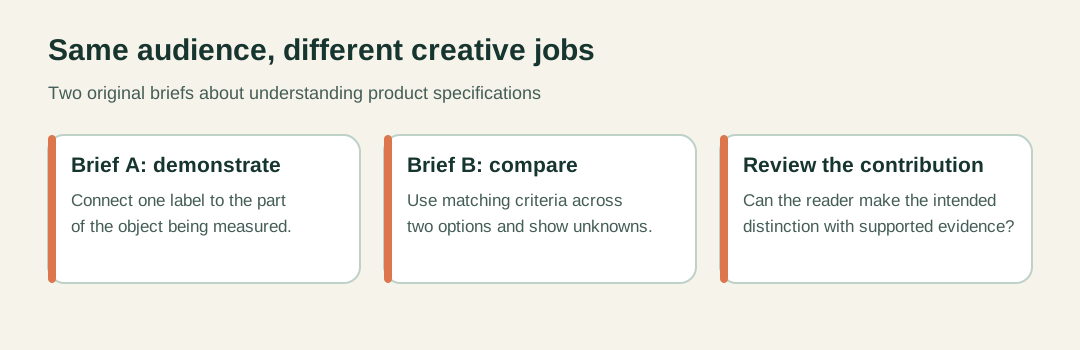
Original commissioning examples. Shared brief fields do not prescribe a shared creative structure.
Describe the visual work and the boundaries
Tell the creator what an image must explain, what it may depict and what should never be presented as real evidence.
For Brief A, the image's job is to connect a measurement label to a specific part of the object. For Brief B, the visual's job is to make the comparison inspectable. These instructions are more useful than “make it premium” because they explain what success looks like.
Specify whether the work needs an authentic photograph, a diagram or a clearly labeled illustration. Generated imagery can support an editorial concept, but it should not masquerade as a screenshot, a customer's result or a real product specification. A native diagram with accurate labels may be the better artifact for a measurement lesson.
Include practical readability requirements. Text should be legible at the intended viewing size. Important distinctions should be labeled in words, not communicated only by color. If the image carries essential information, plan a suitable text alternative and supporting explanation.
State rights and privacy constraints relevant to the assignment. Use material the team is authorized to publish and avoid including customer details simply because they appear in a convenient screenshot. The brief need not become a generic compliance checklist; it should identify the actual constraints of this piece.
If a resource is part of the campaign, describe its contents and production owner. The lead-magnet ideas guide can help choose the artifact, while the delivery guide covers the route. The visual preview and the delivered resource must agree.
Review against the brief without forcing a formula
Judge whether the work resolves the reader’s uncertainty and meets the evidence requirements, not whether it resembles a favorite past post.
At review, return to the reader decision. Can a person identify what the measurement refers to? Can they compare the two options using the same criteria? If the answer is no, explain the missing information or relationship rather than asking for vague extra energy.
Allow a creator to change the proposed form when the reasoning improves. A comparison initially imagined as a Reel may work better as a readable table. The brief's job is to preserve the useful contribution through that change, not to protect an early format preference at any cost.
Separate factual corrections from stylistic preferences. An incorrect unit must be fixed. A different but clear opening may be acceptable. Recording that distinction makes feedback more actionable and reduces cycles in which the creator guesses which comments are requirements.
A natural conversion action should follow the completed explanation. If the reader now needs a blank comparison sheet, offer that sheet accurately. The campaign examples can inform the delivery invitation, but no brief should require every piece to end with the same keyword request.
Save the final brief with the delivered work and the material source notes. The next assignment can reuse useful fields such as reader decision and evidence needs without copying the prose structure. A reusable briefing process should support original work, not make every output sound as though it came from the same mold.